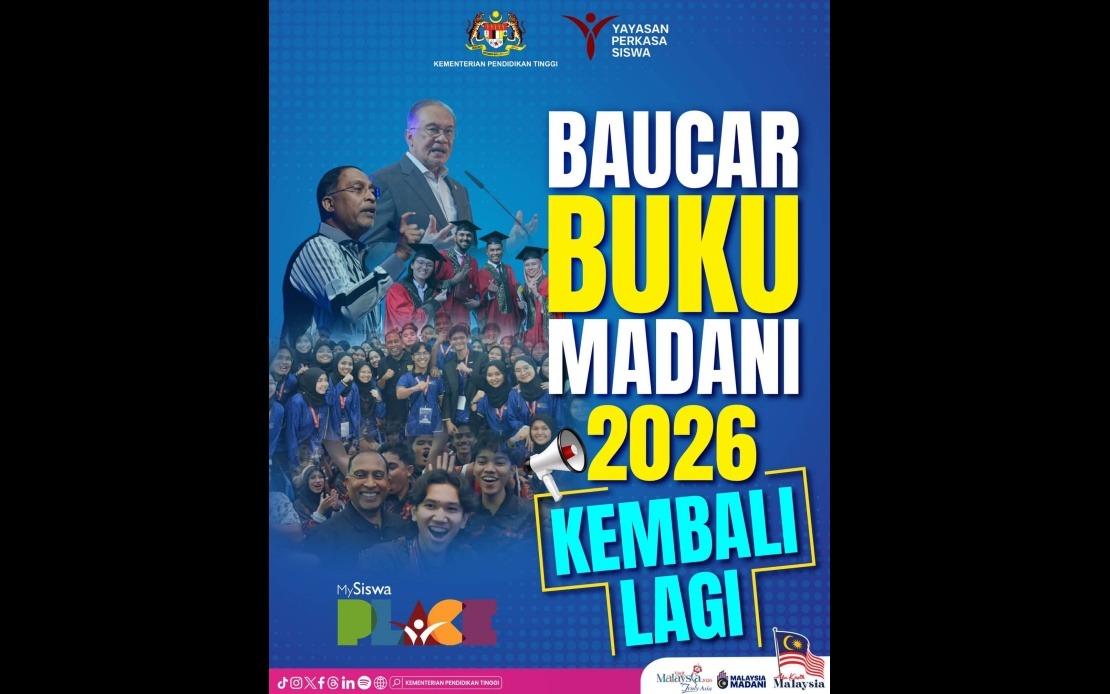
From 11 am on July 15, roughly 1.18 million students across Malaysia's institutions of higher learning will gain access to RM100 MADANI Book Vouchers, a government initiative designed to ease the financial burden of acquiring educational reading materials. The redemption process operates through MySiswaPlace, a dedicated digital portal managed by the Ministry of Higher Education that allows students to verify their entitlement, generate their vouchers, and purchase books online in a secure environment.
The voucher scheme represents a continuation of earlier education support measures, reflecting the MADANI administration's broader philosophy of making quality educational resources more financially accessible to the student population. By subsidising reading materials for tertiary learners, the government aims to remove a significant cost barrier that might otherwise prevent students from acquiring necessary academic texts, reference works, and scholarly publications essential to their coursework and research endeavours.
Beyond direct student support, the initiative carries strategic implications for Malaysia's publishing ecosystem. The scheme deliberately channels purchasing power towards local publishers and booksellers, of which more than 300 registered businesses participate in the MySiswaPlace marketplace. This approach supports domestic publishing houses competing against international digital platforms and encourages the sustainability of a knowledge industry that might otherwise face margin pressures from large-scale online retailers. The policy thus functions as a form of market development, nurturing local capacity in an increasingly digital publishing landscape.
The MySiswaPlace portal itself has been constructed to offer considerable breadth in available materials. Rather than restricting purchases to basic textbooks, the platform encompasses academic monographs, reference publications, scholarly journals, electronic books, and general trade titles that support broader intellectual curiosity beyond formal curriculum requirements. This expansive catalogue recognises that university-level learning extends beyond prescribed course materials and that exposure to diverse reading strengthens critical thinking and subject expertise.
The MADANI government's emphasis on strengthening reading culture and lifelong learning reflects a longer-term educational philosophy. Access to affordable reading materials during tertiary years establishes reading habits that can persist throughout a person's professional life. For a developing economy like Malaysia, where knowledge-intensive sectors are increasingly critical to competitiveness, supporting such habits early in the education pipeline carries economic relevance beyond immediate cost relief. Students who engage extensively with quality reading materials during their studies tend to remain more engaged with professional development and continuing education after graduation.
For Malaysian universities specifically, the subsidy programme addresses a recognised pain point in the student experience. Many undergraduates struggle to reconcile the cost of recommended textbooks—particularly international academic publications that carry substantial import pricing—with modest student budgets. While scholarship programmes exist, they do not uniformly cover consumables such as books. The MADANI vouchers therefore represent a bottom-up approach to equalising educational access, ensuring that financial circumstance does not determine which students can afford to engage fully with their disciplinary literature.
The timing of the voucher release also carries practical significance. Most Malaysian academic calendars feature semester transitions in mid-July, meaning the voucher availability aligns with periods when students actively purchase new course materials. The 11 am launch on July 15 ensures minimal administrative friction; students can immediately apply their vouchers to texts required for upcoming semester modules. This synchronisation with academic rhythms suggests careful policy design aimed at maximising programme uptake and utility.
Prime Minister Datuk Seri Anwar Ibrahim's prominence in ministerial communications around the initiative underscores its political importance to the current administration. Education spending and support for youth rank among the MADANI framework's foundational pillars, positioning the voucher continuation as demonstration of commitment to promised developmental outcomes. The government's articulated reasoning—linking affordable reading access to intellectual development, local industry support, and knowledge-economy preparation—frames the expenditure as investment in human capital rather than simple subsidy.
For students, the practical mechanics demand awareness and timely action. Eligible individuals must first access MySiswaPlace, verify their student status and voucher eligibility, generate their personal voucher codes, and then complete transactions within specified timeframes. The Ministry has not publicly announced whether voucher validity expires at a particular date, a detail that will affect student purchasing behaviour and planning. Clear communication of such administrative details will be essential to programme success.
The initiative also reflects evolving approaches to education financing in Southeast Asia more broadly. As tertiary enrolment expands across the region, governments increasingly recognise that traditional student loan and scholarship models do not uniformly address the full spectrum of educational costs. Targeted voucher schemes, particularly those designed to support specific industries or policy objectives, offer flexibility that broader funding instruments cannot match. Malaysia's approach may thus serve as a model that neighbouring countries observe as they develop their own post-secondary support architectures.

