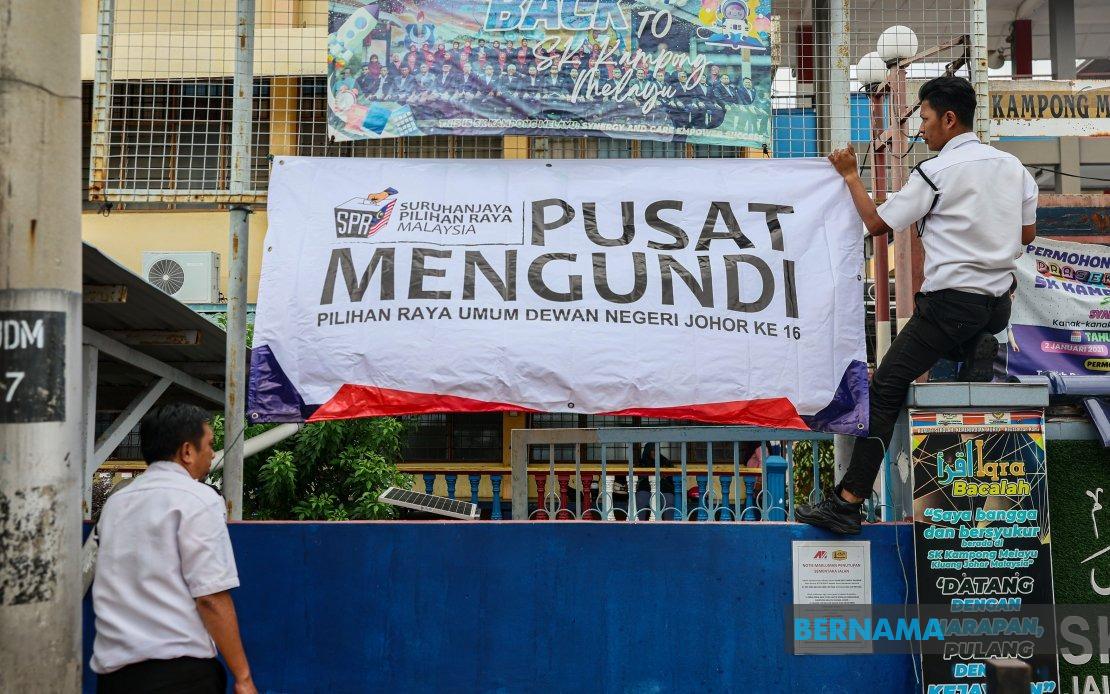
The state of Johor staged its most significant electoral contest in recent years on polling day, with more than 2.7 million registered voters participating in the 16th state election to determine representation across the 56 seats of the State Legislative Assembly. The scale of the operation underscored the importance of this election in Malaysia's political calendar, as Johor remains one of the country's most strategically significant states, home to a substantial portion of the nation's population and economic activity.
Electoral authorities orchestrated the voting process with considerable logistical complexity. The Election Commission activated 1,076 polling centres equipped with 4,889 individual voting streams distributed strategically across the state's diverse geography. Voting commenced at 8 am sharp across all locations, with closure timetables staggered to accommodate various constituencies and island locations. Notably, polling stations on Pulau Besar shut down at 11 am, followed by Pulau Aur and Pulau Pemanggil at noon, reflecting the practical challenges of conducting elections across scattered island communities. The main polling centres remained open until 6 pm, creating a twelve-hour voting window for most constituents to exercise their democratic rights.
The Election Commission mobilised an extensive workforce to ensure operational efficiency throughout the day. A total of 43,036 election workers were deployed statewide, reflecting the massive coordination effort required to administer an election of this magnitude. Additionally, 24,677 postal ballots cast by voters unable to attend polling stations in person needed to be returned by the 6 pm deadline, introducing another administrative layer to the electoral process.
Preparations extended beyond polling day itself. The 14-day campaign period concluded at midnight the previous evening, allowing candidates and political parties to conclude their final appeals to voters. Early voting had already commenced, with 20,607 early ballots cast by police officers, armed forces personnel, and their spouses on Tuesday, providing a preview of the broader electoral engagement expected throughout the day. The Election Commission targeted approximately 70 per cent voter turnout, a significant jump from the 54.92 per cent participation rate recorded in the 2022 Johor state election, suggesting growing electoral engagement among the state's voters.
Weather conditions presented variable challenges across different regions of Johor. The Malaysian Meteorological Department forecasted morning rain in the southern districts including Johor Bahru, Batu Pahat, Kulai, Muar, Pontian and Tangkak, with conditions expected to improve during afternoon and evening hours. Eastern districts including Kluang, Kota Tinggi and Segamat faced afternoon thunderstorm risks, while Mersing anticipated similar weather disturbances extending into the evening. These forecasts prompted election officials to prepare contingency measures, though widespread weather-related disruptions appeared unlikely to significantly impact voting participation.
The candidate landscape reflected Malaysia's fragmented political ecosystem. A total of 172 candidates across eight distinct political entities competed for the 56 available seats. Pakatan Harapan and Barisan Nasional each fielded complete slates of 56 candidates, signalling their ambitions to control the state government entirely. Perikatan Nasional presented 33 candidates, Parti Bersama Malaysia 15, and MUDA four, while three smaller parties and independent candidates filled the remaining positions. This diversity of contenders meant voters faced genuinely competitive contests in most constituencies, with ideological and policy differences sharply drawn across the political spectrum.
The preceding State Legislative Assembly composition provided crucial context for understanding the election's significance. Before dissolution on June 1, Barisan Nasional controlled 40 of the 56 seats, commanding a comfortable majority. Pakatan Harapan held 12 seats, Perikatan Nasional three, and MUDA one. This distribution meant that while Barisan Nasional dominated state politics, opposition coalitions collectively held meaningful representation. The subsequent election campaign centred on whether Barisan Nasional could retain its substantial majority or whether Pakatan Harapan could build on its 12-seat foundation to challenge incumbent governance.
Employers across Johor received official reminders regarding their legal obligation to grant employees reasonable time away from work to fulfil their voting responsibilities. This directive reflected government recognition that working-class participation remained crucial to achieving the targeted 70 per cent turnout, as many voters would otherwise face scheduling conflicts between employment obligations and polling centre hours. The announcement underscored the inclusive approach authorities sought to adopt, ensuring that occupational commitments did not disenfranchise substantial voter segments.
Results were anticipated with particular urgency, as the Election Commission projected final tallies could be completed as early as 10 pm on election night. This relatively swift counting process reflected both improved electoral procedures and the technological infrastructure now deployed at polling stations nationwide. Media organisations and political parties prepared to analyse outcomes intensively, as the Johor state election traditionally served as an important barometer of broader national sentiment and factional dynamics within Malaysia's major political coalitions.
For Malaysian observers, the Johor election carried implications extending far beyond the state's boundaries. As the country's second-largest state by population and third-largest by economic output, Johor's political direction influenced national coalition calculations and leadership legitimacy. Opposition and ruling parties alike invested substantial resources in the campaign, recognising that defeat or victory would reverberate through Malaysia's national political landscape, affecting calculations around future federal elections and internal power dynamics within both Barisan Nasional and Pakatan Harapan. The 2.7 million voters participating thus held disproportionate significance for Malaysian democracy as a whole.

