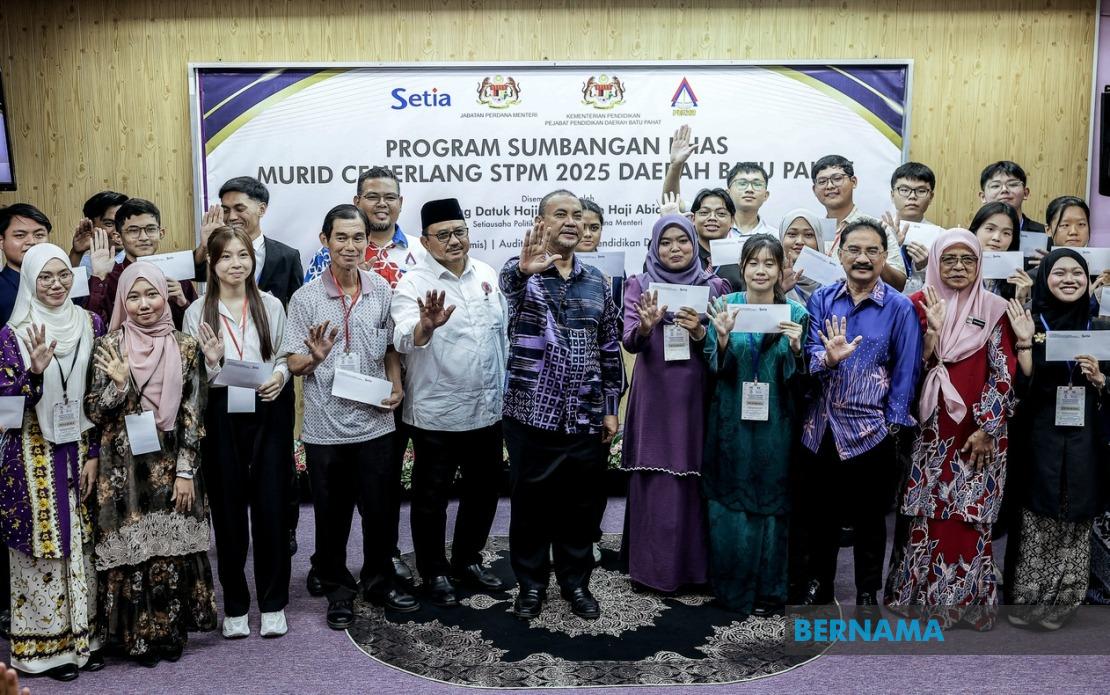
The Prime Minister's Office has recognised the outstanding academic achievements of 214 high-performing STPM students in Batu Pahat district through a special contribution scheme aimed at supporting their progression into higher education. Datuk Azman Abidin, Political Secretary to the Prime Minister, presented the awards during the 2025 STPM Top Achievers Award Ceremony held at the Batu Pahat District Education Office, marking a tangible demonstration of government support for Malaysia's most promising secondary school graduates.
The recognition scheme encompassed former students from 16 secondary schools throughout the district, reflecting a broad-based effort to acknowledge academic merit across multiple institutions rather than concentrating rewards on a select few. This geographic distribution underscores the government's intention to cultivate excellence across the educational landscape and ensure that high-achieving students from all corners of the district receive recognition for their efforts. The scale of the initiative—involving over 200 recipients—suggests a substantial commitment to translating policy rhetoric about education support into concrete financial assistance.
According to Azman, the contribution programme serves multiple strategic objectives beyond simple monetary reward. The initiative functions as a motivational tool designed to inspire not only the recipients themselves but also their peers to pursue academic excellence and maintain high standards throughout their schooling years. This approach reflects recognition that financial incentives, when coupled with public acknowledgement, can reinforce positive behavioural patterns and encourage a culture of achievement within the education system. The message transmitted through such awards extends beyond individual students to shape institutional and community expectations around academic performance.
During the ceremony, Azman outlined the government's broader vision for the scheme, indicating that continuation would depend on budgetary availability while expressing intentions to expand the programme geographically beyond Batu Pahat. This conditional framing suggests that while the government views the initiative favourably, its expansion remains subject to fiscal constraints and competing budget priorities. For students and educators in other districts, such statements carry implications regarding whether similar recognition and financial support might eventually become available in their own localities, potentially influencing educational planning and student expectations nationwide.
The government framed the contribution as evidence of its commitment to education empowerment and recognition of student achievement, positioning the policy within a broader narrative about state investment in human capital development. By explicitly linking financial support to the validation of academic excellence, the government seeks to reinforce the message that merit-based advancement remains a cornerstone of national policy. This alignment of material incentives with meritocratic values carries particular resonance in the Malaysian education context, where competition for university places remains intense and where such recognition can serve as both motivation and validation for high-achieving students.
Among the recipients was Afida Auni Airulnizam, a 20-year-old former student of Sekolah Menengah Kebangsaan Tun Sardon in Rengit, who expressed gratitude for the contribution and characterised it as meaningful recognition of her efforts. For Afida, the award represents more than financial assistance; it functions as external validation of her academic accomplishments and demonstrates that her dedication has been noticed and appreciated by broader society. She identified her elder brother, currently pursuing university studies, as an inspirational figure and indicated her intention to follow a similar trajectory by studying sports science at the tertiary level should she secure admission.
Afida's profile illustrates the typical demographic characteristics of top STPM performers—driven, family-oriented individuals from supportive home environments who view education as a pathway to professional advancement. Her aspiration toward sports science reflects the diversification of career interests among high-achieving Malaysian students, moving beyond traditionally dominant fields toward specialised disciplines that address evolving labour market demands. The fact that such students require financial support despite their academic excellence highlights the economic barriers that can impede even the most capable individuals from pursuing higher education without government assistance.
Another recipient, Muhd Ammar Firdaus Mohd Fadzil, aged 20 and a former student of SMK Tun Ismail, welcomed the initiative particularly for its potential to alleviate the financial burdens associated with preparing for tertiary education. His perspective underscores an often-overlooked dimension of educational support—the costs associated not merely with university fees themselves but with the preparatory expenses that precede university enrolment. These might include examination fees, tutorial services, accommodation during the application process, or other ancillary costs that, while individually modest, collectively represent significant financial obstacles for families of modest means.
The timing of this recognition scheme carries implications for Malaysia's broader education policy trajectory. With the government actively implementing programmes that directly acknowledge and reward academic achievement, there emerges a reinforcing cycle where students perceive clear tangible benefits to educational excellence. This contrasts with policy environments where high achievement brings only abstract promises of future opportunity. The provision of immediate financial recognition creates a more immediate incentive structure that may prove particularly effective in motivating students from economically disadvantaged backgrounds, who might otherwise lack compelling reasons to pursue exceptional academic results.
The geographical focus on Batu Pahat, a district in Johor, reflects the government's willingness to allocate resources to recognition schemes outside major metropolitan centres. This approach potentially helps retain talented students within their home districts by demonstrating that excellence receives acknowledgement regardless of location, potentially countering the magnetic pull that cosmopolitan centres exert on ambitious young people. For education officials and policymakers in other Malaysian districts watching this initiative, the expansion pathway outlined by Azman suggests that lobbying for similar programmes in their own areas may yield results if sustained and framed appropriately.
The inclusion of students from 16 different secondary schools creates opportunities for inter-school competition and institutional pride, as schools may leverage their students' recognition in promotional materials and institutional narratives. Headmasters and educators gain valuable evidence that their institutions nurture academic excellence, information that influences parental school selection decisions and student motivation. In this sense, the contribution scheme generates benefits extending well beyond individual recipients to encompass entire schools and the broader education ecosystem.
Looking forward, the government's stated intention to continue and potentially expand the scheme, contingent upon funding availability, suggests that education ministry officials and planners are already contemplating how to incorporate such programmes into long-term budgeting. The programme's success in the Batu Pahat trial will likely influence decision-making regarding national rollout. Success metrics might include recipient performance at university, satisfaction surveys among recipients and parents, and measurable changes in secondary school achievement rates within participating institutions. These metrics will ultimately determine whether what began as a localized recognition initiative evolves into a nationwide feature of Malaysia's education landscape.

