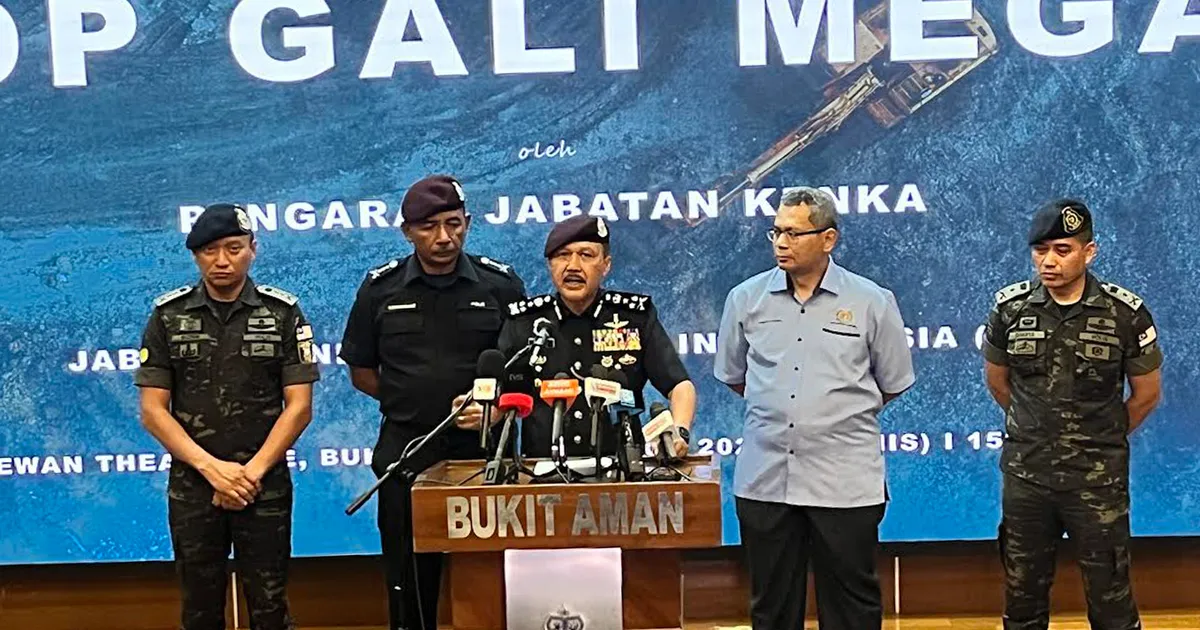
Malaysian law enforcement has intensified its assault on illicit mineral extraction, with a coordinated operation between August 19 and 23 yielding the arrest of 99 individuals and the seizure of assets valued at RM119 million. The multi-agency operation demonstrates renewed commitment to combating the persistent problem of unregulated resource extraction that has plagued the country's mining sector for years.
During the five-day enforcement drive, authorities recovered approximately 33,000 tonnes of illegally extracted natural resources. The confiscated materials encompassed a diverse range of commodities essential to Malaysia's construction and manufacturing industries: coal destined for energy production, quarry stone for building materials, earth and sand for construction purposes. These commodities alone were assessed at RM21 million, representing the commercial value of resources extracted without proper licensing or environmental oversight.
The magnitude of the RM119 million asset seizure indicates that enforcement efforts extended beyond the raw materials themselves. Authorities likely targeted equipment, machinery, vehicles, and financial assets connected to the illegal mining networks. Such comprehensive asset recovery reflects a strategic shift toward dismantling the operational infrastructure that sustains underground mining enterprises, rather than merely apprehending individual workers or low-level operators.
Illegal mining in Malaysia represents a significant governance challenge with multifaceted consequences. The practice undermines legitimate mining operators who comply with regulations and environmental standards, creating an unequal competitive landscape where lawbreakers enjoy cost advantages by avoiding licensing fees, environmental remediation obligations, and proper safety protocols. This distorts market pricing and erodes confidence in the regulatory framework designed to manage natural resource extraction.
The environmental implications of unregulated mining operations are substantial and often irreversible. Illegal extraction typically occurs without proper land rehabilitation measures, leading to scarred landscapes, soil degradation, and contamination of water sources. In regions where illegal mining clusters, groundwater systems can become compromised, affecting both agricultural productivity and residential water supplies. The absence of environmental impact assessments means that critical ecosystems may be destroyed without any understanding of long-term consequences.
For Malaysian readers and regional observers, the crackdown carries implications extending beyond immediate law enforcement metrics. It signals intensifying pressure on supply chains connected to illicit minerals, potentially affecting downstream industries that inadvertently source materials from unregulated operations. Construction companies, quarrying businesses, and manufacturers should expect heightened scrutiny regarding raw material provenance, with authorities likely increasing documentation requirements and traceability standards.
The timing and scale of this operation suggests coordination among multiple enforcement agencies, potentially including the Royal Malaysian Police, the Malaysian Geological Board, local authorities, and the Ministry of Natural Resources. Such inter-agency cooperation has historically been challenging in Malaysia, where jurisdictional overlaps and resource constraints sometimes hinder effectiveness. The success of this operation may establish a template for future coordinated enforcement activities.
The 99 arrests raise questions about the supply chain networks sustaining illegal mining. Such operations typically require distribution networks, equipment suppliers, and buyers willing to purchase materials without verifying their origin. Disrupting these networks requires tracking not only the extractors but also intermediaries and end-buyers. Authorities' willingness to pursue asset seizures suggests they are pursuing cases against network participants beyond simple miners.
From a regional perspective, Malaysia's illegal mining problem connects to broader Southeast Asian patterns of unregulated resource extraction. Countries throughout the region struggle with similar challenges, particularly in border areas where enforcement capacity is limited and cross-border smuggling facilitates illegal material movement. Successful domestic enforcement in Malaysia can influence regional approaches and demonstrate the feasibility of systematic crackdowns.
The financial scale of the operation—RM21 million in raw materials plus RM119 million in total assets seized—underscores the economic significance of the illegal mining sector. These figures suggest that underground operations represent substantial economic activity, which partly explains their resilience despite enforcement efforts. Addressing the root causes requires understanding what incentivizes participation: poverty in mining communities, lack of legitimate employment alternatives, and inadequate compliance monitoring in remote areas.
Looking forward, the crackdown's sustainability depends on consistent enforcement follow-through. Previous campaigns have sometimes yielded short-term results followed by renewed illegal activity as enforcement attention shifted elsewhere. Maintaining momentum requires sustained funding, personnel deployment, and inter-agency coordination, as well as meaningful prosecution of arrested individuals to create deterrent effects.
The operation also highlights the importance of intelligence-gathering and informant networks in identifying illegal mining sites. Many operations occur in remote, densely forested areas where discovery relies on tip-offs from community members, competing businesses, or forest rangers. Building public confidence in reporting mechanisms and ensuring witness protection will strengthen future enforcement efforts.

