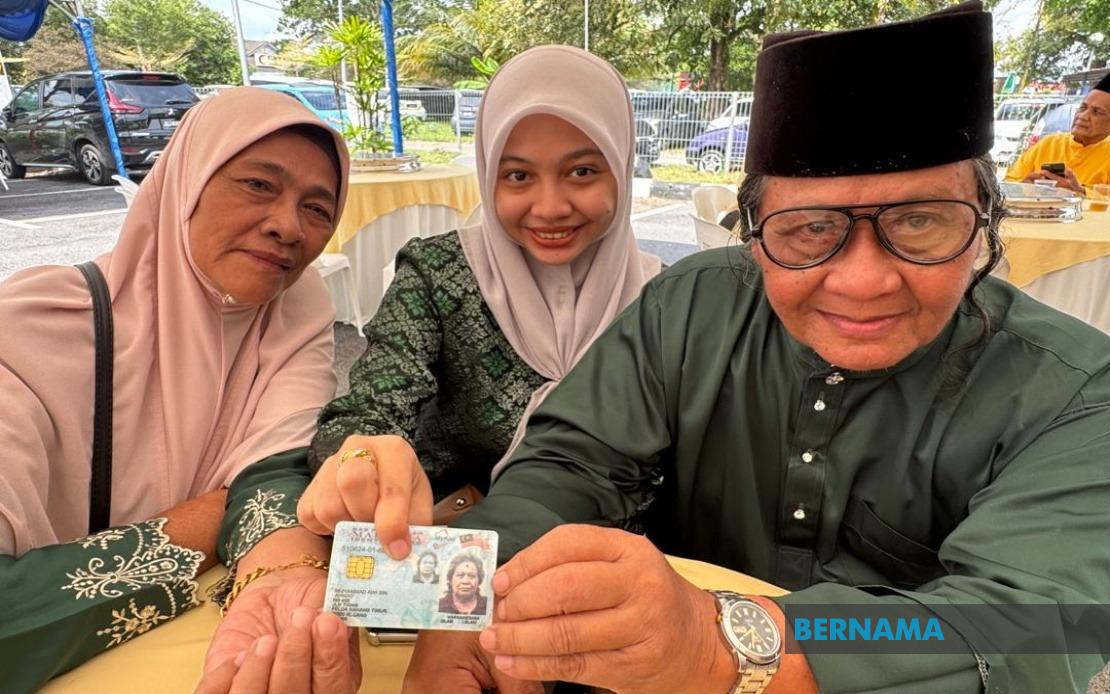
Muhammad Awi Ahmad received what might be the most meaningful birthday present of his life when he obtained the ownership title to his 4.2-hectare plantation and residence in Felda Kahang Timur on his 75th birthday. His achievement marks the culmination of a three-decade struggle that reflects both the historical complexities of Malaysia's Federal Land Development Authority scheme and the tenacity of individual settlers who refused to let bureaucratic delays determine their futures.
The journey to secure formal ownership began for Muhammad Awi in 1990, nearly four years after he started cultivating his plot in 1986. His initial application was rejected, as was a second attempt in 2000. For someone who had invested decades of labour into developing the land, watching multiple applications fail must have felt like an existential threat to his family's future security. The turning point arrived when the Johor state government under Menteri Besar Datuk Onn Hafiz Ghazi prioritized resolving this long-standing issue, approving his application within approximately a year—a dramatic acceleration compared to his previous waits.
The land title handover ceremony, held at Dewan Dato' Onn in Rumah Komuniti Parlimen Sembrong with Menteri Besar Onn Hafiz in attendance, distributed ownership documents to 210 recipients across three districts: Kluang, Kota Tinggi, and Mersing. This represents a significant milestone in what has been one of Malaysia's most persistent agricultural administration challenges. The symbolic weight of the ceremony extended beyond mere bureaucratic completion—it represented formal recognition of decades of labour and investment by families who had treated these plots as their inheritance even without legal documentation.
The broader context reveals the scale of this achievement. To date, 99.9 percent of Felda settlers in Johor—27,639 out of 27,642 who submitted applications—have now received ownership titles. This near-complete resolution of what was once a seemingly intractable problem suggests that focused governmental attention and streamlined administrative procedures can address even decades-old institutional failures. The figure underscores that the issue was not insurmountable but rather required political will and administrative reform.
Muhammad Awi's daughter Norliyani, aged 25 and representing the younger generation of Felda families, articulated a perspective that extends beyond her father's personal victory. She emphasized that securing land titles for the first generation of settlers prevents a cascade of legal and social complications affecting subsequent generations. Without clear ownership documentation, the second and third generations face profound uncertainty about whether they can inherit, develop, or secure credit against land their families have cultivated for four decades.
Her observation highlights a critical intergenerational dimension often overlooked in discussions of Felda land disputes. First-generation settlers, many now elderly, might have alternative options or cultural connections to their original villages. But younger settlers have built their entire lives, identities, and economic prospects around these plantations. For them, uncertain land tenure represents an existential threat—they have nowhere else to return to and cannot build futures without stable land ownership. The scenario Norliyani feared, where family land ends up belonging to others despite generations of cultivation, carries profound emotional and practical consequences beyond simple property disputes.
Another successful applicant, Mohd Farhan Mohamad, provides additional insight into the persistence required to navigate this system. At 43 years old, he spent nearly two decades pursuing a land title that his father, Mohamad Masek, had cultivated since the 1980s. The elder Mohamad Masek's wish to secure ownership before his later years motivated his son's determination through multiple applications and rejections. The approval that finally arrived this year, after a fresh application submitted just twelve months earlier, suggests that reformed processes have dramatically improved approval timeframes and success rates.
The historical backdrop of Felda itself shapes understanding of why these disputes persisted for so long. Established in 1956, Felda was designed as a poverty-alleviation scheme that allocated land to settlers and provided development support. However, the institutional arrangements created ambiguity: while settlers occupied, improved, and cultivated the land, actual ownership often remained unclear or complicated by bureaucratic procedures. This gap between de facto use rights and de jure ownership created vulnerability. Settlers could be displaced, their land transferred, or their claims disputed without clear legal standing—a situation that accumulated legal and psychological stress across four decades.
The resolution of these title issues carries significant economic implications for rural Johor and broader Felda regions. Settlers with clear ownership can access agricultural credit more readily, use land as collateral for business expansion, and make long-term investment decisions without fear of loss. Banks and microfinance institutions, reluctant to advance credit without clear title, may become more willing to support rural development. This could catalyze agricultural modernization, diversification, and improved productivity across Felda lands that have sometimes been constrained by economic uncertainty.
The handover ceremony also signals a shift in how the Johor government prioritizes rural and agricultural constituencies. The event's prominence—held in a parliamentary community centre and attended by the Menteri Besar himself—suggests that land security for agricultural communities has become a measurable success metric for the current administration. This political visibility may serve as a model for other states where similar Felda land title disputes persist, potentially catalyzing comparable efforts elsewhere.
For Malaysian policymakers overseeing agricultural development schemes, this resolution offers both lessons and warnings. The fact that achieving near-complete resolution required focused attention, expedited procedures, and high-level political engagement suggests that institutional inertia and bureaucratic complexity had created self-perpetuating delays. The success in Johor implies that other states might similarly resolve stalled applications through administrative reform rather than accepting them as inevitable features of the system.
Beyond the specific Johor achievements, this development reflects broader questions about land security and rural livelihoods across Southeast Asia. Land tenure uncertainty remains a persistent challenge across the region, affecting millions of small farmers and agricultural families. Malaysia's progress in Johor, while incomplete, demonstrates that determined effort can substantially resolve such disputes, potentially offering insights for neighbouring countries wrestling with similar agricultural administration challenges.
The emotional resonance of Muhammad Awi's 75th birthday gift—receiving formal recognition of his life's work—extends beyond sentimentality. It represents closure to decades of uncertainty and validation of his claim to fruits of his labour. As Johor continues this work with the final 0.1 percent of applicants, and as other states potentially follow its example, the landscape of agricultural land security in Malaysia gradually shifts toward greater certainty and dignity for rural communities.

