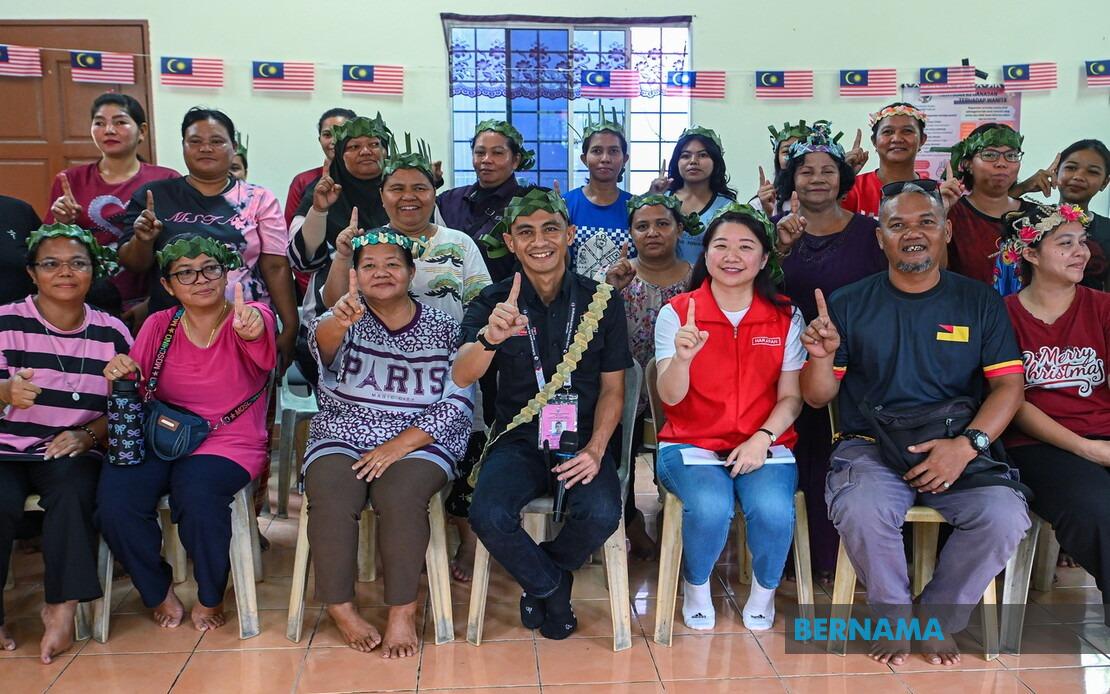
Datuk Ahmad Faez Abdul Razak, the Pakatan Harapan candidate contesting the Labu state seat in Negeri Sembilan, has made the advancement of the Orang Asli community a centrepiece of his election platform. Speaking after attending an Orang Asli Women Empowerment programme at Kampung Orang Asli Tekir, Ahmad Faez outlined a comprehensive development agenda aimed at raising living standards and creating sustainable economic opportunities for indigenous residents in the constituency.
At the heart of Ahmad Faez's manifesto sits the resolution of customary land issues affecting Kampung Orang Asli Tekir, a matter he intends to bring before the State Legislative Assembly if voters grant him the mandate. This signals recognition that land rights remain a fundamental concern for Orang Asli communities across Malaysia, particularly in peninsular states where development pressures and competing claims have historically marginalised indigenous land tenure. By positioning this as a legislative priority rather than an administrative footnote, Ahmad Faez is appealing to grassroots frustrations that have persisted across multiple election cycles.
Beyond land matters, Ahmad Faez has committed to upgrading essential infrastructure within the village, including road networks and internet connectivity. These seemingly modest improvements represent critical gaps in rural Orang Asli settlements, where poor accessibility has historically constrained economic participation and access to services. The emphasis on digital connectivity is particularly pertinent in contemporary Malaysia, where internet access has become foundational to education, commerce, and civic engagement. For a community with a population of 796 residents, such infrastructure investments could meaningfully alter economic trajectories.
Education and youth development occupy a prominent position in Ahmad Faez's platform, reflecting acknowledgment that the Orang Asli demographic skews young and requires targeted skills development. He has identified the community's potential but emphasised that unlocking this potential demands structured support mechanisms. This framing avoids paternalistic undertones by presenting the Orang Asli not as passive beneficiaries but as individuals possessing genuine capabilities requiring appropriate institutional backing.
The candidate has identified handicraft production as a key income-generation avenue with expansion potential. Rather than simply celebrating existing craft traditions, Ahmad Faez's approach involves broadening market access and enhancing commercialisation pathways. This suggests engagement with marketing networks and supply chain development that could connect Kampung Orang Asli Tekir's artisans to wider consumer bases, both domestically and potentially internationally through platforms increasingly available to rural producers.
Modernising agricultural practices represents another plank of Ahmad Faez's economic development strategy. The introduction of fertigation systems exemplifies technology transfer aimed at improving yields and sustainability. Such approaches acknowledge that subsistence-level agriculture alone cannot generate the income levels necessary for contemporary living standards, while simultaneously preserving the agricultural sector as a viable livelihood source through efficiency gains. This balanced approach differs from development models that seek to displace traditional livelihoods entirely.
Ahmad Faez has emphasised the longevity of his engagement with the Labu constituency, claiming two years of consistent community presence prior to the election campaign. He has rejected the characterisation of politicians as ephemeral election-time visitors, positioning himself instead as a committed long-term stakeholder in local affairs. Such claims warrant scrutiny but resonate with voter preferences for representatives demonstrating genuine community investment beyond election cycles.
Kampung Orang Asli Tekir's village chief Nasir Musil has endorsed Ahmad Faez's commitment while articulating additional community priorities. Nasir has emphasised infrastructure development and economic advancement but also highlighted the persistent problem of stray cattle creating hazards for road users. This practical concern, while less immediately glamorous than headline development initiatives, speaks to immediate quality-of-life issues affecting daily safety and mobility—matters that affect electoral perception despite receiving limited media attention.
The three-cornered contest in Labu pits Ahmad Faez, a first-time contestant, against incumbent Mohamad Hanifah Abu Baker representing Parti Pribumi Bersatu Malaysia and Siti Nur Umaira Hasim of Barisan Nasional. This configuration suggests a competitive environment where incumbency does not guarantee retention, particularly if the governing coalition faces anti-establishment sentiment. Ahmad Faez's freshness as a candidate may appeal to voters seeking change, while his stated two years of ground engagement attempts to offset typical disadvantages faced by newcomers.
The broader context of Negeri Sembilan state politics involves complex coalition dynamics and voter preferences that extend beyond individual constituency concerns. The state election, with early voting scheduled for July 28 and polling day on August 1, occurs within Malaysia's broader political landscape characterised by significant flux and realignment. Ahmad Faez's focus on Orang Asli development reflects both genuine policy conviction and strategic electoral positioning, recognising that indigenous communities, while demographically small, wield disproportionate influence in specific constituencies and increasingly command political attention as parties compete for previously marginalised votes.
The emphasis on Orang Asli advancement across campaign rhetoric from multiple parties indicates emerging recognition that indigenous communities represent neither monolithic voting blocs nor constituencies to be ignored. Ahmad Faez's detailed commitments—spanning land rights, infrastructure, education, and economic enterprise—suggest substantive engagement with community concerns rather than tokenistic appeals. Whether implemented if elected, such commitments establish benchmarks against which future performance can be measured, creating accountability mechanisms that extend beyond election cycles.

