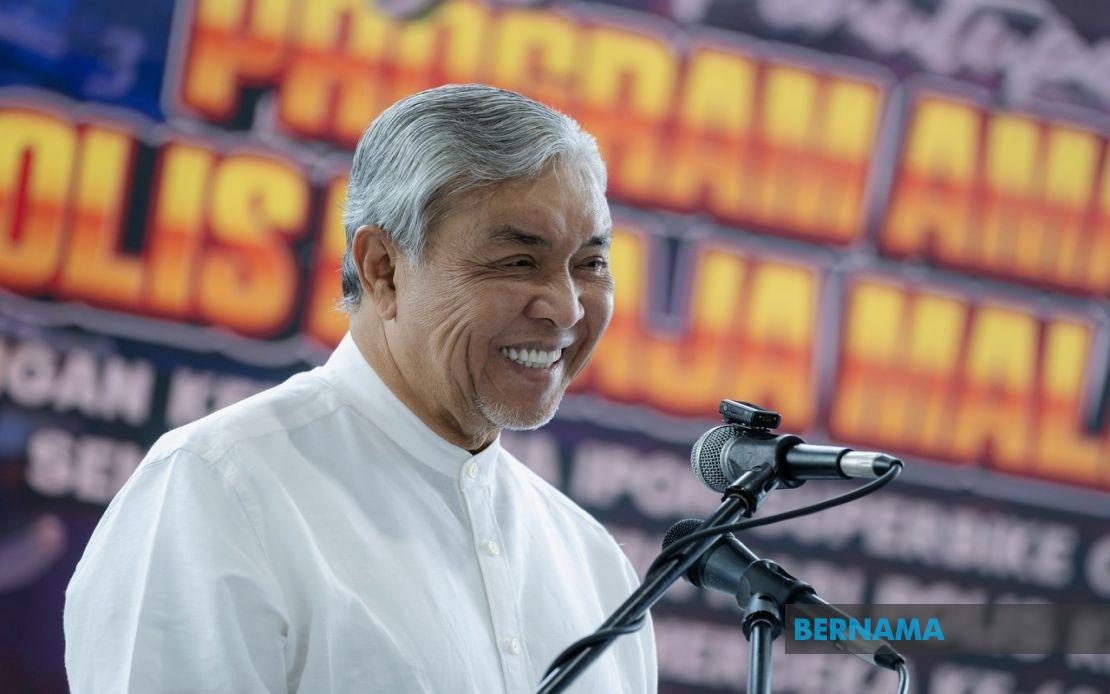
Deputy Prime Minister Datuk Seri Dr Ahmad Zahid Hamidi has underscored the importance of Malaysian motorcycle enthusiasts respecting and obeying traffic laws when travelling in neighbouring countries, framing compliance as essential to maintaining regional harmony within the ASEAN bloc. Speaking at the conclusion of the Negeri Sembilan Contingent Charity Ride programme at the Kuala Lumpur Police Contingent Headquarters, Ahmad Zahid stressed that observing local regulations transcends mere legal obligation and represents a broader commitment to interstate relations built on reciprocal respect.
The Deputy Prime Minister's remarks came directly in response to a viral incident in Hat Yai, Thailand, where Thai traffic authorities halted a group of Malaysian high-powered motorcycle riders and issued traffic citations. Social media users had circulated video footage suggesting the Malaysian riders were subjected to unfair treatment by Thai police. Thai authorities subsequently clarified their position, stating that the summonses were issued for legitimate traffic violations, specifically the use of flashing lights and illegally modified exhaust systems that exceeded permitted noise thresholds. The clarification highlighted a disconnect between public perception and regulatory enforcement, a pattern increasingly common in cross-border motorcycling incidents across Southeast Asia.
Ahmad Zahid articulated a nuanced diplomatic position, acknowledging that while Malaysian travellers expect fair treatment abroad, they bear an equal responsibility to understand and comply with each host nation's specific legal framework. He characterised the principle as one of foundational importance to ASEAN solidarity, noting that the ten-member regional grouping functions most effectively when member states exercise tolerance and mutual deference. His statement implicitly recognised that individual travellers' actions—whether deliberate or inadvertent violations of local traffic codes—carry broader implications for Malaysia's standing within regional partnerships, a reality that extends beyond the immediate enforcement action to encompass bilateral relations.
The enforcement action in Thailand has become emblematic of a growing tension within Southeast Asia's motorcycling community, where riders from wealthier nations frequently traverse borders with equipment and practices that may be legal domestically but constitute violations elsewhere. High-powered bikes, aftermarket exhaust systems, and decorative lighting modifications represent status symbols within enthusiast circles, yet precisely these customisations frequently trigger enforcement in neighbouring jurisdictions where noise and safety standards differ markedly. The incident thus reflects a deeper challenge: how regional motorcycle communities reconcile their shared passion for riding with divergent regulatory environments, a question that Ahmad Zahid's statement indirectly encourages riders to resolve by prioritising compliance.
Ahmad Zahid revealed that Malaysia's government is simultaneously examining the converse problem—foreign-registered vehicles violating Malaysian traffic laws upon entering the country. This reciprocal concern underscores that traffic regulation conflicts are not unidirectional phenomena but rather mutual frustrations requiring coordinated solutions. The Deputy Prime Minister indicated that such issues could be addressed through established diplomatic channels, specifically the Annual Consultation Meeting platform where Prime Minister Datuk Seri Anwar Ibrahim convenes with other ASEAN leaders. This institutional approach suggests that rather than permitting cross-border traffic enforcement to become sources of friction, Malaysia seeks to establish predictable protocols and mutual understanding at the highest political level.
Beyond the contentious Thailand incident, Ahmad Zahid used the occasion to commend the Charity Ride programme, which succeeded in raising RM102,000 through contributions from 53 participating companies. The fundraising initiative demonstrated the constructive potential of organised motorcycle activities when channelled toward social welfare objectives. The collected funds are earmarked for distribution among 120 Royal Malaysia Police family units and 12 welfare homes positioned along the convoy's route, illustrating how enthusiast communities can leverage their collective resources to support vulnerable populations and law enforcement families. This positive framing served to distinguish between responsible, organised riding activities and the isolated incidents that occasionally generate negative attention.
The Deputy Prime Minister articulated an ambitious vision for expanding such charitable initiatives, expressing his personal intention to participate in a large-scale motorcycle convoy scheduled for conjunction with Malaysia's 70th National Day and the police force's 220th Police Day celebrations in the following year. Ahmad Zahid proposed that such an event should mobilise a minimum of 220 riders, suggesting a scaling-up of the charitable ride model to create a flagship national event. This proposal reflects recognition that when properly organised and oriented toward prosocial outcomes, motorcycle enthusiast activities can enhance national celebration and community cohesion whilst simultaneously promoting respect for road safety and regulatory compliance.
The timing of Ahmad Zahid's remarks carries particular significance given Malaysia's ongoing efforts to position itself as a responsible regional actor within ASEAN. Cross-border incidents involving Malaysian citizens, regardless of their apparent triviality, can accumulate into diplomatic friction if not addressed through clear articulation of shared values and mutual commitment to legal compliance. By publicly emphasising that Malaysian travellers must respect host nations' regulations, Ahmad Zahid sends a dual message: to the international community that Malaysia takes its citizens' conduct seriously, and to domestic motorcycle enthusiasts that their personal choices have broader implications for national reputation and regional relations.
The deputy premier's emphasis on tolerance and mutual understanding also implicitly acknowledges the legitimate regulatory differences that exist across ASEAN states. Rather than suggesting that Thai authorities acted unreasonably in enforcing their traffic laws, Ahmad Zahid framed the incident as an opportunity to reinforce principle—that ASEAN member states must trust each other's regulatory frameworks even when they diverge from domestic norms. This stance reflects diplomatic maturity and regional consciousness, positioning Malaysia as a nation that prioritises institutional relationships over episodic disputes. It also sets expectations for Malaysian citizens that respecting host nations' laws is not a concession to be grudgingly accepted but rather a fundamental element of interstate conduct.
For Malaysian motorcycle enthusiasts who frequently venture into Thailand, Laos, and other neighbouring countries, Ahmad Zahid's statement carries practical implications. Riders considering modifications to their bikes must now confront the likelihood that equipment legal in Malaysia may trigger enforcement action abroad, with potential consequences ranging from fines to confiscation. The message extends beyond high-powered bike clubs to encompass the broader motorcycling community, suggesting that national policy increasingly emphasises compliance over challenging foreign authorities' interpretation of their own regulations. This represents a subtle but significant recalibration of Malaysia's position, prioritising diplomatic stability and shared regional norms over individual travellers' grievances about enforcement fairness.
The charitable dimension of Ahmad Zahid's remarks should not be overlooked, as it demonstrates the government's recognition that motorcycling communities, when engaged constructively, can become partners in social welfare and public safety initiatives. By commending the Charity Ride programme and proposing an expanded version for national celebrations, the Deputy Prime Minister offers a template for channelling enthusiast passion toward nationally endorsed objectives. This approach potentially transforms the relationship between authorities and motorcycle communities from one of enforcement and resistance toward collaborative engagement around shared civic purposes, a model that could mitigate cross-border incidents by fostering communities oriented toward responsibility rather than provocation.

