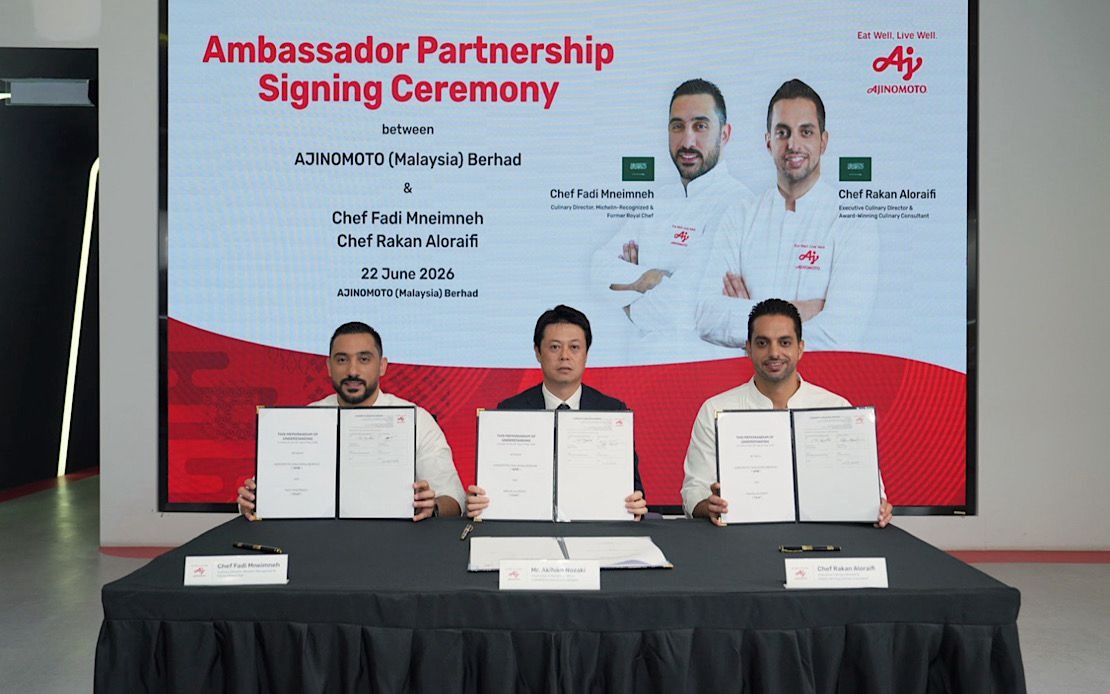
Ajinomoto (Malaysia) Berhad is capitalizing on mounting appetite for premium halal products across the Middle East by forging a strategic alliance with two of Saudi Arabia's most respected culinary personalities. The partnership marks a deliberate attempt to position the Malaysian food manufacturer as a trusted supplier within a region where halal certification carries both commercial and cultural significance, while simultaneously introducing modern food science concepts to regional chefs and hospitality professionals.
The two culinary collaborators—Chef Fadi Mneimneh, a Michelin-starred director who previously served as a royal chef, and Chef Rakan Aloraifi, an award-winning executive director and consultant—represent some of the Arabian Peninsula's most influential voices in gastronomy. By engaging personalities with their reach and credibility, Ajinomoto gains direct access to decision-makers within Saudi Arabia's booming hospitality and food service sectors, sectors that have expanded significantly amid the country's Vision 2030 economic diversification agenda.
During a recent factory tour at Ajinomoto's manufacturing facility in Bandar Enstek, Negeri Sembilan, the two chefs witnessed firsthand the company's production processes, halal certification standards, and quality control measures. This immersive experience serves a dual purpose: it authenticates the halal integrity that Middle Eastern buyers demand, while simultaneously educating influential culinary figures about the intersection of Japanese food technology and traditional Arab flavour profiles. Such facility visits transform abstract product claims into tangible, verifiable evidence—a critical factor when building confidence among conservative regional markets.
The centrepiece of the engagement was a series of live cooking demonstrations in which Chef Fadi and Chef Rakan prepared authentic Middle Eastern dishes incorporating Ajinomoto's ingredient portfolio. Rather than positioning umami as a foreign or Western concept, the demonstrations framed the Japanese seasoning principle as a natural complement to established regional cooking traditions. By showing how umami enhances depth and complexity without altering the fundamental character of dishes like traditional meat preparations and savoury sauces, Ajinomoto addresses a potential resistance point: the concern that international food science might dilute authentic Arab cuisine.
This approach reflects broader market realities across Southeast Asia and the Middle East, where consumers increasingly view authenticity and innovation not as opposing forces but as complementary values. Malaysian companies exporting to these regions have discovered that success requires demonstrating respect for local culinary heritage while introducing tangible improvements in flavour, consistency, or nutritional value. Ajinomoto's strategy mirrors this insight by positioning umami as a tool that enhances rather than replaces traditional methods.
The halal certification angle deserves particular emphasis for Malaysian readers, as it highlights the commercial value of Malaysia's established reputation in this space. While Saudi Arabia possesses its own halal standards and certification bodies, the perception that Malaysian halal products undergo rigorous oversight gives them competitive advantage. Ajinomoto, as one of Malaysia's leading food manufacturers, leverages the national brand equity built over decades of halal innovation and export excellence. This national positioning extends beyond product quality to encompass Malaysia's diplomatic standing in the Muslim world—an intangible but commercially relevant asset.
The collaboration also encompasses broader networking opportunities, with participation from Ajinomoto's distributor representative in Brunei, indicating that the company views this initiative as a potential springboard for deeper regional integration across Southeast Asia and the Arabian Peninsula. Such networking events serve as informal forums where supply chain partners, hospitality procurement professionals, and culinary innovators exchange intelligence about emerging market trends, competitive pressures, and shifting consumer preferences. For Malaysian companies seeking to expand regionally, these conversations often prove as valuable as the formal business transactions they facilitate.
Looking ahead, Ajinomoto has committed to continued collaboration with both chefs at planned Hotel, Restaurant and Café (HORECA) industry events scheduled for October 2026 in Riyadh and Jeddah. The HORECA sector represents a critical distribution channel for food ingredients and prepared products, as hotels, restaurants, and institutional food services collectively account for substantial volumes of product consumption. By securing prominent speaking roles and cooking demonstrations at these high-profile industry gatherings, the two chefs will effectively serve as brand ambassadors, introducing Ajinomoto's product range to procurement decision-makers who wield considerable purchasing power.
The timing of this expansion initiative aligns with broader economic transformations across the Gulf Cooperation Council states. Saudi Arabia's continued investment in tourism infrastructure, hospitality training, and culinary excellence creates receptive conditions for premium ingredient suppliers and food technology companies. Simultaneously, growing middle-class consumption in the region has elevated demand for diverse, high-quality food experiences, moving beyond basic sustenance toward experiential dining that emphasizes both tradition and sophistication.
For Malaysian stakeholders, this partnership represents a model for how domestic food manufacturers can maintain competitive advantage in export markets by combining halal credibility with culinary credibility. Rather than competing primarily on price or volume, Ajinomoto differentiates itself through partnership with respected local figures who can testify to product quality and suitability within regional culinary contexts. This approach requires deeper engagement and relationship-building than transactional export models, but generates stickier competitive advantages that prove more durable against price-based competition.
The initiative also underscores Malaysia's broader strategic positioning as a halal hub and food manufacturing centre for Muslim-majority and Muslim-conscious markets. As Chinese, Indian, and other international competitors increasingly target these same markets, Malaysian companies that combine halal certification with genuine innovation and cultural understanding occupy defensible market positions. Ajinomoto's chef partnerships exemplify this strategy in action, transforming product attributes into culturally resonant narratives that appeal to both professional food service operators and ultimate consumers.
Beyond immediate sales objectives, these collaborations contribute to longer-term brand building and market perception. When influential Saudi chefs publicly champion Malaysian halal food products and demonstrate their culinary value, they implicitly validate Malaysia's food manufacturing credentials across the region. Over time, such validation compounds into sustained competitive advantage, making Malaysian suppliers the preferred partners for quality-conscious buyers and premium market segments.

