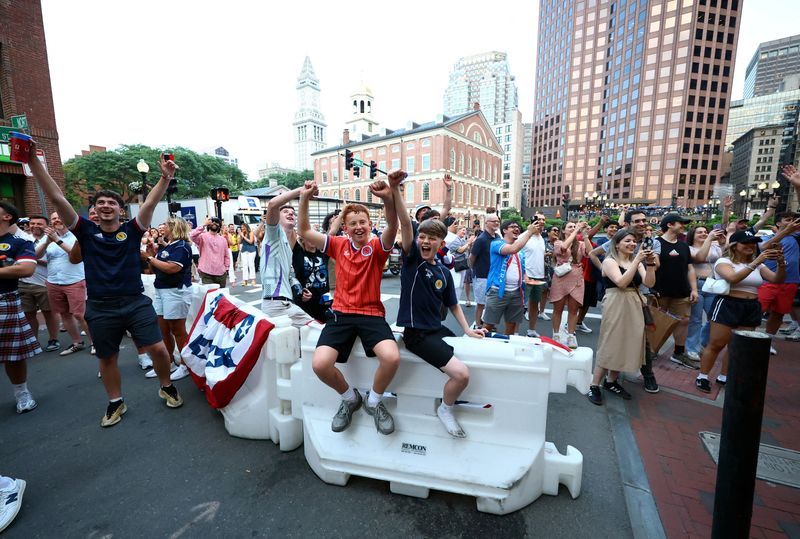
As football's premier global competition unfolds across the United States, a notable shift is occurring among international visitors who arrived with considerable apprehension about their World Cup experience. Prior to the tournament's kickoff, many overseas supporters expressed legitimate concerns regarding visa accessibility, affordability challenges, personal safety anxieties, and the perceived lack of enthusiasm for soccer within American society. Yet the reality unfolding on social media reveals a strikingly different narrative, with countless visitors documenting encounters with generous strangers, distinctive culinary traditions, and an unexpectedly hospitable national character that has pleasantly defied their preconceptions.
Scottish supporters—members of the storied Tartan Army—exemplify this phenomenon. One fan recounted a chance meeting with locals in a Boston establishment where strangers spontaneously purchased drinks and extended warm welcomes simply because visitors had travelled to experience the games. Such interactions, multiplied across countless venues and municipalities, are creating powerful, emotionally resonant memories that transcend the sporting spectacle itself. Meanwhile, Swiss visitors and other international tourists have taken to online forums to articulate their surprise at the friendliness and openness they've encountered, suggesting a cultural warmth that contradicts certain international perceptions of American society shaped by political rhetoric and media narratives.
The significance of these interactions extends well beyond pleasant anecdotes. According to sports analytics experts, hosting major sporting events fundamentally reshapes how international audiences perceive host nations. Darin White, founder of Samford University's Sports Industry Program and former soccer coach, employs a residential metaphor to illustrate this concept: the front exterior of a home represents a visitor's initial impression before entering, much as sports events introduce countries to international audiences. For many nations worldwide, such tournaments represent the first substantive, emotionally engaging exposure to a place they might otherwise have never seriously contemplated. Research consistently demonstrates that major sporting events possess genuine transformative capacity regarding long-entrenched stereotypes and preconceived notions.
What distinguishes this particular World Cup experience is its geographic distribution. Unlike previous tournaments that concentrate international visitors primarily in major metropolitan centres such as New York, Los Angeles, and Orlando, this edition disperses fans throughout secondary and tertiary American cities including Kansas City, Atlanta, and Houston. This dispersal introduces visitors to authentic regional cultures and communities often overlooked by conventional tourism. Argentine supporters, for whom asado barbecue occupies cultural significance paralleling that of football itself, ventured to Kansas City specifically to experience the local dry-rub grilling traditions. Visitors from Germany similarly embraced regional Texas culture, complete with cowboy hats and barbecue experiences, demonstrating a genuine enthusiasm for understanding authentic American regional identity rather than merely consuming standardised tourist attractions.
White emphasises that this off-the-beaten-path exposure generates particularly powerful brand-building moments for the United States. When a Moroccan visitor receives navigation assistance from a Dallas stranger, or when a German family obtains directions from a Seattle resident, these unheralded encounters accomplish substantial diplomatic work through human connection rather than official channels. Individual kindnesses accumulated across thousands of visitors collectively reshape international narratives about American character, potentially counterbalancing negative perceptions cultivated through geopolitical tensions and inflammatory rhetoric from government officials who have championed isolationist messaging and damaged relationships with traditional allies including Canada, Britain, and Germany.
Nevertheless, meaningful obstacles persist and continue limiting the tournament's inclusive impact. Extreme temperatures, particularly in Miami and other southeastern venues, create physical hardship for players and spectators alike, with mounting heat expected as the competition advances deeper into summer months. More significantly, the combination of expensive ticket allocations and costly travel arrangements has already excluded substantial portions of the potential international audience, with many supporters unable to justify the financial investment necessary for attendance. Visa restrictions and outright denials have proven equally consequential, with citizens from Iran, Haiti, Ivory Coast, and Senegal—all tournament participants—facing partial or comprehensive exclusion from American territory.
These immigration barriers carry particular poignancy given the substantial diaspora communities these nations maintain throughout the United States. Iranian and Haitian populations possess established American roots and represent significant cheering blocs; however, restrictive entry policies prevent many from attending matches featuring their national teams. The situation proves even more complicated for Ivory Coast and Senegal, whose American communities remain comparatively small, meaning visa denials eliminate important representation. Despite these limitations, American spectators have filled stadiums with remarkable enthusiasm, supporting not only domestic teams or nations of ancestral heritage but also extending solidarity toward underdog squads and nations with minimal local supporter representation.
Jessica Ambres, a Brooklyn resident who attended France versus Senegal in New Jersey whilst wearing Senegalese colours, exemplified this inclusive spirit. As a Black American, she articulated a deliberate connection to African diaspora communities and deliberately chose to champion Senegalese football despite the geographical and genealogical distance. Her presence, and that of countless similar supporters, underscores an important dimension of American society that international visitors are discovering: a genuine capacity for empathetic engagement across ethnic, national, and cultural boundaries when motivated by authentic human connection and shared passion for sport.
The economic and political establishments within the United States have recognised the promotional value inherent in fostering positive international sentiment. Boston Mayor Michelle Wu publicly encouraged the Tartan Army and other visiting supporters to regard Boston as perpetually welcoming, explicitly inviting them to return during future seasons and years rather than limiting their engagement to the tournament period. Such explicit municipal messaging reflects calculated understanding that international goodwill generated through warm hospitality can yield sustained benefits regarding tourism, business relationships, and soft power influence extending far beyond the competition's conclusion.
As the tournament progresses toward its culmination, critical questions remain regarding whether the goodwill currently being cultivated will endure once the final whistle sounds and international visitors return home. The transformative power of sports events depends substantially on whether positive impressions translate into sustained attitudinal shifts and whether memorable personal interactions overshadow broader geopolitical and policy concerns. For Malaysia and other Southeast Asian nations, this American experiment in sporting diplomacy offers instructive lessons regarding how hosting major events can reshape international perceptions when accompanied by genuine hospitality and inclusive engagement rather than purely administrative competence.

