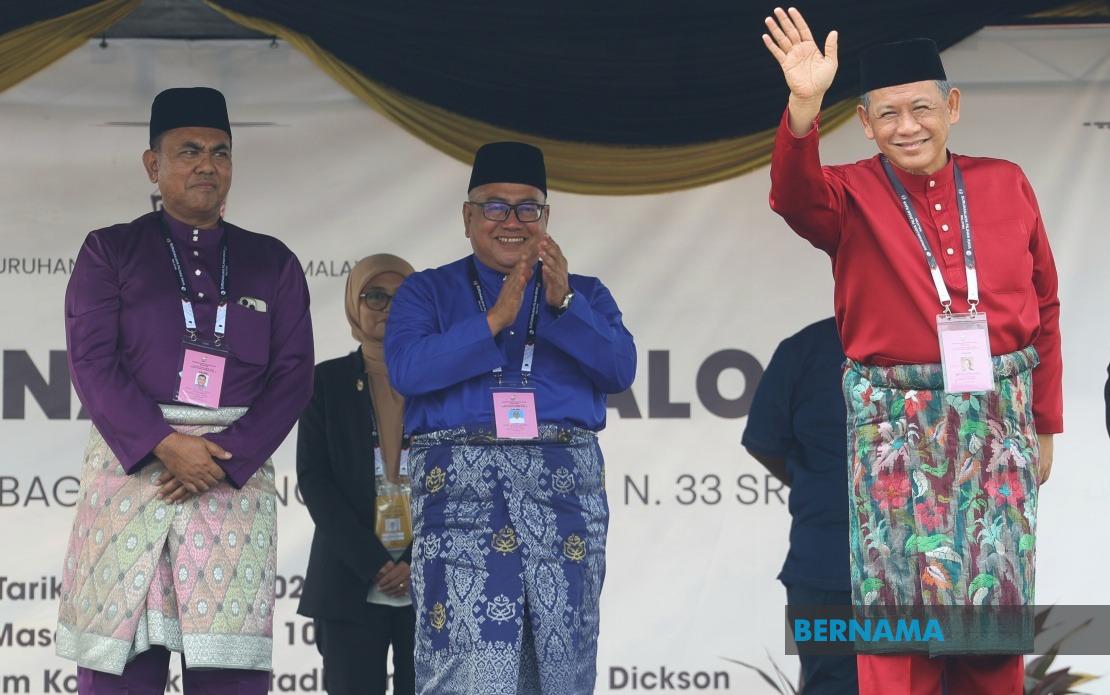
Negeri Sembilan's governing Pakatan Harapan faces a significant test of its grip on power as the state's 16th election takes shape, with Menteri Besar Datuk Seri Aminuddin Harun confronting a formidable three-cornered contest in his Linggi stronghold. The nomination process concluded on July 18 at the Port Dickson District Administration Complex, formally confirming that Aminuddin will contend against Datuk Mohd Faizal Ramli, the Barisan Nasional incumbent seeking to reclaim the seat, alongside Datuk Zamri Md Said of Bersatu, the party that has increasingly positioned itself as an alternative to both the traditional coalition and the opposition.
The emergence of a three-way race in Linggi exemplifies the fragmentation reshaping Malaysia's political landscape at the state level. Bersatu's decision to field a candidate represents a deliberate challenge to Pakatan Harapan's dominance in Negeri Sembilan, potentially splitting the anti-BN vote depending on voter sentiment. For Aminuddin, already facing the formidable challenge of defending against an entrenched Barisan Nasional incumbent, the Bersatu candidacy introduces additional uncertainty into a constituency that has become one of the state's most closely watched battlegrounds. The three-cornered configuration reflects deeper anxieties within Malaysia's ruling coalition about maintaining electoral momentum across peninsular states.
The Linggi race constitutes only one dimension of a broader contest reshaping Negeri Sembilan's political composition. In Sri Tanjung, Pakatan Harapan's Dr G. Rajassekaran will defend his seat against both Barisan Nasional's A. Achutan and Bersatu newcomer Leevineshwaraan Murugan, continuing the pattern of three-way contests emerging across multiple constituencies. The Lukut division presents a different configuration, where Pakatan Harapan incumbent Choo Ken Hwa faces Perikatan Nasional candidate Sathes Kumar Nilameham and independent candidate Teo Seng Lee, indicating that opposition forces are mounting sustained challenges to the state's ruling party across diverse geographical areas.
Bagan Pinang has transformed into another significant battleground, with PAS incumbent Abd Fatah Zakaria contesting against Pakatan Harapan's Nasir Raman and Bersatu's Sheikh Junaidy Jamaludin. This constituency represents a particularly intricate dynamic, as it pits the Islamist party currently positioned within the opposition Perikatan Nasional bloc against both Pakatan Harapan's efforts to reclaim ground and Bersatu's expanding electoral footprint. The intersection of these competing narratives in Bagan Pinang encapsulates the complicated political realignment occurring across Malaysia's states, where older coalitional structures are yielding to more fluid and competitive electoral contests.
The Chuah constituency presents a notably different picture, configured as a straight two-cornered contest between Pakatan Harapan's Yew Boon Lye and Barisan Nasional's Pau Jeou Ching. This binary confrontation, relatively rare in this election cycle, suggests that certain constituencies maintain more straightforward political alignments despite broader fragmentation elsewhere. The existence of both two-cornered and three-cornered races across Negeri Sembilan creates an unpredictable electoral environment where traditional models of political prediction become unreliable. Voters in different constituencies will essentially be making distinct choices shaped by the particular candidate configurations before them.
The Election Commission has designated August 1 as polling day for the state election, with early voting opportunities scheduled for July 28. This timeline provides a compressed campaign period for candidates to mobilize support and communicate their messages to voters across the state. Early voting provisions for military personnel and police officers—comprising approximately 22,339 eligible voters according to commission data—reflect recognition that security sector employees require flexible voting arrangements. The logistical and administrative planning surrounding these voting mechanisms underscores the complexity of conducting democratic elections across a state with diverse geographical characteristics and constituencies.
The electoral arithmetic involves nearly 890,000 registered voters across Negeri Sembilan, comprising 867,151 ordinary voters alongside the aforementioned military and police personnel and their spouses. This substantial electorate base means that individual constituency results will hinge on mobilization efforts, candidate appeal, and local issue salience rather than simply reflecting state-level political trends. Different communities across the state's constituencies may prioritize distinct concerns, from economic development to education to communal representation, making constituency-by-constituency analysis essential to understanding potential outcomes. The sheer number of eligible voters creates both opportunity and risk for Pakatan Harapan, as the governing coalition must sustain its support base while countering determined opposition challenges.
For Pakatan Harapan specifically, the Negeri Sembilan election represents a crucial test of its ability to retain control of a state it has governed since 2018. The party's performance here carries implications extending beyond the state itself, as it influences perceptions of the coalition's electoral viability in other peninsular states heading into potential federal-level electoral contests. Aminuddin's personal contest in Linggi will attract disproportionate attention as a barometer of both his personal political standing and the broader health of Pakatan Harapan's electoral prospects. A loss in Linggi would carry considerable symbolic weight, whereas a convincing victory would provide reassurance to supporters regarding the coalition's capacity to weather political headwinds.
Barisan Nasional's positioning in this election remains significant, particularly given its traditional strength in Negeri Sembilan and its efforts to recover from recent electoral setbacks at the federal level. The incumbency advantage held by Barisan Nasional candidates in certain constituencies, including Mohd Faizal Ramli in Linggi, provides tangible assets in competing against ruling coalition contenders. However, Barisan Nasional faces the complicating reality that Bersatu's interventions in multiple constituencies may fragment opposition votes, potentially benefiting Pakatan Harapan in certain areas while creating openings elsewhere. The strategic calculus for Barisan Nasional thus involves not only competing against Pakatan Harapan but also gauging how Bersatu's presence will affect overall vote distributions.
Bersatu's expanded footprint across Negeri Sembilan constituencies signals the party's intention to position itself as a consequential force in state-level politics even as it remains outside the governing coalition. By fielding candidates across multiple seats rather than concentrating in selected areas, Bersatu is attempting to broaden its political base and demonstrate relevance to voters seeking alternatives to both the ruling coalition and traditional opposition formations. The party's strategy appears designed to capture dissatisfaction with existing political arrangements while avoiding the perception of being simply subsumed within conventional political blocs. This approach carries inherent risks, as Bersatu may fragment opposition support in ways that ultimately benefit Pakatan Harapan in some constituencies while strengthening opposition prospects in others.
The Negeri Sembilan election ultimately represents a microcosm of Malaysia's evolving political dynamics, where established patterns of two-coalition contestation are giving way to more complex multi-cornered competitions. The state's voters will render verdicts on not only individual candidates and party performance but implicitly on the broader question of which political combinations and governing arrangements they prefer going forward. For Malaysian observers and political analysts, the results in constituencies ranging from Linggi to Bagan Pinang to Sri Tanjung will provide crucial data regarding voter preferences, coalition cohesion, and the direction of electoral competition as Malaysia approaches potentially significant federal-level political developments.

