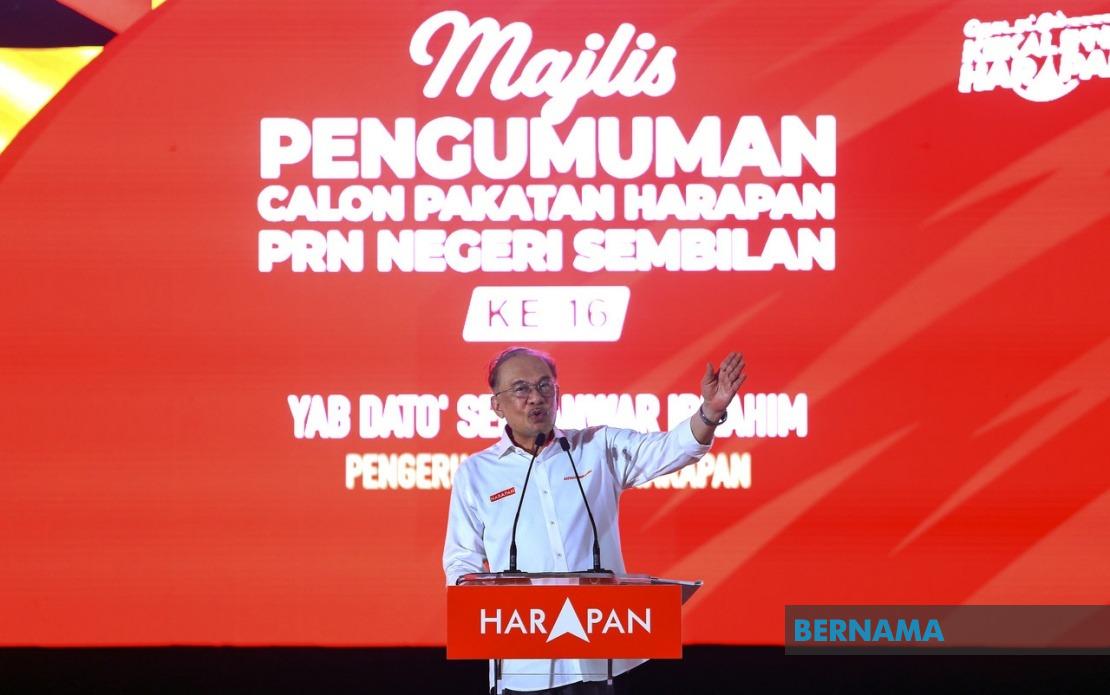
Pakatan Harapan has formally announced its candidacy lineup for the 16th Negeri Sembilan State Election, with Prime Minister Datuk Seri Anwar Ibrahim unveiling the coalition's choices at a packed campaign rally in Kuala Pilah on July 14. Among the key nominations is Negeri Sembilan Menteri Besar Datuk Seri Aminuddin Harun, who will contest the Linggi seat as the coalition's flagbearer in one of the state's most significant contests.
Aminuddin's nomination carries substantial weight within Negeri Sembilan politics. As chairman of the state branch of Pakatan Harapan, he brings organisational heft and established voter networks to the Linggi challenge. His track record in the Sikamat constituency since 2008—where he has secured consecutive victories across four election cycles—demonstrates his ability to maintain grassroots support and navigate the complexities of state-level politics in one of Malaysia's smaller peninsular states.
The decision to field Aminuddin in Linggi rather than retain him in Sikamat marks a strategic repositioning by Pakatan Harapan for the upcoming contest. The shift suggests coalition strategists view Linggi as a critical battleground where his seniority, administrative experience as Menteri Besar, and political credibility can be leveraged to maximise PH's electoral performance. Linggi's composition and voting patterns would have been carefully analysed before the coalition committed its top state leader to the seat.
Equally significant is the announcement that DAP secretary-general Anthony Loke will defend the Chennah constituency. Loke's decade-long tenure in the seat since 2013 underscores his personal popularity and the confidence Pakatan Harapan maintains in his electoral viability. As one of DAP's most prominent national figures, his retention in Negeri Sembilan validates both his local standing and his importance to the coalition's broader Malaysian political strategy. The decision to re-nominate him signals that DAP and its partners view Chennah as secure territory worth consolidating with an established incumbent.
The candidate announcement ceremony itself reflected the coalition's investment in the Negeri Sembilan campaign. The event drew thousands of supporters and was graced by the attendance of senior Pakatan Harapan figures, including Amanah president Datuk Seri Mohamad Sabu, communications director Datuk Seri Fahmi Fadzil, and election director Datuk Seri Amirudin Shari. Such high-level participation underscores how the coalition views the state election within its broader political calculus, particularly as Negeri Sembilan, though small, represents a testing ground for PH's cohesion and ground organisation ahead of future national contests.
The involvement of Anwar in the announcement ceremony himself is noteworthy. As Prime Minister, his direct participation in state-level candidate nominations demonstrates the centralised approach Pakatan Harapan has adopted for this contest. This contrasts with some earlier electoral processes where coalition partners operated with greater autonomy. The visible unity on the campaign platform—bringing together leaders from DAP, Amanah, and PKR—sends a message to voters about the coalition's commitment to maintaining its partnership, a crucial consideration for Negeri Sembilan electors evaluating stability and effective governance.
For Malaysian political observers, the nominations reflect broader patterns in how Pakatan Harapan manages succession and senior leadership deployment. Aminuddin's elevation to the Linggi contest aligns with efforts to position state-level administrators in seats where they can leverage executive experience and administrative visibility. Meanwhile, Loke's retention demonstrates the value PH places on experienced legislators who have built substantial local franchises over multiple election cycles.
Negeri Sembilan holds particular importance in Malaysia's political ecosystem. Though geographically modest and economically overshadowed by larger states, it has historically served as a barometer of voter sentiment and a testing ground for electoral innovations. The state's demographics—comprising urban centres like Seremban alongside rural constituencies—provide representation across Malaysia's social spectrum. A strong performance here by Pakatan Harapan would reinforce the coalition's claim to represent both urban middle-class voters and rural communities.
The broader implications of these nominations extend beyond Negeri Sembilan itself. They illustrate how Pakatan Harapan is consolidating control in states where it holds power while attempting to leverage senior figures to extend influence into contested areas. The deployment of two national-profile leaders—Aminuddin as a state administrator and Loke as a national DAP figure—suggests the coalition views Negeri Sembilan as winnable territory where strategic resource allocation could yield returns.
For regional observers monitoring Malaysian politics, these candidacies provide insight into how coalitions manage internal negotiations and leadership allocation. The fact that both major nominees represent the coalition's established incumbent strength—rather than fresh challengers seeking to overthrow opposition governments—indicates Pakatan Harapan is prioritising consolidation of existing power bases rather than dramatic territorial expansion in this particular contest.
The announcement also carries implications for Negeri Sembilan's political future and governance trajectory. With Aminuddin formally confirmed as Menteri Besar candidate, voters understand that re-election of a Pakatan Harapan majority would likely result in continuity of executive leadership. This clarity about succession and leadership stability can influence electoral calculations, particularly among voters prioritising predictability and administrative continuity over radical change.

