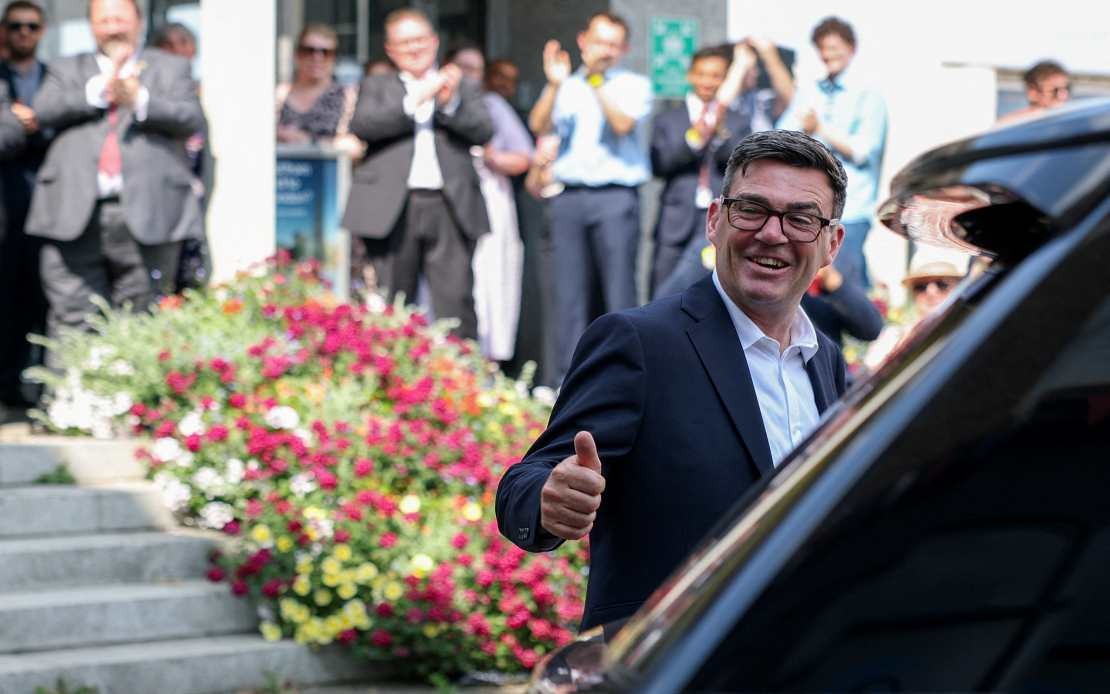
Andy Burnham formally became Prime Minister of the United Kingdom on Monday, following his rapid ascent to the Labour Party leadership just weeks after returning to Parliament. In his inaugural address delivered from Downing Street after visiting King Charles III, the former mayor of Greater Manchester outlined a vision centred on restoring public trust in governance and providing what he termed "breathing room" for ordinary Britons struggling with economic pressures.
Burnham's elevation to the nation's highest office caps an unusual political trajectory. Without facing a contested leadership election, he inherited the premiership after Keir Starmer's departure, bringing with him the management experience accumulated during his tenure leading the Greater Manchester combined authority. This swift transition underscores the internal confidence Labour placed in his ability to command the party and stabilise a government that has cycled through seven prime ministers over the previous decade—a pattern Burnham explicitly acknowledged as unsustainable and damaging to institutional credibility.
Central to his opening message was an emphasis on political continuity and measured governance. Burnham characterised the current moment as requiring both "reflection and resolution," suggesting that Britain must confront its challenges with honesty while demonstrating genuine capacity for problem-solving. His advisors indicated that this framing would distinguish his premiership from the volatility that has marked recent Westminster leadership, positioning stability itself as a concrete political product rather than merely an aspirational goal.
The cost-of-living crisis remains the defining domestic challenge confronting the new administration. Burnham's repeated invocation of "breathing room" signals his intention to prioritise immediate relief for households affected by inflation, energy prices, and wage stagnation. His political allies emphasised that such relief must translate into tangible improvements rather than rhetorical comfort, suggesting the government will pursue measurable outcomes on household expenses within the opening months of his tenure.
Among his stated priorities, devolution features prominently. Burnham has signalled a determination to redistribute power away from London's centralised apparatus, likely reflecting his experience managing a major metropolitan region. This approach could reshape relationships between Westminster and England's regional authorities, potentially offering Manchester and other cities greater control over local spending and policy implementation. For Southeast Asian observers, this represents a significant shift in how a major Western democracy organises its governance structure—moving away from capital concentration toward dispersed regional authority.
Within days of assuming office, Burnham announced the scrapping of Keir Starmer's digital identity scheme, a controversial initiative that would have established biometric systems for citizen verification. By reallocating those resources toward cost-of-living measures, he signalled a recalibration of government priorities. The decision reflects broader anxiety within British politics regarding state surveillance and personal data security—concerns that have gained traction across Western democracies, including Australia and Canada.
Energy policy presents an immediate and consequential test. Reports indicate the new government is considering expanded North Sea oil and gas drilling as a means to moderate energy costs, a position that directly contradicts Labour's 2024 manifesto commitment to prohibit fresh licensing. Environmental advocates have urged Burnham to maintain the original pledge, arguing that increased extraction will not materially lower bills whilst locking in fossil fuel dependency. This dilemma epitomises the tension between short-term economic relief and longer-term climate commitments that confronts centre-left governments globally.
Thames Water's financial distress adds another layer of complexity to the early weeks of the Burnham administration. The utility company carries approximately £20 billion in debt, prompting speculation that temporary nationalisation may become necessary to prevent systemic failure. Burnham has previously expressed openness to greater public ownership of essential services, positioning such intervention as compatible with Labour's broader ideological framework. Creditors have signalled willingness to negotiate with the new government to structure a rescue arrangement, suggesting a potential resolution may emerge before the autumn.
Cabinet formation has occupied immediate attention, with particular focus on the chancellorship—the position second in political importance only to the prime ministership itself. The contest reportedly centres on Energy Secretary Ed Miliband and Home Secretary Shabana Mahmood, both senior figures capable of managing Treasury operations. This selection will signal whether Burnham intends to prioritise energy transition or domestic security as secondary governing pillars. The choice carries implications for Britain's approach to decarbonisation and immigration—matters of significance throughout Europe and the Commonwealth.
Burnham's assumption of power arrives at a moment of profound uncertainty in global geopolitics. The United Kingdom navigates complex relationships with the European Union following Brexit, potential shifts in the North Atlantic Treaty Organisation amid American political change, and ongoing security challenges in Eastern Europe and the Middle East. How his government recalibrates British foreign policy and defence posture will reverberate through allied nations, including Singapore, Australia, and other Indo-Pacific partners who depend on UK strategic engagement.
For Malaysia and Southeast Asia, developments in British governance bear practical consequences. London remains a significant financial centre for regional capital, and shifts in UK regulatory or economic policy affect cross-border investment flows, banking relationships, and trade arrangements. Additionally, Britain's intelligence partnerships through the Five Eyes alliance shape regional security dynamics, making leadership stability at Westminster consequential for partners across the Indo-Pacific.
The early indication that Burnham will prioritise delivery of concrete improvements over symbolic gestures suggests a pragmatic approach to governance. Whether this translates into sustained public confidence or merely delays the cycle of volatility that has characterised recent British politics remains an open question. His government's first hundred days will provide crucial signals about whether the UK can indeed achieve the "reflection and resolution" its new leader has promised.

