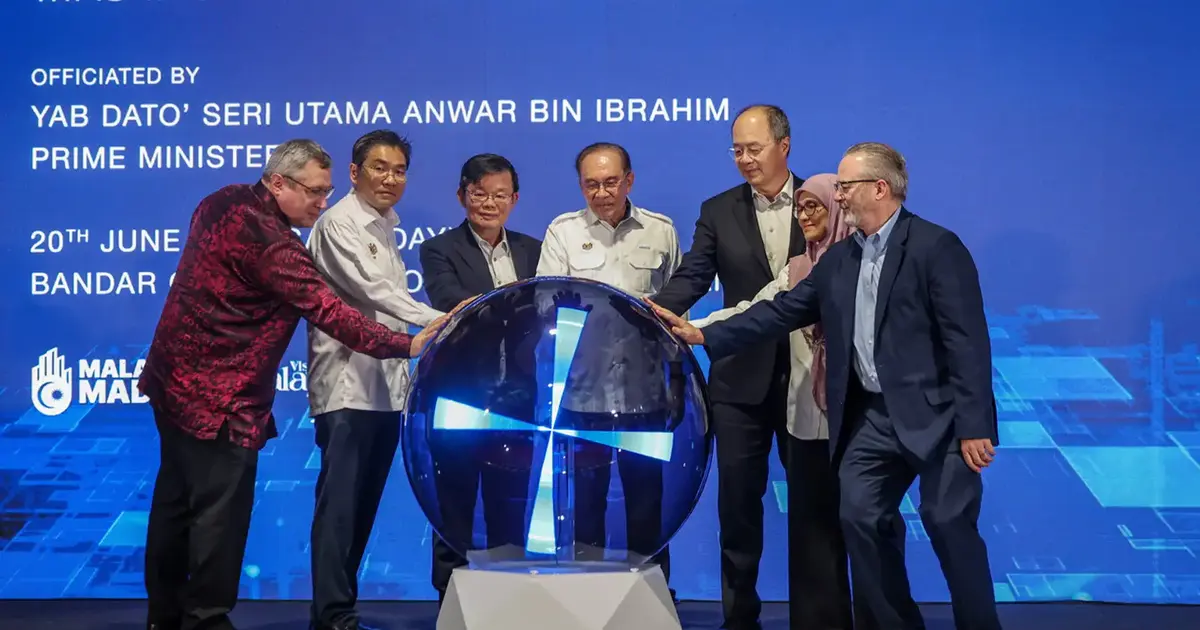
Prime Minister Anwar Ibrahim has moved to strengthen institutional links between Malaysia's higher education sector and its semiconductor manufacturing ecosystem by naming a dedicated adviser tasked with fostering closer collaboration. The appointment underscores the government's recognition that universities must play a more active role in supporting the nation's position as a key player in global semiconductor production and supply chains.
The timing of this initiative reflects growing momentum within Malaysian policy circles to position the country's academic institutions as innovation partners rather than merely training grounds for the industry. As geopolitical tensions reshape semiconductor manufacturing patterns worldwide, Malaysia—home to major facilities operated by Intel, Penang Skills Development Centre, and numerous contract manufacturers—stands to benefit significantly from embedding research capabilities and talent pipelines directly within university campuses.
Anwar emphasised that the arrangement entails no additional expenditure from the government budget, a critical consideration given Malaysia's fiscal constraints and competing policy priorities. This financial neutrality makes the initiative particularly attractive politically, as it allows the administration to claim proactive industrial policy without opening new spending lines that might complicate budget negotiations or require reallocation from other portfolios. The structure likely involves leveraging existing university administrative capacity or drawing upon industry funding to support the adviser's work.
The semiconductor sector represents one of Malaysia's most strategically important manufacturing pillars. The industry generates substantial foreign direct investment, provides employment across skill levels from assembly technicians to advanced engineers, and anchors Malaysia's position within regional and global technology value chains. Penang and the Klang Valley host concentrations of semiconductor facilities that collectively contribute billions of ringgit annually to the economy. Yet persistent skills gaps and the challenge of conducting world-class research within Malaysian universities have created friction points limiting deeper industry-academia integration.
Universities in Malaysia have historically struggled to maintain research relevance for industry partners, partly due to funding constraints, infrastructure limitations, and the often-theoretical orientation of academic programmes. The new adviser role appears designed to bridge this gap by identifying research priorities aligned with industry needs, facilitating connections between university laboratories and company technical teams, and potentially streamlining pathways for translating academic discoveries into commercial applications. Such intermediation can prove invaluable in spurring innovation clusters.
The appointment also signals recognition that Malaysia cannot compete solely on labour cost advantages in semiconductor manufacturing. As automation advances and geopolitical pressures push production towards developed nations, Malaysia must differentiate through higher-value activities including design, process innovation, and advanced testing. Universities equipped to conduct cutting-edge research in semiconductor materials, device physics, and manufacturing processes become competitive assets in this transition.
From a regional perspective, the move positions Malaysia within a broader scramble by Southeast Asian nations to capture semiconductor industry investment flowing away from China and Taiwan due to trade tensions. Vietnam, Thailand, and Indonesia have all pursued their own strategies to attract semiconductor facilities and build supporting ecosystems. Malaysia's advantage lies in existing manufacturing infrastructure, a relatively skilled workforce, and established relationships with multinational firms. Strengthening university partnerships enhances this advantage by reducing skills shortages and accelerating the adoption of new technologies.
Industry analysts have long identified the talent pipeline as a crucial bottleneck constraining semiconductor expansion in Malaysia. While the country produces engineering graduates, many lack specific expertise in semiconductor device fabrication, advanced packaging, or failure analysis—areas where manufacturers face persistent recruitment challenges. Closer university engagement offers potential to redirect academic curricula towards these practical needs, developing graduates immediately valuable to employers and reducing the retraining burden companies must shoulder.
The adviser will likely work across multiple stakeholder groups including the Ministry of Higher Education, the Ministry of Investment, Trade and Industry, individual universities with engineering or materials science expertise, and major semiconductor manufacturers. Coordination among these often-siloed institutions has historically proved difficult. Appointing a dedicated adviser with sufficient authority and access to decision-makers offers a mechanism to overcome bureaucratic fragmentation and accelerate decision-making around specific initiatives—whether establishing joint research centres, creating internship programmes, or developing new academic concentrations.
Looking ahead, the effectiveness of this appointment will depend substantially on the adviser's background, mandate clarity, and genuine commitment from industry partners to engage meaningfully with universities. Previous attempts to foster university-industry collaboration in Malaysia have sometimes foundered when industry partners treated engagement as a recruiting channel rather than genuine knowledge partnership, or when universities lacked capacity to conduct research at commercial-grade standards. The adviser's success will require navigating these pitfalls.
For Malaysian universities themselves, this initiative represents an opportunity to elevate their research impact and graduate employment outcomes simultaneously. Institutions that successfully align research programmes with semiconductor industry needs will attract both student interest and industrial funding, potentially breaking dependence on government budget allocations that have faced persistent pressures. This could begin a virtuous cycle where academic excellence in semiconductor-relevant fields attracts talent and funding, further strengthening Malaysia's position within global technology ecosystems.
The appointment also carries implicit messaging about the government's sectoral priorities. By elevating semiconductor industry-academia collaboration to the level of prime ministerial attention, Anwar signals that Malaysia views semiconductor manufacturing and design as strategic national assets meriting top-level coordination. This sends reassuring signals to multinational firms considering whether to deepen Malaysian operations, while also communicating to universities that technology innovation matters to government planning.

