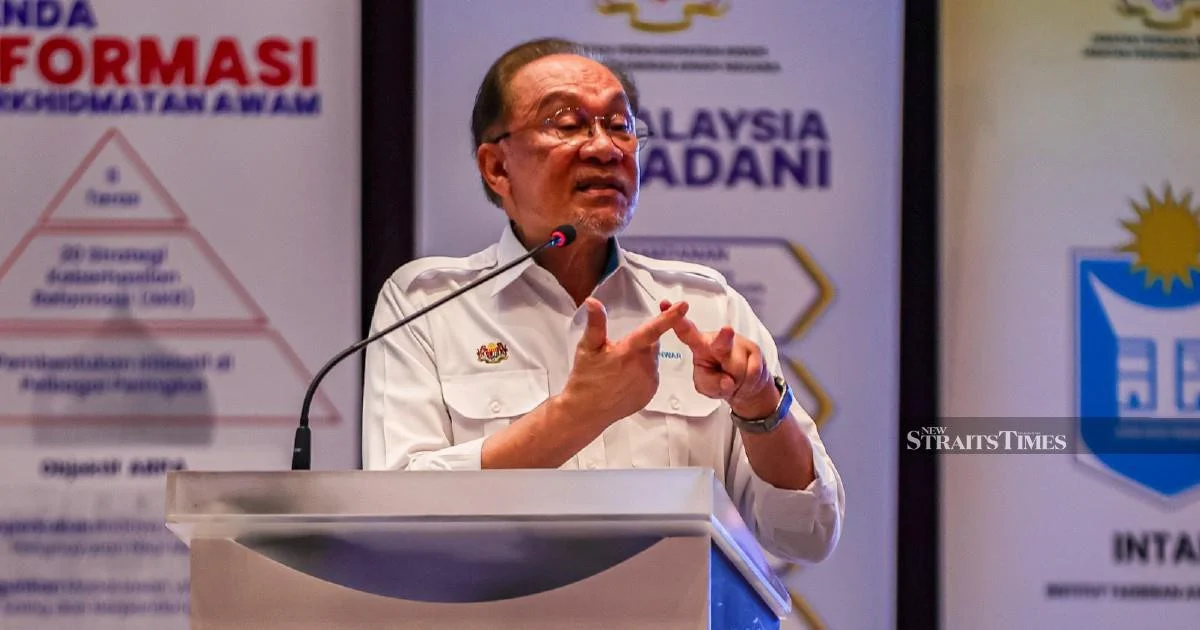
Prime Minister Datuk Seri Anwar Ibrahim moved swiftly to contain political tensions within the Pakatan Harapan coalition, asserting that Amanah president Datuk Seri Mohamad Sabu made no derogatory comments about coalition partners during remarks delivered at the ruling alliance's candidate announcement in Tangkak last Friday. Speaking in Alor Gajah, Anwar sought to downplay what had become a flashpoint of intra-coalition friction, characterising the episode as a misunderstanding rather than a calculated slight.
The incident underscores the delicate balancing act required to maintain cohesion among Pakatan Harapan's diverse membership. The coalition, which has governed since 2018 with interruptions and reforms, comprises ideologically distinct parties with sometimes competing interests and messaging strategies. Amanah, the Islamic-oriented social democrat party, occupies a middle position within the alliance, frequently serving as a bridge between the secular-leaning Democratic Action Party and the Muslim-centric elements within the coalition. When senior figures from one component party are perceived to criticise others, even obliquely, the resulting friction can ripple through the broader partnership.
Anwar's intervention suggests that coalition leadership viewed the controversy as potentially destabilising at a sensitive political moment. Malaysia's political landscape remains volatile, with the government holding a relatively slender parliamentary majority and facing constant pressure from the opposition Perikatan Nasional bloc, which commands substantial support across several states. Any visible discord within Pakatan Harapan risks undermining the unity message the coalition needs to project ahead of future electoral contests and by-elections.
The nature of Mohamad Sabu's original remarks remains somewhat ambiguous from public accounts, but the fact that they generated sufficient concern to warrant a public clarification from the Prime Minister himself indicates the sensitivity of intra-coalition communication. Such incidents often stem from rhetorical flourishes or colloquialisms that land differently depending on audience interpretation and the partisan lens through which they are viewed. In Malaysian politics, where coalitions are constructed from parties with distinct ethnic and religious constituencies, even mild jests can be magnified into accusations of bad faith.
Anwar's decision to defend Amanah rather than merely comment neutrally reflects the political importance of that party within the coalition structure. Amanah has positioned itself as a progressive Islamic voice, and its credibility with its core support base depends partly on demonstrating that it can operate effectively within a diverse alliance without compromising its identity. Conversely, the party's coalition partners need confidence that Amanah will not use its Islamic credentials as a platform to marginalise secular viewpoints or non-Muslim concerns.
The Tangkak event itself carried electoral significance, as candidate announcements represent key moments when the coalition seeks to project unity and competence to voters. The constituency and surrounding areas represent the type of competitive ground where Pakatan Harapan must maintain consistent messaging and avoid the appearance of internal conflict. Any sense of discord can be weaponised by opposition parties seeking to sow doubt about the coalition's capacity to govern coherently.
Matthew Sabu's profile as Amanah president adds another dimension to the controversy. Having previously served as Defence Minister and held various senior party positions, he carries substantial influence within the coalition. His public statements carry weight among party members and potentially signal broader coalition direction. This makes him a focal point for both supporters and critics seeking to interpret coalition intentions.
Prime ministerial intervention in such matters serves multiple purposes beyond the immediate clarification. It demonstrates leadership authority within the coalition, signals to aggrieved parties that Anwar is actively managing tensions, and provides political cover for all parties involved to move past the incident without loss of face. By framing the matter as a misunderstanding rather than a deliberate provocation, Anwar creates space for the controversy to dissipate naturally without requiring formal apologies or recriminations.
The broader context matters significantly for Malaysian observers. Coalition politics in Malaysia remain structurally fragile, dependent on personal relationships between party leaders and the willingness of component parties to subordinate sectional interests to collective strategic goals. The Pakatan Harapan arrangement, though it has produced the longest-serving prime minister in recent years through Anwar's ascension, continues to operate under significant strain from divergent ideological commitments and electoral incentives.
Moving forward, the incident illustrates how surface-level political disagreements can quickly escalate in Malaysia's polarised environment. The Prime Minister's calm intervention, however, provides a model for de-escalation that emphasises coalition unity over recrimination. Whether this approach proves sufficient to maintain Pakatan Harapan cohesion through upcoming electoral challenges remains a critical question for Malaysia's political trajectory.

