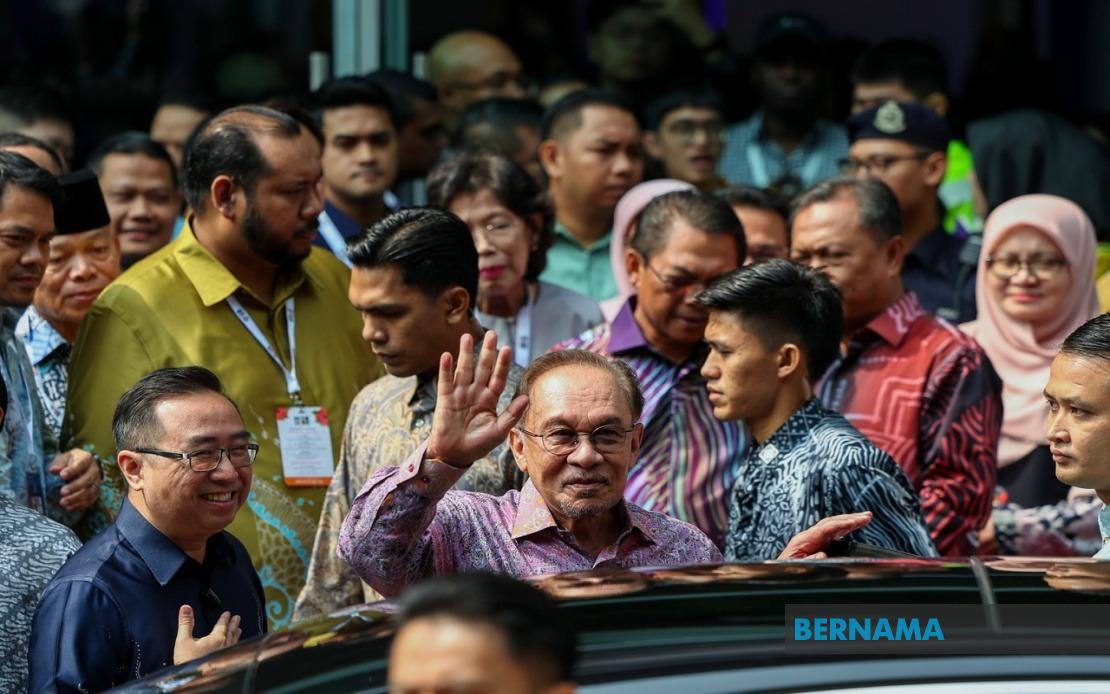
Prime Minister Anwar Ibrahim has publicly stated that he was not informed of efforts to invite former PKR deputy president Datuk Seri Mohamed Azmin Ali back into the party, casting doubt on claims that the party is actively recruiting its former members. Speaking at the launch of the National Innovation and Commercialisation Expo (NICE) 2026 at the Kuala Lumpur Convention Centre (KLCC), Anwar dismissed the notion with a terse response when questioned about the matter, suggesting either a communication breakdown within PKR's leadership structure or deliberate distance from any such outreach effort.
The timing of Anwar's denial is significant, as it emerged just days after Azmin, who now holds the position of secretary-general at Parti Pribumi Bersatu Malaysia (Bersatu), publicly stated that he would never return to PKR regardless of any invitations. Azmin's categorical rejection of rejoining his former party reflects the deepening political divisions within Malaysia's ruling coalition, where personalities and factional allegiances continue to shape party dynamics more visibly than programmatic differences. His move to Bersatu, where he occupies a senior position, underscores the competitive jockeying for influence among coalition partners as they position themselves ahead of potential political realignments.
The apparent disconnect between Anwar's disavowal and reports of PKR extending invitations to former members raises questions about internal communication and strategic coordination within the party. If invitations were indeed being issued to departed members, the fact that the party president claims ignorance suggests either that such outreach was conducted at a lower organizational level without his knowledge, or that Anwar is deliberately separating himself from recruitment efforts he may view as either futile or politically awkward. For a party where the president exercises considerable influence, this gap is noteworthy and may reflect broader questions about PKR's internal governance and decision-making processes.
Reports indicate that other former PKR figures are being approached to return to the fold. Datuk Kamarudin Jaffar, the former member of parliament for Bandar Tun Razak, and Datuk Mansor Othman, who previously represented Nibong Tebal, have been mentioned as potential candidates for party readmission. Separately, Datuk Dr Xavier Jayakumar, who served as PKR vice-president, has already confirmed his intention to rejoin the party, suggesting that at least some former members remain open to reconciliation with PKR leadership. These individual cases illustrate the complex web of relationships and negotiations that characterise Malaysian political parties, where defections and returns are often accompanied by negotiations over positions, policy influence, and resource allocation.
The recruitment of returning members carries significant implications for PKR's organizational strength and its standing within the ruling coalition. For a party that has experienced notable departures, particularly during periods of internal instability, bringing members back represents both a symbolic validation of leadership continuity and a practical effort to rebuild party machinery. Each returnee brings not only individual political capital but also their networks and influence within specific constituencies or demographic groups, making such moves strategically important for electoral preparation and internal balance.
Anwar's seeming reluctance to acknowledge or champion such recruitment efforts may reflect calculation about political messaging. Acknowledging active outreach to former members, particularly those who left under controversial circumstances or during periods of factional conflict, could be interpreted as a sign of weakness or instability within the party. By maintaining distance from such efforts, Anwar may be attempting to project an image of a party confident in its current direction rather than one desperately seeking to reclaim lost members. This narrative strategy is common in Malaysian politics, where public statements about party discipline and forward momentum carry weight among voters and coalition partners.
Azmin's decision to remain with Bersatu despite any overtures reflects the structural reality of Malaysian coalition politics, where individual ambitious politicians must weigh party loyalty against personal advancement. As Bersatu's secretary-general, Azmin occupies a prominent position within that party, and returning to PKR would mean surrendering such standing for uncertain advancement prospects. His public dismissal of PKR invitations also signals to Bersatu leadership that his commitment is firm, an important reassurance in a coalition where trust among partner parties remains conditional and contingent on demonstrated loyalty.
The broader context involves PKR's efforts to consolidate its position within the Pakatan Harapan coalition and maintain relevance in Malaysian politics. As one of the coalition's major components, PKR's ability to retain and attract talent directly affects its negotiating position with coalition partners and its electoral viability. The apparent focus on recruiting returning members suggests PKR leadership recognizes that the party needs to rebuild internal strength, particularly at the grassroots and state levels where party infrastructure remains critical for electoral success. This strategic imperative likely explains the outreach to figures like Kamarudin, Mansor, and Xavier, regardless of whether Anwar personally champions such efforts.
The incident also illuminates the sometimes opaque nature of Malaysian party politics, where formal organizational structures and actual decision-making processes do not always align clearly. Anwar's public denial of involvement in recruitment decisions that appear to be occurring suggests either surprising lapses in communication within PKR's hierarchy or a deliberate choice to maintain plausible deniability. For Malaysian observers, this ambiguity is familiar territory, reflecting how Malaysian political parties often operate through informal networks and personal relationships rather than transparent institutional mechanisms. Understanding such dynamics is essential for following the actual currents of Malaysian politics beneath the surface of official pronouncements.

