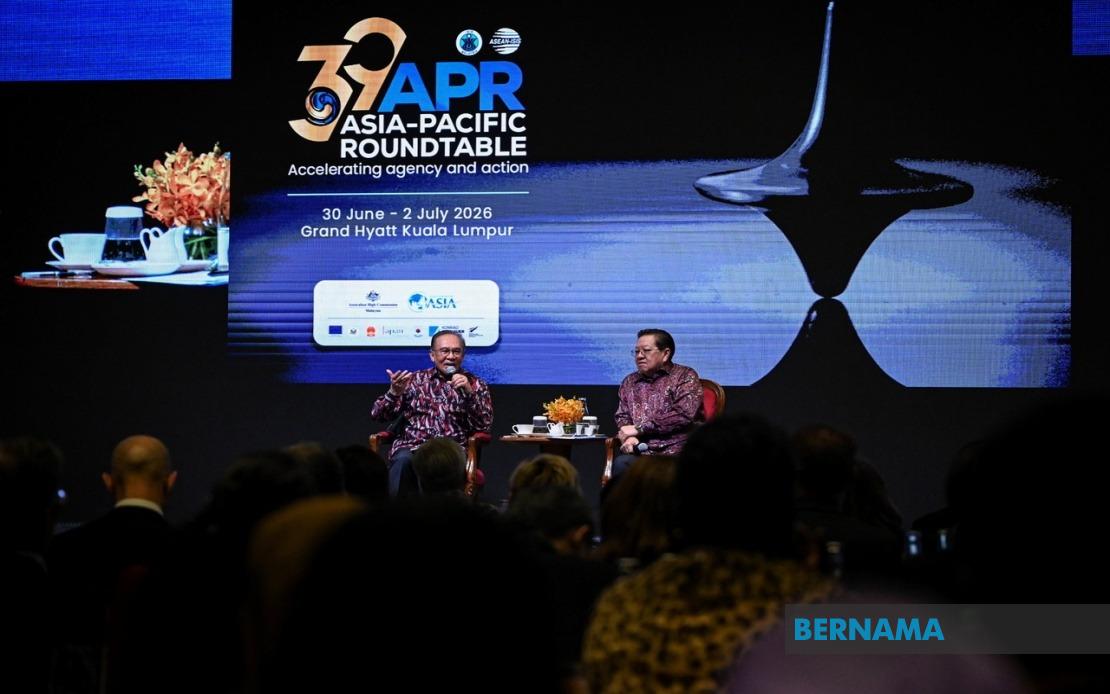
Malaysia's Prime Minister Datuk Seri Anwar Ibrahim has firmly rejected the prevailing pessimism surrounding the South China Sea, declaring at the 39th Asia-Pacific Roundtable in Kuala Lumpur that conflict is neither predetermined nor insurmountable through diplomatic channels. Rather than accepting the increasingly common portrayal of the strategically vital waterway as a flashpoint destined for confrontation, Anwar positioned dialogue, institutional trust and commitment to international legal frameworks as the authentic pathway toward preserving peace in one of the world's most economically consequential regions.
During the question-and-answer session, Anwar articulated Malaysia's distinctive experience within the complex maritime environment, emphasising that his government has consistently maintained substantive and constructive exchanges with China despite the existence of overlapping territorial claims. The Prime Minister deliberately distanced himself from what he termed a "phobia" about looming threats, instead highlighting the calibre of bilateral relations that Malaysia has cultivated with Beijing. He underscored that his personal interactions with President Xi Jinping and Premier Li Qiang have been characterised by excellent rapport and the absence of contentious issues that might precipitate escalation.
This measured positioning reflects Malaysia's broader geopolitical strategy of balancing engagement across major powers while avoiding the zero-sum framing that has increasingly defined discourse around great power competition in Asia. Rather than accepting the narrative that rising tensions are inevitable, Anwar's comments suggest Kuala Lumpur believes there remains sufficient space for constructive problem-solving and that the region need not resign itself to conflict. For Malaysian policymakers, maintaining this pragmatic stance is crucial given the country's significant maritime interests and its role as an ASEAN member.
Crucially, Anwar referenced Beijing's explicit endorsement of the United Nations Convention on the Law of the Sea, which provides the foundational legal framework for maritime conduct globally. He also highlighted China's continued participation in ongoing negotiations on the ASEAN-China Code of Conduct, a multilateral agreement designed to establish protocols that prevent disputes from escalating into armed confrontation. The Code of Conduct represents more than a decade of painstaking diplomatic work, and its eventual finalisation would institutionalise behavioural norms that all parties have committed to respecting.
The Prime Minister extended his critique of alarmist narratives to the broader regional discourse, cautioning against excessive focus on the prospect of warfare throughout Southeast Asia. He argued that such framing undermines the foundational principles upon which ASEAN has built its institutional architecture—principles centred on dialogue, engagement and the peaceful resolution of disputes. ASEAN's track record of maintaining peace over multiple decades, Anwar suggested, stems directly from the habit among member states' leaders of maintaining open communication channels and addressing disagreements before they metastasise into major crises.
This observation carries particular significance for Southeast Asian stability. Unlike other regional organisations or power dynamics elsewhere, ASEAN has institutionalised direct leader-to-leader engagement as a conflict prevention mechanism. The Association of Southeast Asian Nations' consensus-based decision-making and emphasis on non-interference in internal affairs, while sometimes criticised as inhibiting robust action, have paradoxically created sufficient diplomatic flexibility for members to cooperate despite fundamental differences. Anwar's remarks implicitly defend this model against criticisms from those who advocate more confrontational approaches.
Beyond the South China Sea, Anwar extended his emphasis on negotiation to other regional disputes, specifically addressing the Cambodia-Thailand border tensions. He welcomed both nations' demonstrated commitment to continuing talks aimed at resolving their boundary disagreements, a position that underscores Malaysia's preference for consistent application of diplomatic principles across multiple flashpoints. His observation that many border disputes across Southeast Asia represent historical legacies of the colonial era provides important context—these are not new tensions created by contemporary great power competition but rather century-old issues that successive governments have inherited.
The Prime Minister expressed confidence that sustained engagement and development of mutual confidence would eventually enable Cambodia and Thailand to achieve peaceful settlement. This optimism, though measured, reflects a conviction that time, persistent dialogue and incremental trust-building can overcome even longstanding territorial disagreements. For Malaysia, which itself has maritime boundaries with several neighbours including Thailand, Brunei and Indonesia, supporting regional frameworks that prioritise negotiation over confrontation serves national interests.
Anwar's advocacy for dialogue also extends to the architecture of global governance institutions. He indicated that Malaysia and ASEAN remain committed to pursuing reforms of multilateral organisations including the United Nations and the World Trade Organisation. This suggests that Kuala Lumpur views regional stability and global institutional reform as interconnected challenges requiring concurrent attention. A more representative and responsive international legal order, from Malaysia's perspective, would better support regional dispute resolution mechanisms.
The Prime Minister's remarks at the Asia-Pacific Roundtable reflect a strategic choice to project Malaysian leadership on the basis of pragmatism and institutional building rather than ideological confrontation. By rejecting conflict narratives whilst simultaneously affirming the importance of law-based order, Anwar positions Malaysia as a stabilising presence committed to evidence-based policymaking. This approach carries particular weight given Malaysia's geographic location in the heart of Southeast Asia and its stakes in preserving the rules-based maritime order upon which regional prosperity depends.
For investors, regional neighbours and major powers watching Malaysian policy, Anwar's statements provide reassurance that Kuala Lumpur will continue pursuing engagement over escalation. This consistency matters because it allows other actors to plan with greater confidence and reinforces the coalition of countries across ASEAN that favour negotiated outcomes. In an era when geopolitical discourse frequently defaults to predictions of conflict and competition, Malaysia's insistence that alternatives exist represents both a principled position and a practical commitment to shaping the region's trajectory.

