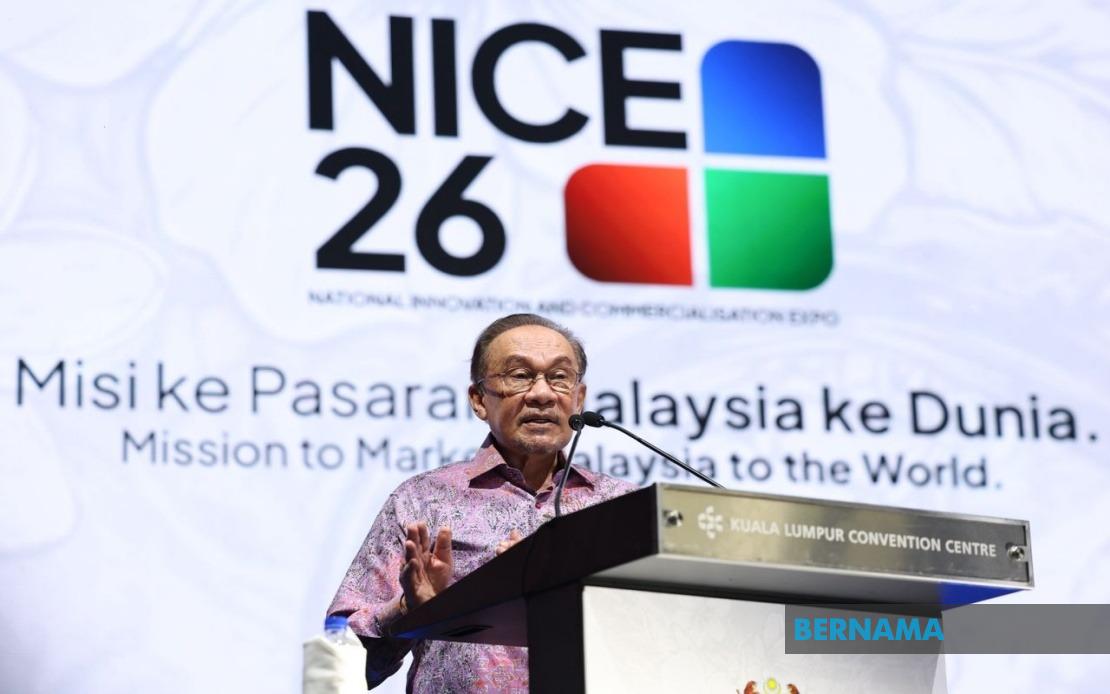
Prime Minister Datuk Seri Anwar Ibrahim has issued a forceful call to dismantle the layers of administrative red tape that continue to impede Malaysia's technological advancement and commercial innovation, arguing that the nation risks falling behind in a rapidly evolving global landscape if it persists with traditional approval mechanisms. Speaking at the National Innovation and Commercialisation Expo (NICE) 2026 at the Kuala Lumpur Convention Centre (KLCC), Anwar emphasised that the contemporary business environment demands agility and responsiveness rather than adherence to lengthy procedural protocols that were designed for a different era.
The Prime Minister underscored that the modern innovation ecosystem fundamentally operates according to different principles than those embedded in conventional institutional hierarchies. Commercialisation and technological development, he stressed, require organisations to embrace speed and flexibility as core operational values, moving away from the cumbersome committee approvals and multi-stage clearance procedures that characterise Malaysia's traditional bureaucratic framework. This shift represents not merely an administrative convenience but an existential requirement for nations seeking to establish themselves as credible players in technology sectors where first-mover advantage and rapid market entry often determine competitive positioning.
Anwar offered a concrete example demonstrating the potential gains from streamlined decision-making processes. The establishment of Artificial Intelligence faculties at multiple Malaysian universities exemplified this principle, with institutions successfully launching these programs within a three-month timeframe through expedited approval channels. Under the standard bureaucratic approach, comparable initiatives would typically require a full year to navigate the various institutional approval stages, including senate deliberations and university council reviews. This dramatic reduction in implementation timelines illustrates not merely a marginal efficiency improvement but a fundamental rethinking of how academic and research institutions can respond to emerging technological priorities.
The Prime Minister's critique implicitly challenges the governance structures of Malaysia's higher education sector, where layered approval processes often reflect historical institutional design rather than contemporary operational necessity. Senate meetings, council reviews, and departmental consultations, while potentially valuable for deliberation, have evolved into bottlenecks that delay the launch of programs addressing urgent skills gaps in high-demand fields. The AI faculty example suggests that streamlined procedures need not compromise academic quality or institutional integrity, but rather redirect administrative effort toward substantive program development rather than procedural compliance.
Anwar's remarks carry particular relevance for Malaysia's positioning within Southeast Asia's emerging technology landscape. Regional competitors including Singapore, Vietnam, and Indonesia have begun aggressive efforts to develop domestic capabilities in artificial intelligence, semiconductor manufacturing, and digital infrastructure. Malaysia's capacity to compete effectively in attracting international talent and investment increasingly hinges upon the speed with which universities and research institutions can launch relevant programs and commercialise research outputs. The continued reliance on approval processes designed for traditional disciplines creates a structural disadvantage that compounds over time as institutional momentum builds elsewhere in the region.
The Prime Minister specifically directed his exhortation toward leadership at the Ministry of Science, Technology and Innovation (MOSTI) and other relevant government departments, essentially calling upon these bodies to acknowledge and accept the reality that institutional practices require fundamental recalibration. His language suggested recognition that bureaucratic inertia often persists not from deliberate obstruction but from institutional habit and risk aversion, wherein administrators default to established procedures precisely because they represent known territory. Breaking this pattern demands explicit top-level endorsement permitting responsible innovation in approval methodologies, coupled with clear accountability frameworks that protect against genuine malfeasance while enabling operational flexibility.
The National Innovation and Commercialisation Expo serves as an appropriate forum for advancing this agenda, as such gatherings typically convene entrepreneurs, researchers, government officials, and institutional leaders who collectively shape Malaysia's innovation ecosystem. Anwar's intervention at this venue signals executive commitment to removing procedural obstacles, potentially providing political cover for institutional leaders exploring more flexible governance approaches. The public articulation of these principles by the Prime Minister creates both opportunity and expectation for meaningful change, establishing a baseline against which subsequent institutional performance can be measured.
Malaysia's trajectory in emerging technology sectors increasingly depends upon the ability to translate research capacity and educational infrastructure into commercially viable enterprises and products reaching global markets. Other nations have recognised that bureaucratic efficiency itself constitutes a form of competitive advantage, with streamlined approval processes forming part of their broader value proposition for attracting research investment and entrepreneurial talent. When establishing an AI faculty requires a year of administrative procedures whilst comparable institutions in neighbouring countries accomplish the same objective in months, the cumulative effect amounts to strategic disadvantage that becomes progressively more difficult to overcome.
The Prime Minister's intervention reflects growing recognition within Malaysia's political leadership that institutional modernisation cannot proceed through incremental adjustment alone, but requires explicit top-level pressure and permission for operational experimentation. The challenge ahead lies in translating these declarative commitments into sustained institutional change, particularly given the conservative incentives embedded within government bureaucracies and university systems. Success would require not merely one-time approvals for technology faculties but systematic reconsideration of how Malaysian institutions approach innovation, research commercialisation, and program development across multiple sectors and institutions.

