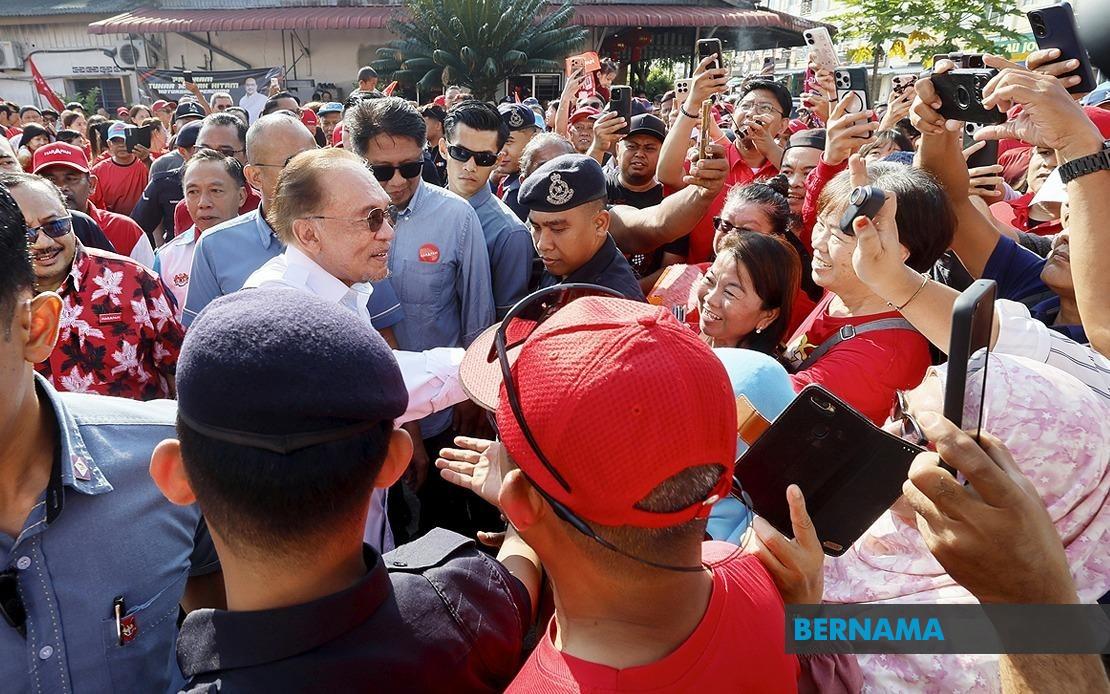
Prime Minister Datuk Seri Anwar Ibrahim has moved to counter persistent perceptions of political favouritism by asserting that his federal government distributes development resources and infrastructure investments equitably across all Malaysian states, irrespective of whether they are governed by parties aligned with Pakatan Harapan or opposition-controlled administrations. Speaking at a campaign event in Batu Pahat on July 9, Anwar underscored this commitment as a core principle guiding his administration's approach to governance and public service delivery, positioning it as a departure from what he characterised as selective assistance during election campaigns.
Anwar, who also serves as chairman of Pakatan Harapan, elaborated on his government's track record by pointing to substantive development initiatives spanning multiple states across the nation. He emphasised that since taking office, his administration has initiated and funded numerous infrastructure and development projects that transcend state boundaries and political divides. This assertion carries particular weight in Malaysian politics, where questions about resource allocation between federal and state governments—particularly those controlled by opposition parties—have long been a source of tension and public debate. The Prime Minister's remarks therefore represent an attempt to address and neutralise one of the more enduring criticisms levelled at ruling coalitions in Malaysia.
To substantiate his claims, Anwar provided specific examples of major federal investments, beginning with the Johor-Singapore Special Economic Zone (JS-SEZ), a flagship regional development project designed to enhance economic integration and competitiveness within the southern corridor of Peninsular Malaysia. This project exemplifies the type of large-scale infrastructure initiative that requires sustained federal commitment and substantial capital deployment. Beyond this signature project, he also highlighted federal support for flood mitigation and management infrastructure, noting that his government has channelled billions of ringgit into flood prevention and control projects in Segamat and Muar—both constituencies within Johor. These investments address critical environmental and public safety concerns that transcend partisan political considerations.
The Johor-Singapore Special Economic Zone represents a particularly significant initiative for the region, as it seeks to leverage geographical proximity to Singapore and facilitate cross-border economic cooperation. Such projects typically involve coordinated federal-level planning, substantial budgetary allocations, and long-term strategic commitment. For Malaysian readers and policymakers, the successful development of this zone could have considerable implications for employment generation, investment flows, and regional GDP growth. The zone's development also reflects broader federal strategy to position Malaysia as a competitive hub within Southeast Asian economic networks, a consideration that extends beyond immediate state-level political considerations.
Anwar's emphasis on addressing flood mitigation in specific constituencies is particularly resonant given Malaysia's recurring challenges with seasonal flooding that affect hundreds of thousands of residents annually. Investment in flood control infrastructure represents a tangible form of governance that directly impacts public welfare and property protection. The allocation of federal resources to these projects in Johor—regardless of the state government's political alignment—demonstrates how infrastructure spending intersects with the federal government's basic obligation to protect citizens from natural disasters. This framing allows Anwar to position resource allocation as a matter of public necessity rather than political distribution.
The Prime Minister's remarks were delivered during a campaign event for the 16th Johor state election, a context that inevitably imbues his statements with electoral significance. Campaign trails typically provide platforms for political leaders to address voter concerns and articulate their government's accomplishments and policy direction. In this instance, the setting in Senggarang offered Anwar an opportunity to communicate directly with voters while simultaneously attempting to establish a record of equitable federal governance. The presence of Communications Minister Datuk Fahmi Fadzil alongside Pakatan Harapan's state and local candidates reinforced the coalition's unified messaging around federal-state cooperation and inclusive development.
The question of fair resource distribution between federal and state governments has assumed particular importance in Malaysian politics given the country's system of multi-level governance and the existence of multiple states controlled by different political coalitions. Opposition-controlled states have historically raised concerns about receiving proportionally lower allocations from federal budgets or facing bureaucratic obstacles in accessing federal development funds. These grievances, whether substantiated or perceived, have contributed to broader narratives about political discrimination and unequal treatment. By proactively addressing this issue, Anwar appears to be attempting to establish a counter-narrative based on meritocratic and need-based resource allocation rather than partisan considerations.
The inclusion of Kelantan and Kedah in Anwar's enumeration of states receiving federal development support is strategically significant, as both states are controlled by parties outside the Pakatan Harapan coalition—Kelantan by PAS and Kedah by Perikatan Nasional. By explicitly referencing development initiatives in these opposition-controlled states, Anwar sought to demonstrate tangible evidence of his commitment to equitable treatment. This rhetorical strategy attempts to insulate his administration against charges of partisan favouritism by providing concrete examples of federal investment in states where his coalition does not exercise electoral control.
For Malaysian readers concerned with governance quality and institutional fairness, Anwar's statements raise questions about verification and transparency in federal resource allocation. While the Prime Minister's assertions appear categorical, the actual mechanisms by which federal development funds are distributed, the criteria employed in project selection, and the comparative levels of investment across states governed by different political parties remain matters requiring detailed scrutiny. Independent analysis of federal budget allocations and infrastructure spending patterns would be necessary to substantively validate claims about equitable treatment across all states.
The broader implications of this debate extend to questions about institutional integrity and the separation between electoral politics and administrative governance in Malaysia. If federal agencies and development bodies are perceived to make allocation decisions based on political considerations rather than objective criteria related to need, capacity, or strategic importance, this undermines public confidence in state institutions. Conversely, if federal resources are genuinely allocated according to transparent, merit-based criteria, this supports the development of more impartial and professional governance systems. Anwar's emphasis on this principle, whether or not accompanied by corresponding institutional reforms and transparent allocation mechanisms, signals recognition of this concern's importance to Malaysian voters and civil society.
Moving forward, the credibility of claims about equitable federal treatment will depend on sustained policy implementation and verifiable outcomes across multiple state jurisdictions. Infrastructure projects take years to complete, and their benefits accrue gradually over extended periods. The actual distribution of federal resources, employment creation in different regions, and infrastructure quality metrics will provide empirical measures against which such assertions can be evaluated. For observers across Southeast Asia, Malaysia's approach to balancing federalism with partisan politics offers insights into how multi-level governance systems navigate the tension between political competition and administrative fairness.

