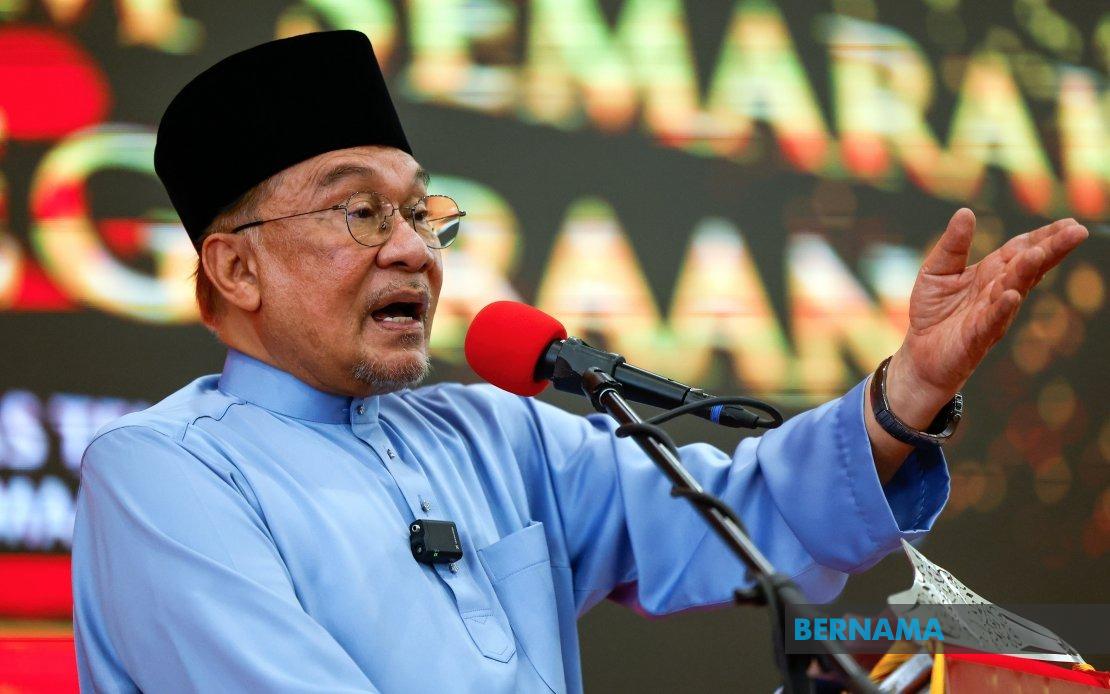
Prime Minister Datuk Seri Anwar Ibrahim is maintaining an aggressive campaign schedule in Negeri Sembilan as Pakatan Harapan enters the final stretch before the state election on Saturday. The comprehensive itinerary underscores the coalition's determination to consolidate support across key constituencies during what political analysts view as a critical juncture in the campaign cycle, with less than 48 hours remaining before voters cast their ballots.
The Prime Minister's Thursday schedule demonstrates the strategic focus on community engagement across diverse demographics and urban-rural divides. His day commences with an afternoon community tea gathering in the Chennah constituency within Jelebu district, an area that has historically shown mixed electoral preferences. This grassroots approach reflects PH's broader strategy of building personal connections with voters beyond traditional town hall meetings, allowing constituents direct access to the party's highest-ranking leader.
Following the Jelebu engagement, Anwar will participate in a Temu Anwar programme at the Islamic Dakwah Centre Hall in Paroi, a venue selection that signals the coalition's efforts to strengthen ties with Muslim-majority communities and religious organisations. This particular programme appears designed to address concerns within constituencies with significant Islamic advocacy networks, positioning PH as attentive to spiritual and community values alongside secular governance priorities.
The evening component of Anwar's schedule includes a formal dinner with the Indian community at Klana Resort, highlighting PH's targeted approach to specific ethnic voting blocs. This engagement carries particular significance given Indian Malaysian communities' historical role as swing voters in determining electoral outcomes across peninsular Malaysia. The resort setting suggests a formal networking environment intended to address business and professional concerns within this demographic.
The campaign day culminates with two major rallies scheduled for late evening, reflecting the traditional Malaysian political culture of nighttime campaigning when working professionals and families are available. The first rally takes place at Betaria Business Centre in Seremban at 9 pm, positioning the capital of Negeri Sembilan as a key battleground for PH's statewide ambitions. A subsequent rally follows at Desa Cempaka Night Market in Nilai at 10.30 pm, extending the campaign message into suburban areas that have undergone rapid residential expansion in recent years.
The calibre of leadership attending these events amplifies their political significance. Alongside Anwar, Negeri Sembilan Menteri Besar Datuk Seri Aminuddin Harun will campaign as PH's candidate for the Linggi seat, effectively staking the incumbent chief minister's political future on coalition performance. DAP secretary-general Anthony Loke Siew Fook, who is contesting the Chennah seat, brings organisational depth from the Democratic Action Party's machinery. This convergence of senior figures demonstrates PH's assessment that the Negeri Sembilan contest requires intervention at the highest levels.
Additional party luminaries scheduled to participate include Amanah president Datuk Seri Mohamad Sabu, PKR vice-president Datuk Seri Amirudin Shari, and communications officials Datuk Seri Fahmi Fadzil. The presence of multiple coalition party presidents and vice-presidents indicates the seriousness with which PH regards this electoral contest, particularly given recent political volatility affecting coalition stability in other states.
The 16th Negeri Sembilan state election represents a comprehensive test of PH's electoral viability and internal cohesion. The coalition is fielding candidates across all 36 state seats, with PKR contributing 16 nominees, DAP providing 11, and Amanah fielding nine. This distribution reflects negotiated agreements within the coalition regarding seat allocation, though such arrangements occasionally generate intra-coalition tensions. The broad contest coverage signals PH's ambition to achieve decisive control of the state assembly rather than merely defending existing positions.
The competitive environment remains fluid, with a total of 103 candidates contesting the 36 seats, indicating that independent candidates and opposition parties maintain meaningful presence. The total registered electorate of 867,151 ordinary voters represents a substantial constituency that will determine whether PH retains its current dominance or whether voters opt for alternative governance arrangements. Negeri Sembilan's status as a relatively small state makes it politically significant as a potential bellwether for broader peninsular electoral trends.
Campaigning concludes at 11.59 pm on Friday, creating a compressed final day for last-minute mobilisation efforts. The intensity of Anwar's schedule in these final hours reflects campaign strategists' belief that momentum and voter turnout management remain decisive factors. The nighttime rally strategy appeals to working-class and service-sector voters who constitute substantial portions of Negeri Sembilan's electorate, particularly in Seremban and Nilai. This tactical approach acknowledges demographic realities that differentiate state-level contests from federal elections, requiring customised engagement strategies.
The campaign's timing and messaging reveal PH's broader positioning challenges in maintaining coalition unity while appealing to diverse voter interests. By deploying the Prime Minister himself, the coalition emphasises executive competence and federal-level governance performance as selling points for state-level contests. Whether this top-down approach translates into ballot box support remains the central question facing PH strategists as voters prepare to exercise their democratic choices on Saturday.

