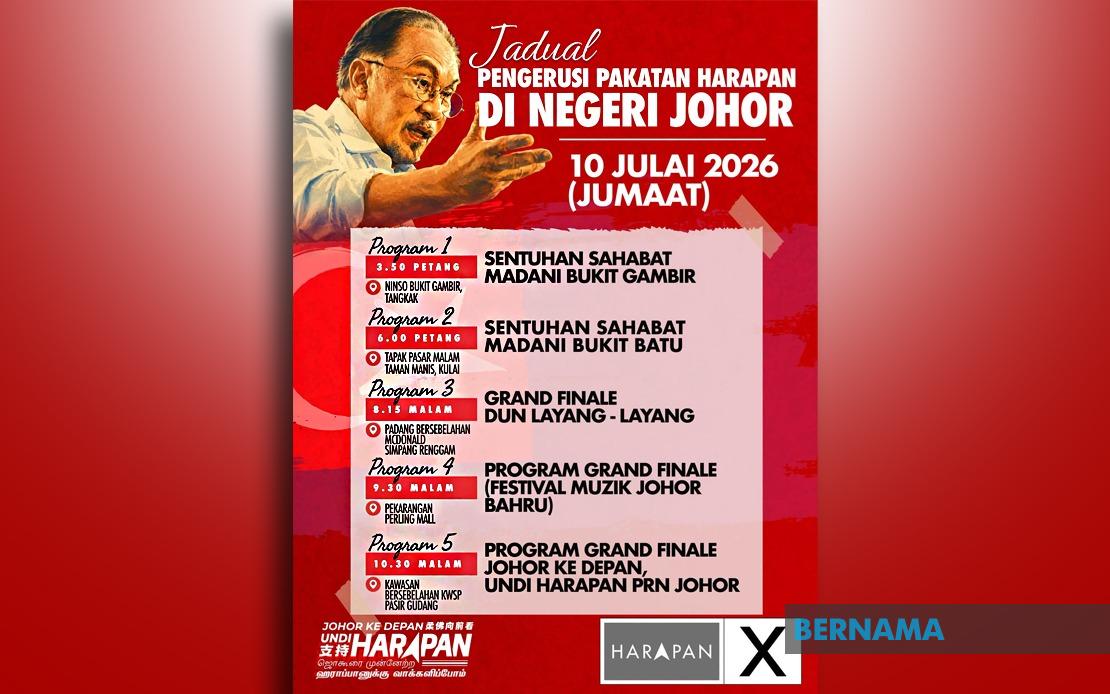
Prime Minister Datuk Seri Anwar Ibrahim is set to execute an aggressive final campaign drive across Johor tomorrow, visiting five strategic locations to mobilize support for Pakatan Harapan candidates ahead of the 16th Johor State Election. The whirlwind tour represents the coalition's last major push to secure victory in a state that remains politically competitive, with Anwar himself taking to the ground to energize voters in the closing hours before the electoral period officially ends.
Anwar's itinerary spans the entire evening, beginning with a "Sentuhan Sahabat MADANI" community engagement programme in Bukit Gambir, Tangkak scheduled for 3:50 pm. This opening stop signals the coalition's emphasis on grassroots connection, suggesting a strategy that combines high-profile leadership presence with direct voter interaction. The programme name itself, evoking the MADANI framework that has become central to the government's messaging, underscores how the administration is attempting to frame the election around broader developmental narratives rather than purely local concerns.
Following Bukit Gambir, Anwar will proceed to Bukit Batu in Kulai at approximately 6:00 pm, continuing his traversal of the state's more populated urban and semi-urban centres. The sequential scheduling across multiple DUN constituencies within a single evening reveals a deliberate concentration on areas where Pakatan Harapan believes it can secure pivotal gains or defend vulnerable seats. For Malaysian observers, this intensity of presidential-level engagement indicates perceived vulnerability in what was traditionally a Barisan Nasional stronghold, suggesting the ruling coalition cannot afford complacency in Johor.
The campaign reaches its crescendo in the final hours, with Anwar scheduled to attend the DUN Layang-Layang "Grand Finale" programme in Simpang Renggam at 8:15 pm. This event, explicitly branded as a finale, signals a coordinated messaging strategy designed to convey momentum and inevitability. The deliberate timing in the evening hours, when more working Johoreans return home, maximizes potential attendance. Following this, Anwar will appear at the Johor Bahru Music Festival at Perling Mall at 9:30 pm, a striking choice that blends entertainment with politics—a tactic increasingly common in Southeast Asian campaigns seeking to engage younger, more digitally-connected demographics.
The campaign concludes with the "Johor Ke Depan, Undi Harapan PRN Johor" (Johor Forward, Vote Harapan for Johor State Election) Grand Finale Programme in Pasir Gudang at 10:30 pm, pushing campaigning activity into the late evening hours. This extended schedule, running effectively from mid-afternoon into the night, exemplifies the high-octane approach that campaign strategists believe is necessary to sustain voter enthusiasm in the final critical hours. The naming convention across these events—repeatedly employing the term "Grand Finale"—reinforces a narrative of conclusive momentum that the coalition wishes voters to internalize.
Anwar's personal commitment to this exhausting schedule carries symbolic weight beyond mere logistics. The Prime Minister's hands-on participation, rather than delegating the final push to subordinates, communicates that Pakatan Harapan views the Johor election as sufficiently significant to warrant his direct involvement. In Malaysian politics, where personality and leader visibility significantly influence voter perception, such presence can sway undecided voters who interpret it as an indication of either confidence or, conversely, last-minute concerns about electoral prospects.
The campaigning period, which commenced on nomination day on June 27, will formally conclude at 11:59 pm tomorrow, meaning these final events will occur literally in the closing moments before the ban on campaign activities takes effect. This timing is deliberately calculated—campaigns often schedule their most energetic, emotionally resonant events to conclude right as the legal window closes, ensuring the final voter impressions occur when political activity is at maximum intensity and media coverage remains elevated.
Saturday's election will determine representation for 56 state assembly seats, with approximately 2.7 million registered voters eligible to participate. These figures underscore the substantial electorate at stake; Johor's population and political weight make it a barometer for broader national political trajectories. A strong Pakatan Harapan performance would validate the government's positioning and potentially influence upcoming national political calculations, while a disappointing result could embolden opposition forces and complicate the ruling coalition's agenda.
For Malaysian observers and regional analysts monitoring Southeast Asian democratic health, state elections like Johor's provide crucial data points about electoral competitiveness and voter sentiment between general elections. The intensity of Anwar's final campaign push suggests internal coalition assessments indicate a race closer than public statements might acknowledge. The decision to concentrate resources and leadership presence so heavily in final hours implies confidence in late-campaign momentum-building—or alternatively, concern that traditional voting patterns require reinforcement through elevated presidential attention.
The multimodal campaign approach—combining traditional political rallies with contemporary entertainment formats like music festivals—reflects how Malaysian campaigns have evolved to meet changing voter preferences and media consumption habits. Younger voters increasingly demand campaigns that integrate into their lifestyle rather than interrupt it, and the Perling Mall music festival directly addresses this demographic consideration. This fusion of politics and popular culture has become standard practice globally, though its application varies significantly across Malaysian constituencies depending on demographic composition.
For the broader Southeast Asian context, Johor's election holds implications beyond state-level politics. As the region's largest trading nation and a significant economic engine, Johor's political stability and governance direction influence investor confidence and regional integration efforts. A clear electoral result providing a strong mandate would facilitate policy implementation, whereas a closely divided state assembly could create implementation challenges. The Pakatan Harapan coalition's performance here will thus reverberate through regional economic and political calculations.
With the campaigning period about to conclude and voting scheduled for Saturday, the electorate faces final decision-making moments. Anwar's intensive itinerary represents the coalition's comprehensive effort to ensure every persuadable voter receives direct exposure to its political messaging in these concluding hours. Whether this final push proves decisive will become apparent once voting concludes and results are tallied, providing another significant data point in Malaysia's ongoing political evolution.

