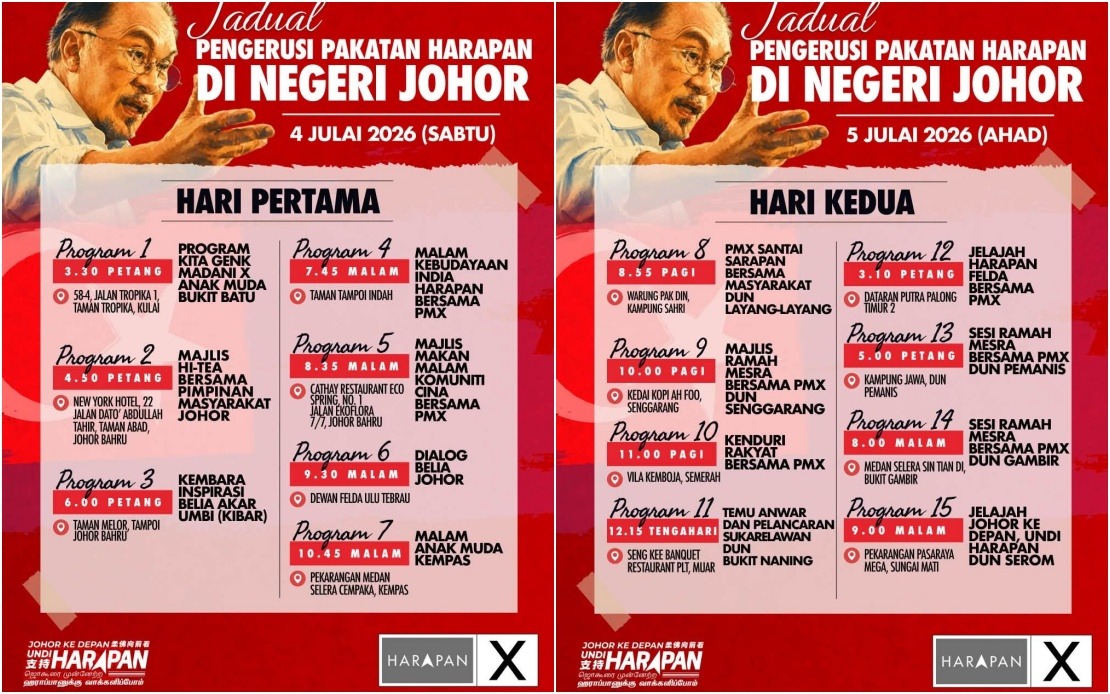
Pakatan Harapan (PH) chairman Datuk Seri Anwar Ibrahim is mounting a comprehensive ground operation in Johor this weekend, with the party leader scheduled to participate in 15 separate campaign events aimed at energising support among voters before the 16th Johor state election on July 11. The ambitious itinerary reflects PH's determination to consolidate its position in the economically significant southern state, where 56 party-backed candidates will contest across the constituencies. Anwar issued a public call through social media for all eligible voters in the state to join these weekend activities, signalling PH's strategy to broaden grassroots engagement beyond traditional party machinery.
The campaign schedule underscores how Malaysian political parties now deploy their senior leaders across multiple community-focused events compressed into tight timeframes, seeking to maximise visibility and connect with diverse demographic segments. Anwar's Saturday itinerary commences at 3.30 pm with the Kita Genk MADANI x Anak Muda Bukit Batu programme in Kulai, targeting younger voters through youth-focused initiatives. The spacing between consecutive events—typically one to two hours apart—suggests PH has choreographed the weekend to reach different constituencies and communities sequentially, beginning with afternoon youth engagement before transitioning to evening cultural and community-based gatherings.
The evening portion of Saturday's schedule reveals the diversity of voter outreach strategies employed during contemporary Malaysian electoral campaigns. Anwar will participate in a high-tea gathering with Johor community leaders at 4.50 pm, followed by the Kembara Inspirasi Belia Akar Umbi youth programme in Tampoi at 6 pm. This is succeeded by the Harapan Indian Cultural Night and a Chinese Community Dinner, both scheduled within a ninety-minute window. The deliberate inclusion of culturally specific dining events demonstrates how parties now explicitly segment campaign activities along ethnic and community lines, recognising Malaysia's multicultural electorate and the importance of targeted messaging to different constituencies. These events typically combine social entertainment with political messaging, allowing Anwar to address community concerns whilst participating in culturally significant occasions.
The late-night programming reflects campaign intensity during state election periods in Malaysia, where multiple events often extend past conventional working hours. Following the community dinners, Anwar is scheduled to address the Johor Youth Dialogue at Dewan Felda Ulu Tebrau at 9.30 pm, before concluding his Saturday engagements with the Anak Muda Kempas Night in Kempas at 10.45 pm. This back-to-back scheduling of youth-oriented and constituency-specific events suggests PH views younger voters as a key demographic whilst maintaining traditional grassroots connections in established political strongholds and outlying areas alike. The intensity of the timetable also raises practical questions about campaign fatigue and the sustainability of such compressed schedules for senior political figures.
Sunday's programme maintains similar momentum, beginning with an early-morning breakfast engagement with Layang-Layang constituents at 8.55 am. This is followed by a Meet-and-Greet at Dewan Undangan Negeri Senggarang in Senggarang at 10 am, succeeded by the Kenduri Rakyat Bersama PMX community feast at Semerah by 11 am. The deliberate use of traditional Malaysian dining events—breakfasts and kenduri rakyat—reflects how campaign organisers leverage familiar social practices to create accessible entry points for voter engagement. These intimate gatherings allow political leaders to discuss local issues directly with constituents in informal settings, potentially proving more effective than formal rally addresses.
The afternoon and evening segments of Sunday sustain the campaign's comprehensive coverage strategy. Anwar will launch the Bukit Naning Volunteers initiative at 12.15 pm before participating in a Jelajah Harapan Felda engagement at Dataran Putra Palong Timur 2. Additional meeting sessions are scheduled at Pemanis and Gambir constituencies, constituencies that may represent either competitive battlegrounds or areas where PH seeks to consolidate existing support. The weekend concludes with the Jelajah Johor Ke Depan, Undi Harapan DUN Serom programme at Sungai Mati at 9 pm, suggesting an extended campaign day spanning thirteen hours from breakfast to final evening engagement. This marathon approach reflects modern Malaysian electoral strategy where senior party figures attempt to achieve maximal geographical and demographic coverage within compressed timeframes.
Johor represents a strategically vital state for PH's national political positioning. As Malaysia's second-largest state by population and a significant economic contributor, electoral performance in Johor significantly influences national political narratives and party momentum heading into any future general elections. The state's historically competitive political landscape, with multiple strong alternative coalitions contesting, intensifies the importance of high-level campaign engagement. Anwar's personal weekend deployment suggests PH leadership views the state contest as sufficiently competitive to warrant concentrated senior-level attention rather than routine distributional campaigning.
The campaign scheduling also reflects evolving voter engagement patterns in Malaysian elections, particularly the blending of cultural, economic, and social programming into political events. Rather than relying solely on formal campaign rallies, contemporary electoral operations increasingly embed political messaging within community celebrations, dining events, and volunteer initiatives. This approach aims to reach voters in relaxed social settings where political considerations may be secondary to immediate community experiences, potentially improving message retention and voter receptivity. The pattern evident in Anwar's weekend timetable exemplifies how Malaysian political parties now attempt to make campaign participation feel like community participation rather than formal political activity.
The choice of venues and constituencies across Johor's diverse landscape indicates PH's recognition of the state's geographic and demographic complexity. Events spanning from Kulai to Senggarang to Semerah represent strategic distribution across different regions, constituencies, and voter bases. The inclusion of Federal Land Development Authority (FELDA) settlement engagements and volunteer initiatives in areas like Bukit Naning suggests particular attention to rural and semi-rural constituencies where traditional community structures remain influential in electoral decision-making. This targeted geographic strategy reflects sophisticated campaign planning aimed at addressing specific constituency dynamics rather than generic state-wide messaging.
Voting in the 16th Johor state election is scheduled for July 11, with early voting permitted on July 7, providing a narrow campaign window during which Anwar's intensive weekend activities represent a critical mobilisation effort. The compression of campaign activities into a single weekend, concentrated in a single state, demonstrates how Malaysian political campaigns utilise intense bursts of senior leader visibility to generate momentum in final campaign stages. Early voting provisions, available four days before the main polling date, may capture a significant portion of the electorate, making pre-election weekend engagements particularly strategically valuable. The timing of Anwar's campaign swing—immediately before early voting commences—positions these events to influence both early and election-day voter decisions.
The breadth of PH's campaign infrastructure, coordinating fifteen distinct events across a single weekend whilst maintaining distinct programmatic themes and venue changes, reflects substantial organisational capacity and resources. Such operational complexity requires extensive ground preparation, logistical coordination, security arrangements, and local committee mobilisation. The ability to execute such campaigns successfully often correlates with party health and organisational vitality, suggesting PH possesses effective state-level machinery in Johor despite the competitive political environment. However, the sustainability and effectiveness of such compressed, high-intensity campaigns remain debated among political analysts, with some questioning whether rapid venue transitions allow meaningful voter engagement versus merely generating attendance statistics.
The explicit mention of PH's 56 candidates provides context for understanding the campaign's scope and scale. Distributing fifteen events across 56 candidates represents roughly one event per 3.7 candidates, though some events may have multiple candidate appearances. This ratio suggests the campaign combines large public rallies featuring Anwar alongside smaller, constituency-specific engagements, optimising senior leader time allocation. The integration of various candidate participation levels—from Anwar's visible presence to support from other party leaders referenced obliquely in event names—reflects typical Malaysian campaign structures where senior figures provide momentum-generation and credibility whilst allowing lower-profile candidates additional visibility through local-level events.
For Malaysian voters and regional observers, the intensity and composition of Anwar's campaign weekend illuminates contemporary electoral dynamics in competitive state contests. The approach combines cultural specificity, community integration, youth engagement, and targeted geographic coverage within a professionally orchestrated schedule, representing best practices in modern Malaysian political campaigning. Whether such efforts successfully translate voter engagement into electoral support will become apparent following the July 11 polling, providing empirical evidence regarding the effectiveness of concentrated, senior-leader-focused campaign strategies in contemporary Malaysian electoral conditions.

