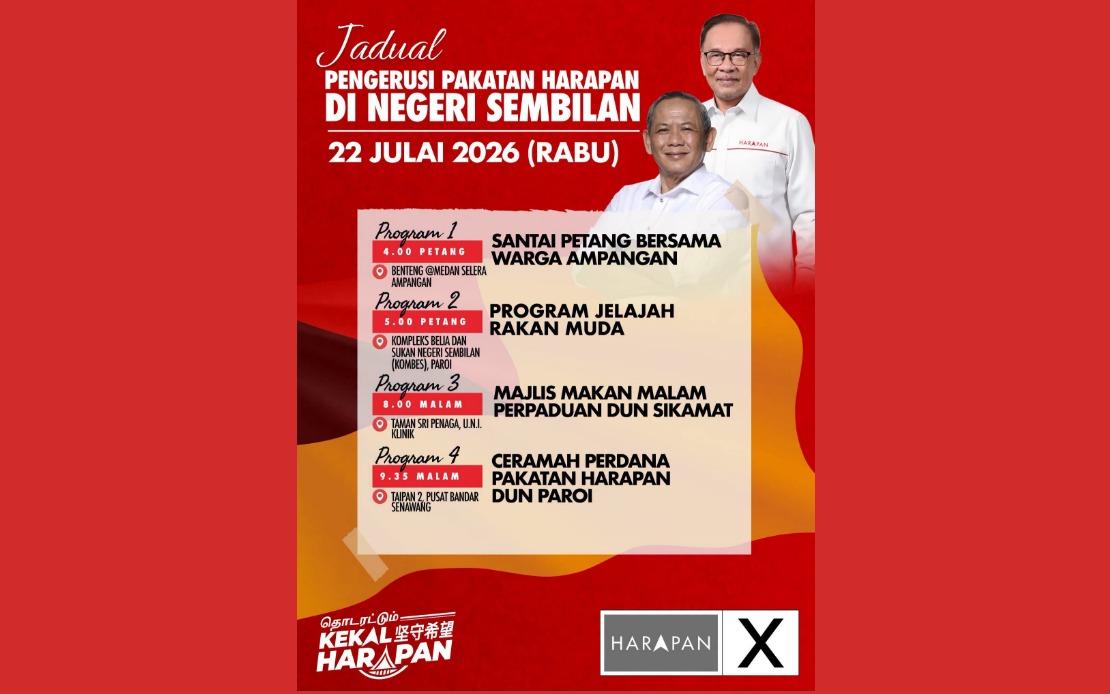
Prime Minister Datuk Seri Anwar Ibrahim took centre stage in Negeri Sembilan's electoral contest on July 22, embarking on a series of campaign engagements designed to energise Pakatan Harapan's push to retain control of the state government. The PKR president and PH coalition chairman's intervention on the fifth day of the campaign signals the coalition's determination to maintain its hold on the state administration, currently helmed by Chief Minister Datuk Seri Aminuddin Harun.
Anwar's campaign itinerary reflected a strategic effort to reach multiple voter constituencies across different demographics and localities. Beginning at 4 pm, he was scheduled to commence proceedings at Benteng @ Medan Selera Ampangan with an engagement programme titled 'Santai Petang Bersama Warga Ampangan', designed to foster direct dialogue with residents in the Ampangan area. This grassroots engagement approach forms a critical component of modern Malaysian electoral strategy, allowing senior politicians to demonstrate accessibility and responsiveness to local concerns.
The prime minister's schedule subsequently took him to the Negeri Sembilan Youth and Sports Complex in Paroi at 5 pm, where he participated in the 'Jelajah Rakan Muda' programme. This particular initiative underscores PH's focus on securing younger voter support, a demographic cohort that has proven increasingly influential in determining electoral outcomes across Malaysia in recent polling cycles. Youth engagement has become particularly crucial for coalition parties seeking to consolidate their base while attracting swing voters concerned with economic opportunities and social policy.
Evening activities included a unity dinner in the Sikamat constituency and a major coalition rally at Pusat Bandar Senawang in Paroi, where Anwar addressed a PH mega ceramah gathering. These larger public forums allow the coalition to present its unified message to concentrated audiences while generating media coverage that extends the campaign's reach beyond those physically present. Such events serve as crucial momentum-building exercises in the weeks preceding polling day.
The 16th Negeri Sembilan state election sees PH contesting all 36 state seats with a carefully balanced slate of candidates distributed across the three coalition partners. PKR fields 16 candidates, DAP contributes 11, and Amanah supplies nine representatives across the state's constituencies. This allocation reflects the coalition's attempt to balance intra-coalition power dynamics whilst presenting a unified front to voters in a state where the composition of the government represents a significant political prize.
PH's electoral strategy centres on the manifesto unveiled on Monday, which contains ten primary commitments targeting state development and social inclusion. These pledges address themes likely to resonate with Negeri Sembilan's diverse electorate, spanning economic development concerns, governance improvements, and community welfare initiatives. Anwar's personal presence amplifies these policy announcements, leveraging his position as national leader to underscore the coalition's serious intent regarding state-level governance.
Negeri Sembilan holds particular significance within Malaysia's broader political landscape. The state has historically demonstrated electoral dynamism, with control shifting between major coalitions in recent decades. Maintaining PH's presence in the state executive reflects the coalition's broader strategy of consolidating support across Malaysia's peninsular states whilst preparing for potential national electoral contests. A loss in Negeri Sembilan would represent a setback for the coalition's narrative of sustained electoral viability.
The electoral schedule established by the Election Commission structures the campaign's final phase. Early voting occurs on July 28, allowing civil servants, election officials, and other designated groups to cast ballots before the general polling date. August 1 marks the primary election day when all registered voters in Negeri Sembilan cast their ballots. This compressed timeline intensifies campaign efforts, making high-profile interventions by senior party figures essential for maximising voter mobilisation and message penetration during the crucial final weeks.
Anwar's personal campaign involvement carries weight beyond mere ceremonial value. As national prime minister, his presence signals that Negeri Sembilan's election constitutes a priority concern for federal leadership, potentially influencing voter perceptions regarding the coalition's commitment to the state. Conversely, his appearance also presents opposition parties with opportunities to critique federal-level policies and governance, potentially complicating the coalition's campaign messaging.
The coalition's comprehensive candidate deployment across all 36 seats demonstrates confidence in their competitive position but also reflects the intensely contested nature of contemporary Malaysian electoral politics. Negeri Sembilan's mixed urban-rural composition and diverse constituent interests require tailored messaging that addresses both metropolitan concerns and rural development priorities. The coalition's strategy of deploying senior national figures like Anwar aims to transcend purely local political narratives, connecting state elections to broader national governance themes.
For Malaysian political observers, the Negeri Sembilan election functions as a significant interim test of PH's sustained electoral appeal following the coalition's complex history of formation, internal negotiations, and governance implementation since 2018. Results will provide indicators regarding voter sentiment towards the coalition's national performance and state-level governance models, with implications extending beyond Negeri Sembilan's borders to influence perceptions among voters in other states facing their own upcoming electoral contests.

