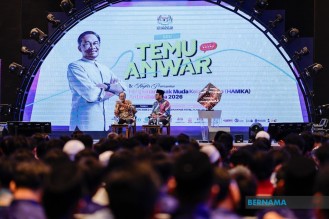
Prime Minister Datuk Seri Anwar Ibrahim has moved decisively to launch a comprehensive forensic investigation into Xeraya Capital, the wholly owned subsidiary of Khazanah Nasional Bhd that oversees the sovereign wealth fund's life sciences portfolio. The directive came following a board meeting where governance concerns surfaced regarding the company, which was established in 2012. As both Prime Minister and Khazanah chairman, Anwar disclosed the development during a public engagement session in Klang whilst officiating the 2026 International Himpunan Anak Muda Kebangsaan gathering, signalling the administration's commitment to transparency in managing state-linked enterprises.
The investigation emerged after Xeraya Capital's board identified documentation irregularities linked to historical transactions during its routine governance oversight in July 2026. Rather than treating the matter as routine administrative housekeeping, Anwar characterised the discovery as reflective of Khazanah's commitment to institutional rigour and accountability. His instruction to management was explicit: conduct a forensic examination adhering to the highest governance standards and due process protocols, with provisions for engaging external authorities where appropriate. This escalation from internal review to forensic investigation underscores the seriousness with which the government now treats corporate governance lapses within its investment vehicles.
For Malaysian observers, the intervention carries broader implications about the administration's willingness to scrutinise entities historically considered untouchable or beyond public accountability. Khazanah manages sovereign wealth exceeding billions of ringgit across diverse sectors from infrastructure to healthcare, making governance failures at subsidiary level potentially consequential for the entire portfolio. The life sciences sector, managed through Xeraya Capital, represents a strategic pillar of Malaysia's economic diversification efforts, particularly given regional competition in biotechnology and pharmaceuticals. Any mismanagement could undermine investor confidence in the government's stewardship of such critical economic drivers.
Anwar framed the investigation not as an indictment of Khazanah's current management but as validation of the institution's proactive governance culture. He commended the management team for raising legacy issues proactively and for their meticulous approach to governance compliance. This measured rhetoric attempts to distinguish between institutional integrity and individual misconduct, positioning the probe as evidence that systems are functioning as intended rather than evidence of systemic failure. The Prime Minister's public endorsement of Khazanah's leadership team may be calculated to reassure investors and business partners that the investigation represents targeted remediation rather than wholesale loss of confidence in the organisation's operations.
Contextualising this intervention, Anwar drew parallels with recent controversies at other government-linked entities, particularly the Federal Land Development Authority. He highlighted a glaring example: a hotel acquisition for RM160 million when its assessed value was RM100 million, a transaction he attributed to political interference in operational management. The comparison carries pointed significance. FELDA, historically a model of efficient governance under longstanding chairmen Tan Sri Taib Andak and Tun Raja Muhammad Alias, generated billions in profits and maintained Malaysia's largest plantation estates. Anwar's invocation of this golden era serves multiple purposes: it establishes standards against which contemporary performance should be measured, it suggests that professional stewardship rather than political placement produces superior outcomes, and it implicitly warns that political interference in corporate governance produces exactly the type of value-destructive decisions now under investigation.
The Prime Minister's emphasis that firm action against misconduct in government-linked entities is not personal but necessary reflects a defensive posture. Past investigations into state enterprises have been criticised as selective or politically motivated, accusations that could resurface here. By arguing that losses ultimately burden the people and that accountability protects public resources, Anwar positions the investigation as a civic duty rather than political manoeuvre. However, the timing and public manner of the announcement suggest a broader narrative about cleaning up governance standards across the state apparatus, consistent with his administration's self-presentation as reform-oriented.
For the investment community and multinational partners considering engagement with Malaysian state-linked enterprises, these developments present mixed signals. On one hand, the willingness to investigate and remediate governance failures demonstrates institutional health and respect for professional standards. On the other hand, the discovery of documentation irregularities at a major subsidiary raises questions about the depth of oversight previously exercised and the adequacy of internal control systems. Investors typically prefer predictability and assurance that governance issues have been identified and addressed swiftly; the forensic investigation approach satisfies this preference but also raises questions about what other irregularities might surface across the broader Khazanah portfolio.
The investigation into Xeraya Capital also intersects with Malaysia's evolving approach to corporate accountability in the post-1MDB era. That crisis exposed vulnerabilities in oversight of state investment vehicles and created political pressure for demonstrable governance reform. Subsequent administrations have faced scrutiny over whether institutional changes have been substantive or superficial. By ordering a forensic investigation rather than attempting to manage the issue quietly, Anwar signals alignment with heightened accountability expectations, though sceptics might argue this represents performative governance if underlying systemic deficiencies remain unaddressed.
The life sciences sector itself warrants consideration in assessing the investigation's implications. Xeraya Capital's investments in biotechnology and pharmaceutical enterprises are intended to position Malaysia as a regional hub in these high-value industries. Governance failures in the holding company could chill investment appetite from partners, both domestic and international, who expect robust oversight of their capital. The forensic investigation, if conducted transparently with findings disclosed appropriately, could actually strengthen confidence by demonstrating that governance breaches are identified and remedied systematically.
Anwar's personal oversight as both Prime Minister and Khazanah chairman concentrates considerable authority and potentially creates accountability gaps if conflicts of interest arise. Governance best practice typically recommends separation of these roles to prevent any suggestion of political pressure on corporate decisions. The investigation into Xeraya Capital occurs under his watch, meaning he simultaneously directs the investigation and bears responsibility for any previous governance failures. While Anwar's track record in fighting corruption and misconduct is established, this structural arrangement could invite questions about the investigation's independence and the credibility of its eventual findings.
Moving forward, the investigation's outcomes will largely determine whether this intervention represents a genuine watershed moment for governance in Malaysian state enterprises or merely a tactical response to an isolated problem. A transparent process culminating in clear remedial actions and accountability for specific individuals would enhance institutional credibility. Conversely, if findings are obscured or accountability proves elusive, the investigation might reinforce perceptions that governance rhetoric exceeds actual reform capacity. The broad Malaysian and Southeast Asian business community will be observing closely to assess whether Khazanah and its subsidiaries operate under genuinely strengthened governance frameworks or whether systemic vulnerabilities persist beneath surface-level procedural adjustments.

