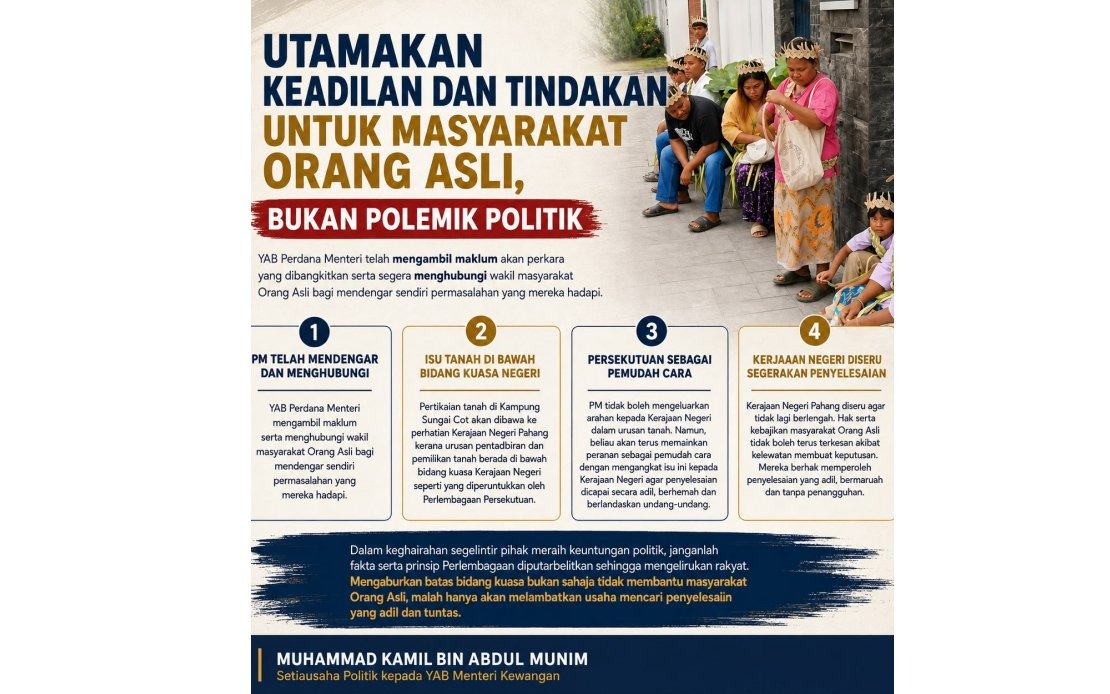
Prime Minister Datuk Seri Anwar Ibrahim has committed to maintaining an active facilitating role in resolving a contentious land dispute affecting the Orang Asli community in Kampung Sungai Cot, Maran, Pahang. According to Muhammad Kamil Abdul Munim, political secretary to the Finance Minister, the Prime Minister will escalate the matter to the Pahang State Government to ensure a resolution that is both fair and legally sound. This development comes as the indigenous community faces ongoing challenges related to land administration and tenure in the state.
The Prime Minister has already taken preliminary steps to understand the situation more comprehensively. Muhammad Kamil revealed that Anwar had personally reached out to community representatives to grasp the nuances of their predicament directly, rather than relying solely on official briefings or intermediaries. This direct engagement signals an attempt by the federal administration to address grassroots concerns while navigating the complex constitutional framework that governs land matters in Malaysia. The move reflects an awareness that indigenous land issues, while formally within state jurisdiction, carry significant political and humanitarian dimensions that warrant federal-level attention.
Crucially, Muhammad Kamil clarified the constitutional parameters within which the Prime Minister operates. Under the Federal Constitution, land administration and ownership questions fall squarely within the purview of state governments, meaning the federal executive cannot unilaterally direct state authorities on such matters. This constraint is not unusual in Malaysia's federal structure, where state governments retain substantial autonomy over land policy. The political secretary emphasised that while the Prime Minister lacks direct authority to issue directives to Pahang's administration, his office would not adopt a passive stance on the issue. Instead, the federal government intends to leverage its position to encourage swift action without overstepping constitutional boundaries.
The statement from Muhammad Kamil included a pointed critique of what he characterised as politicisation of the dispute. He cautioned against distorting constitutional principles or factual circumstances in ways that might mislead the public for short-term political gain. This language suggests frustration with opposition or rival figures potentially using the Orang Asli situation as a rallying point without contributing constructively to its resolution. Such rhetoric also underscores the delicate balance the federal government must maintain between demonstrating commitment to indigenous welfare and respecting the distribution of powers embedded in Malaysia's constitutional architecture.
The Orang Asli community's experience with land disputes is neither novel nor confined to Pahang. Across Malaysia, indigenous groups have historically faced challenges in asserting or defending their territorial claims against competing interests, whether agricultural development, urbanisation, or state-sponsored projects. The Orang Asli constitute one of the country's most vulnerable populations, with limited political representation and often lacking resources to navigate bureaucratic processes or legal proceedings. Land remains central to their cultural identity, livelihood, and survival, making any protracted dispute a matter of significant hardship.
Muhammad Kamil's statement urged the Pahang State Government to accelerate its decision-making processes, stressing that further delays would continue to affect the welfare and rights of the community. This pressure from the federal level reflects an implicit acknowledgment that administrative inertia or bureaucratic complexity might be prolonging the dispute unnecessarily. By calling for urgency, the Prime Minister's office is attempting to break deadlock without appearing to overstep its constitutional mandate. The appeal also carries an implicit warning that sustained inaction could eventually force the federal government to consider alternative avenues or interventions.
Anwar had earlier signalled his intention to engage directly with Pahang's authorities, posting on Facebook that he would raise the matter with the state government given that land jurisdiction rests with the state. This public commitment serves multiple purposes: it demonstrates responsiveness to indigenous concerns, establishes a record of federal engagement for potential future political purposes, and signals to Pahang's leadership that the issue has attracted attention at the highest levels of government. For the Orang Asli community, such visibility offers modest leverage, though ultimately their fate depends on state-level political will and administrative action.
The controversy around Kampung Sungai Cot represents a broader challenge for Malaysia's multi-level governance system. When indigenous rights intersect with state-level land administration, federal governments often find themselves constrained despite political incentives to intervene decisively. The Orang Asli constitute fewer than one percent of Malaysia's population and lack substantial electoral influence in most constituencies, which historically has reduced political urgency around their concerns. However, growing civil society attention and international scrutiny of indigenous rights have gradually shifted this calculus, making such disputes harder to ignore without political costs.
For Malaysian policymakers and observers, the Kampung Sungai Cot case illuminates persistent tensions in how the country balances federalism with social protection. While constitutional federalism provides legitimate reasons for limiting federal intervention in state land matters, it simultaneously creates spaces where vulnerable communities can fall through administrative cracks or experience unequal protection. The Prime Minister's commitment to facilitate rather than direct reflects these constraints, but also risks appearing insufficient to affected communities while potentially frustrating those who view federal passivity as problematic.
Regionally, Malaysia's handling of indigenous land disputes draws scrutiny in an environment where other Southeast Asian nations are grappling with similar tensions between development pressures and indigenous rights. Thailand, Indonesia, and the Philippines all face comparable challenges, and the international discourse around indigenous peoples' land tenure has become more assertive in recent years. How Malaysia manages cases like Kampung Sungai Cot contributes to its regional standing on human rights and social justice matters, particularly among civil society organisations and development-focused international bodies.
Moving forward, the resolution will likely depend on several factors: the political complexion of Pahang's state government and its sensitivity to indigenous concerns, the capacity of the Orang Asli community to mobilise support through civil society channels, and whether the federal government can maintain sufficient pressure without formal constitutional authority. The Prime Minister's personal engagement suggests serious intent, but ultimately cannot substitute for genuine state-level commitment to fair and expeditious resolution. For the community itself, the coming months will test whether federal facilitation translates into concrete improvements in their land security and living conditions.

