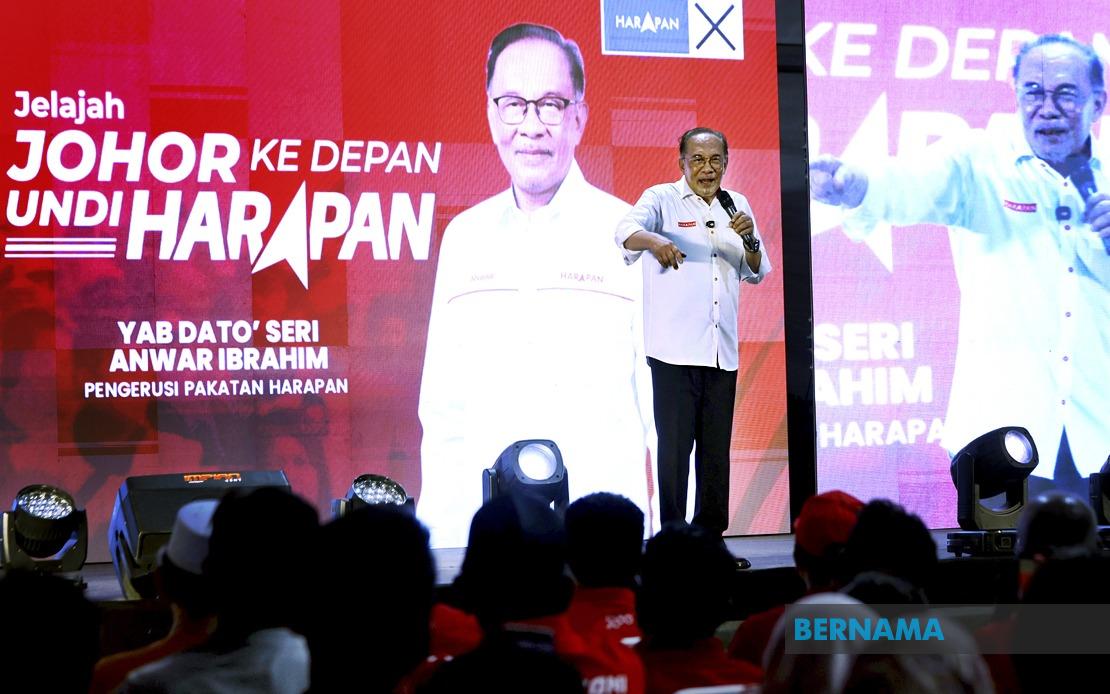
Prime Minister Datuk Seri Anwar Ibrahim has drawn a firm line under what he characterizes as Malaysia's historical tolerance of large-scale corruption and self-enrichment by political elites, declaring that the MADANI Government will pursue a decisive break with practices that have long siphoned public resources into private hands. Speaking at a campaign event in Muar's Sungai Mati constituency, Anwar stressed that the government's central mission involves systematically dismantling the institutional arrangements and political cultures that have enabled endemic corruption to flourish across the Malaysian bureaucracy.
The Prime Minister's intervention signals a sharpening focus on what his administration views as the fundamental governance challenge facing Malaysia—the need to rebuild public trust by demonstrating that political power will no longer be instrumentalised to benefit family members, connected business associates, or favoured contractors. Anwar specifically condemned the historical practice of deploying government authority to award lucrative contracts to spouses, relatives, and politically connected individuals, characterising such behaviour as the defining feature of an old political order that must be eradicated entirely.
Central to Anwar's message is the assertion that integrity and honest conduct must supersede other considerations in evaluating political leadership, including racial and religious identity. By explicitly stating his preference for leaders of all communities who demonstrate genuine commitment to probity, rather than those who merely invoke communal sentiment to obscure questionable conduct, Anwar appears to be directly challenging what he views as opportunistic appeals to narrow political divisions designed to distract from substantive governance failures.
The timing of these remarks reflects the intense political context surrounding Johor's state election campaign, where Anwar has been undertaking an extensive ground operation involving multiple daily events across the state. The sheer intensity of the Prime Minister's personal campaign investment underscores how consequential the Pakatan Harapan coalition regards these contests, both as a validation of its 2022 electoral mandate and as preparation for the anticipated federal electoral cycle.
Anwar's assurance that his administration will protect no one implicated in corrupt dealings represents a significant commitment to institutional independence from political patronage networks. This pledge carries particular weight given Malaysia's history of selective prosecutions and cases that have mysteriously stalled when they implicated figures with powerful political connections or sympathetic patronage relationships. The articulation of an absolute protection principle suggests an intention to insulate anti-corruption agencies from political interference while simultaneously subjecting all officeholders, regardless of seniority or factional belonging, to equivalent accountability standards.
The attendance of Penang Chief Minister Chow Kon Yeow and Ledang MP Syed Ibrahim Syed Noh at the Muar event underscores the coalition's effort to present a unified front on anti-corruption messaging, demonstrating that the commitment to clean governance transcends individual leaders or state-level politics. This collective approach helps establish anti-corruption as a defining characteristic of Pakatan Harapan's political brand rather than simply a personal initiative by the Prime Minister.
Anwar's framing of opposition political movements as driven primarily by personal ambition to recapture federal power positions the government's anti-corruption agenda as philosophically opposed to a competing political model. This rhetorical move transforms the corruption issue from a technical administrative matter into a fundamental contest between different conceptions of how political power should be exercised and for whose benefit. By connecting past corrupt practices to opposition figures' tenure in government, Anwar attempts to create a stark moral distinction between his administration's aspirations and the legacy of previous governments.
The electoral context proves crucial to understanding the immediate significance of these statements. With 172 candidates vying for 56 seats in Johor's July 11 polling, the state election represents both a significant political contest in its own right and a crucial indicator for national political trajectories. Johor, as Malaysia's third-largest state and a traditionally significant political entity, carries symbolic weight beyond its parliamentary arithmetic, and strong Pakatan Harapan performance would provide substantial momentum heading toward the federal election cycle.
For Malaysian observers, Anwar's anti-corruption messaging reflects broader regional and global trends emphasizing institutional transparency and merit-based governance, positioning Malaysia within international conversations about democratic accountability. This international dimension carries practical implications, as international investment communities increasingly factor governance quality and corruption risks into capital allocation decisions, meaning that genuine anti-corruption progress carries tangible economic consequences.
The appeal to voters to judge leaders based on character and integrity rather than partisan rhetoric represents an attempt to reshape the ground on which Malaysian political competition occurs. By elevating governance quality and personal probity as the central metrics for electoral decision-making, Anwar seeks to move beyond racial and religious frameworks that have traditionally structured Malaysian political competition, proposing instead a civic nationalism grounded in institutional performance.
However, translating these rhetorical commitments into durable institutional change requires sustained political will, particularly when investigations into corruption implicate figures within the government coalition itself. The practical test of Anwar's no-protection pledge will arrive when evidence of wrongdoing surfaces involving Pakatan Harapan members or aligned political figures, at which point the gap between rhetorical commitment and actual practice becomes measurable.
Looking forward, the Johor election results will provide important signals about whether voters have absorbed the government's anti-corruption messaging and whether such messaging translates into electoral support. Should Pakatan Harapan achieve strong results, it will validate the strategic decision to lead with governance quality and institutional integrity in its political messaging. Conversely, disappointing results would suggest that voters prioritise other political dimensions or that alternative opposition narratives have proven more persuasive, forcing a recalibration of the government's electoral strategy.

