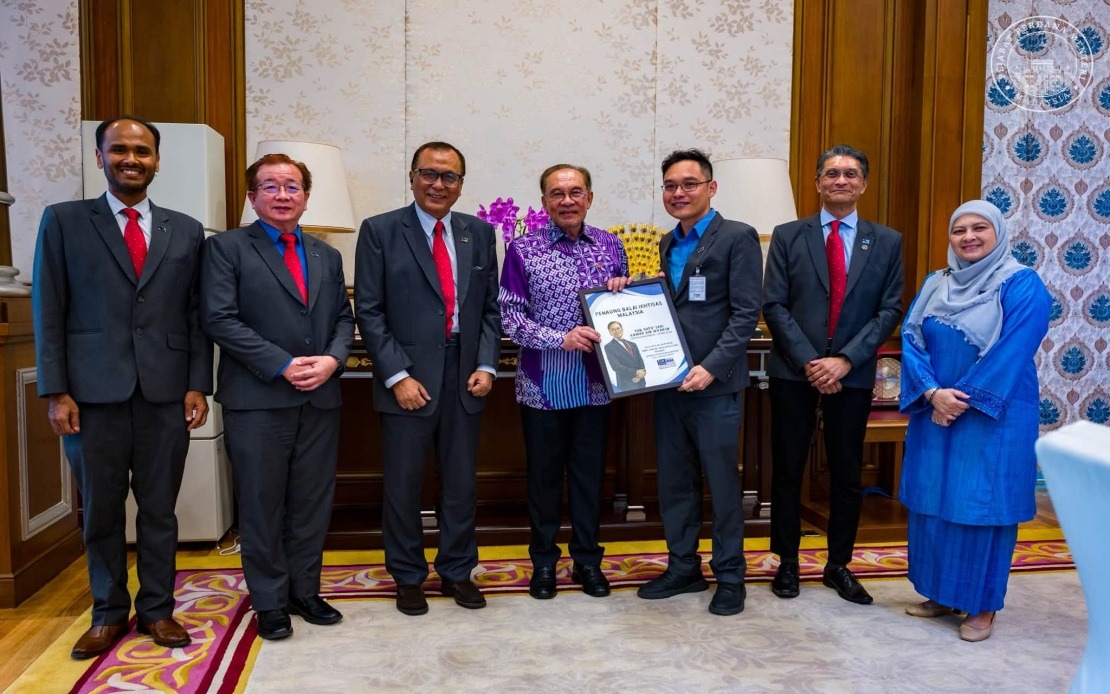
Prime Minister Datuk Seri Anwar Ibrahim has underscored the strategic importance of equipping Malaysia's professional workforce with artificial intelligence capabilities and robust talent development frameworks, following a formal meeting with Balai Ikhtisas Malaysia (BIM), the country's premier professional centre. The discussions, held in Kuala Lumpur on July 16, reflected the government's broader vision of transforming Malaysia into a regional nucleus of professional excellence amid rapid technological disruption reshaping global markets.
BIM's delegation, led by president Prof ChM Dr Juan Joon Ching, presented the organisation's strategic priorities to the Prime Minister, placing particular emphasis on how professionals must acquire AI competencies to remain competitive in an increasingly technology-driven economy. This convergence of interests—between government policy objectives and professional body advocacy—signals a widening recognition across Malaysia's institutional landscape that technological adaptation is no longer discretionary but essential for sustaining economic relevance and attracting high-value investment.
Anwar's articulation of the government's position frames professionals not merely as employees within traditional hierarchies but as strategic partners whose capabilities directly influence national competitiveness and innovation capacity. This reorientation carries significant implications for Malaysia's knowledge economy, suggesting that policymakers view the professional class as instrumental to executing the MADANI agenda—the government's framework for advancing societal wellbeing and sustainable development. By elevating professionals to partner status, the government implicitly commits to creating enabling environments through education policy, regulatory reform, and industry-academia collaboration that strengthen their capacity to lead digital transformation initiatives.
The emphasis on AI readiness reflects both pragmatic and forward-looking considerations. Across Southeast Asia, artificial intelligence adoption remains unevenly distributed, with Singapore and Vietnam making more aggressive investments in AI research and deployment. Malaysia's positioning of AI capability-building as a priority suggests awareness that competitive dynamics in the region are shifting rapidly, and that professional sectors—from finance and healthcare to law and engineering—must develop in-house expertise to extract maximum value from emerging technologies while mitigating associated risks. Without deliberate investment in such capabilities, Malaysian professionals risk becoming consumers of foreign AI solutions rather than architects of domestically-relevant applications.
Talent development emerged as the second pillar of the discussion, a recognition that capability-building alone proves insufficient without structured pathways enabling Malaysian professionals to advance their expertise. The government's engagement with BIM on this front suggests renewed focus on continuous learning frameworks, mentorship systems, and credentialing mechanisms that enable practitioners to transition their skills as technological contexts evolve. This approach acknowledges that talent development is not a one-time institutional investment but an ongoing process requiring coordination between regulatory bodies, professional associations, educational institutions, and employers.
Anwar's acceptance of an invitation to Hari Ikhtisas Malaysia—an annual event celebrating the professional community's contributions to national development—carries symbolic weight beyond ceremonial protocol. The Prime Minister's participation signals that government recognises and values the professional sector's role in driving Malaysia's socioeconomic agenda, a message particularly significant given occasional tensions between professional regulatory bodies and government agencies over licensing, practice standards, and jurisdictional boundaries. Such public acknowledgment can facilitate more collaborative relationships where professionals view government not as an adversary imposing compliance burdens but as a partner invested in their success.
The dialogue also illuminates broader questions about Malaysia's competitive positioning within Southeast Asia. Thailand, Indonesia, and Vietnam are aggressively expanding their professional service sectors and investing in talent pipelines, recognising that knowledge-intensive services generate higher-value economic activity than manufacturing alone. Malaysia's explicit focus on strengthening professional excellence as a regional hub reflects a strategic choice to compete at this higher value-added tier, requiring sustained investment in education, infrastructure, and regulatory environments that attract and retain top-tier talent.
Anwar's emphasis on nurturing talent with integrity, competitiveness, and visionary leadership introduces an ethical dimension often overlooked in purely technical discussions of AI and capability-building. This framing suggests that Malaysia's talent development strategy should not pursue technological advancement divorced from principles of professional conduct and social responsibility. Such an approach potentially distinguishes Malaysia's model from purely metrics-driven development strategies, positioning ethical professional practice as a competitive advantage in attracting multinational corporations and regional clients seeking partners operating under strong governance frameworks.
The government's framing of stronger ties between government and professionals as essential for Malaysia's advancement underscores a fundamental policy shift: recognising that state-directed development models prove insufficient in knowledge economies where professionals retain significant agency and mobility. By cultivating partnership relationships and creating enabling environments for professional advancement, the government acknowledges that talent retention and productivity improvement depend less on compulsion and more on demonstrable commitment to professional development and recognition.
Looking forward, the outcomes of this meeting could translate into concrete initiatives spanning professional education curricula revision to incorporate AI literacy, establishment of centres of excellence in emerging technology domains, or tax incentives for continuous professional development. The effectiveness of such measures will ultimately determine whether Malaysia's positioning as a regional professional hub materialises or remains aspirational rhetoric. The test lies in execution: whether government institutions, professional bodies, and educational providers can align their efforts sufficiently to create ecosystems where Malaysian professionals genuinely lead innovation rather than merely adopt foreign solutions.

