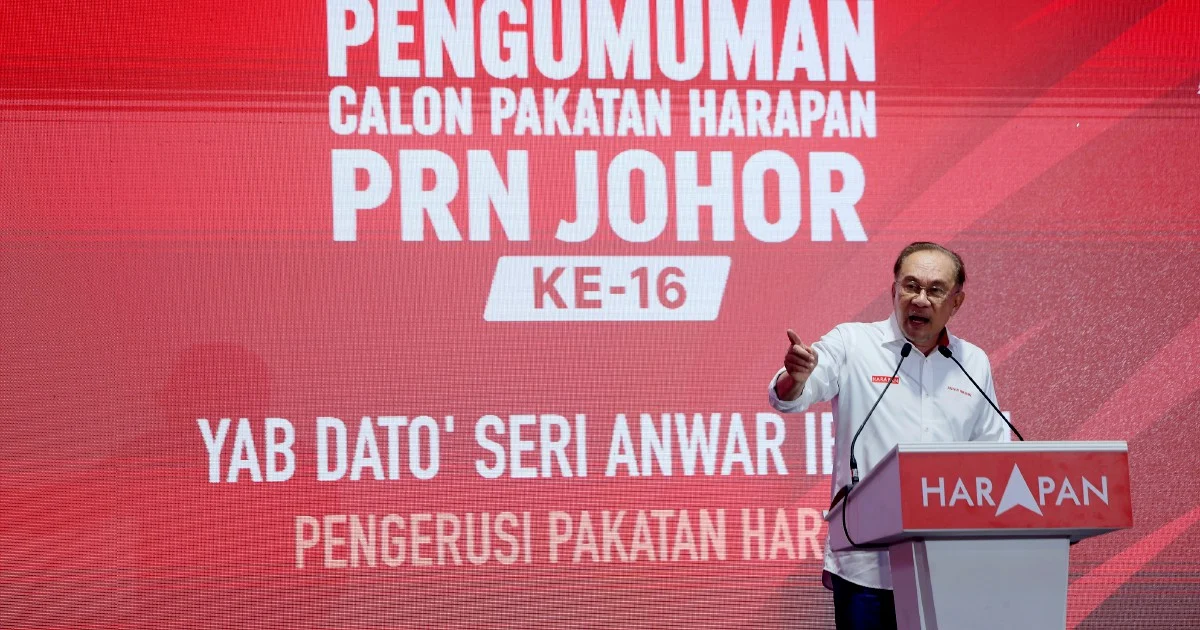
Prime Minister Datuk Seri Anwar Ibrahim has called on Johor's state executive councillors to take a more assertive stance in questioning the Barisan Nasional and Perikatan Nasional federal governments over longstanding grievances concerning the state's revenue allocations. Speaking in Tangkak, Anwar directed his remarks at state administrators to pursue accountability regarding claims that Johor has historically been shortchanged in its proportion of federal resources, a contentious issue that has simmered in state politics for years.
The directive reflects a broader effort by the current federal administration to address historical inequities in the distribution of national revenues among states, particularly those that have experienced shifting political allegiances. Johor's complex political landscape—oscillating between different ruling coalitions at both state and federal levels—has contributed to perceptions that the state's interests may have been deprioritised during periods when its government differed from the federal administration in Putrajaya.
Revenue sharing arrangements between federal and state governments form a critical component of Malaysia's fiscal federalism framework. These allocations determine the resources available for state development projects, infrastructure improvements, and essential services. Johor, as one of Malaysia's largest and economically significant states, has frequently raised concerns about whether its contribution to national finances is proportionally reflected in federal funding returned to the state level.
Anwar's intervention underscores the current government's commitment to reviewing historical revenue distribution patterns that may have been shaped by political considerations rather than objective economic metrics. The prime minister's suggestion that Johor officials should more aggressively challenge previous administrations indicates confidence in the transparency and accountability mechanisms of the present federal government, implicitly positioning it as more receptive to such inquiries.
The timing of these remarks carries significance for Johor's political trajectory and federal-state relations. Under the current Pakatan Harapan-led administration, several states previously governed by opposition coalitions have begun reassessing their financial arrangements with the federal government. Johor's transition through multiple governing coalitions has left it with accumulated grievances that officials may feel emboldened to raise under the current administration.
Previous administrations, whether led by Barisan Nasional or Perikatan Nasional, operated under different policy frameworks and priorities. The Barisan Nasional's traditional dominance across most of Malaysia's political landscape meant that revenue allocation decisions were often made within a single framework. Conversely, the Perikatan Nasional period introduced competing political dynamics that may have influenced resource distribution. Anwar's suggestion that state executives investigate these arrangements reflects confidence that such scrutiny will reveal patterns warranting correction.
Federal revenue allocation mechanisms in Malaysia include both constitutional transfers and discretionary grants. Constitutional allocations are mandated through the Federal Constitution, while discretionary grants offer federal governments latitude in distributing additional resources. It is partly within the discretionary sphere that political considerations may have influenced decisions historically, making this the focus of potential inquiries by state officials.
The implications for Malaysian federalism are substantial. Should Johor's investigation reveal systematic under-allocation of resources during previous administrations, it could establish precedents for other states to similarly challenge their historical treatment. This could prompt a broader national conversation about whether revenue-sharing mechanisms adequately reflect principles of equity and performance rather than political alignment.
For Johor specifically, pursuing such accountability could yield tangible financial benefits if federal compensation is warranted. The state's economic importance—encompassing major ports, industrial zones, and agricultural production—means that even modest adjustments to its revenue share could translate into substantial additional funding for development initiatives. This could accelerate infrastructure projects and improve service delivery across the state.
Anwar's comments also signal confidence in the current administration's capacity and willingness to address historical grievances, a positioning that may strengthen federal-state relations under the present coalition. By explicitly encouraging state officials to demand accountability from predecessors rather than the current government, Anwar demonstrates confidence in transparency while reinforcing the narrative of change and reform that has characterised recent administrations.
The broader context involves Malaysia's ongoing efforts to strengthen accountability and transparency in governance. Revenue allocation, previously often treated as a technical-administrative matter, is being reframed as a governance issue deserving public scrutiny. Anwar's intervention elevates this issue from bureaucratic corridors to public discourse, emphasising that elected officials have responsibility to question arrangements affecting their constituents' wellbeing.
Moving forward, how aggressively Johor's executive council pursues this investigation will reflect both the state government's political confidence and the current federal administration's genuine commitment to accountability. The outcome could reshape federal-state financial relations and establish clearer precedents for revenue-sharing disputes. For Southeast Asian observers, Malaysia's approach to resolving these governance questions offers insights into how federal systems can address historical inequities through transparency mechanisms rather than political confrontation.

