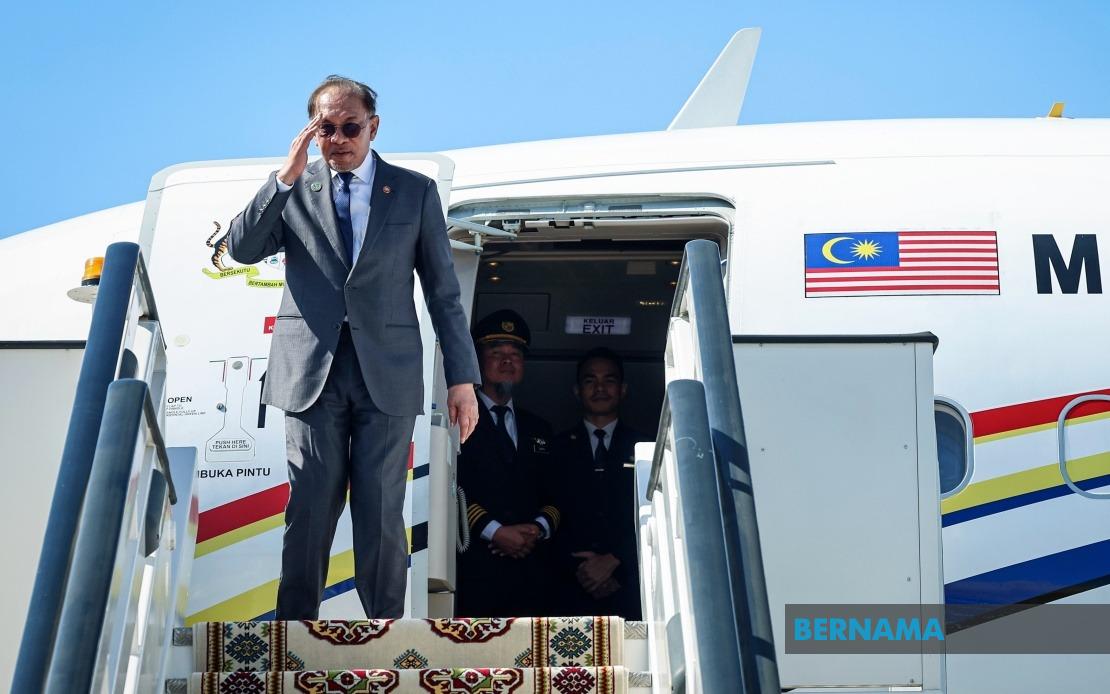
Prime Minister Datuk Seri Anwar Ibrahim transitioned swiftly from international diplomacy to domestic engagements when he arrived in Penang on June 20, fresh from concluding an official visit to Turkmenistan. The one-day working visit packs an ambitious itinerary reflecting the government's concurrent focus on industrial development, corporate partnerships, and recognising the Malaysian media's role in democratic discourse. His delegation departed Ashgabat International Airport at 4.45 pm local time, arriving in time to participate in three significant ceremonies that underscore Penang's continued positioning as a key economic hub within Malaysia's Northern Corridor.
The Prime Minister's opening engagement in Penang centres on the inauguration of MKS Instruments Malaysia Sdn Bhd at Bandar Cassia Technology Park in Batu Kawan, scheduled for 11 am. This facility represents a continued investment in Penang's technology and manufacturing sector, attracting multinational precision-instrument enterprises to the state. As both Prime Minister and Finance Minister, Anwar's personal involvement signals government commitment to boosting foreign direct investment and expanding the technological base beyond traditional manufacturing sectors. The ceremonial opening underscores efforts to diversify Penang's economic portfolio and create higher-value employment opportunities in the technology space.
Following the MKS Instruments opening, Anwar is slated to officiate the groundbreaking ceremony for Setia Fontaines Industrial Park at 1 pm, located in Bandar Setia Fontaines at Kepala Batas. This development reflects property giant Setia's strategic bet on industrial expansion within the Northern Corridor, an initiative that carries broader implications for regional economic integration. The industrial park project demonstrates sustained private-sector confidence in Penang as a destination for manufacturing and logistics operations, capitalising on the state's strategic location and existing infrastructure. Alongside the primary groundbreaking, Setia will unveil two additional strategic collaborations within the wider Setia Fontaines township, suggesting a multi-phased approach to generating mixed-use economic zones that blend industrial activity with residential and commercial development.
The afternoon event centres on the National Journalists' Day (HAWANA) 2026 Grand Finale, scheduled at PICCA Convention Centre @ Butterworth Arena at 3 pm, an occasion anticipated to convene approximately 1,000 media practitioners representing both domestic outlets and international news organisations. This gathering takes on particular significance in Malaysia's media landscape, serving as an annual institutional recognition of journalistic excellence and professional standards within an increasingly complex information ecosystem. The event, organised by the Communications Ministry with Bernama as the implementing agency, functions as a showcase for professional journalism's role in shaping informed public opinion and maintaining institutional accountability.
At the HAWANA ceremony, Anwar will confer both the HAWANA Award and Special HAWANA Award upon individuals judged to have delivered substantial contributions to journalism and the advancement of public discourse. These accolades carry weight within Malaysia's media fraternity, acknowledging journalists who navigate challenging reporting environments while maintaining editorial integrity. Beyond ceremonial recognition, the Prime Minister will also oversee the presentation of Tabung Kasih@HAWANA contributions directed toward media practitioners experiencing financial hardship. This welfare component reflects institutional acknowledgment that journalism, whilst socially essential, often places practitioners under economic and professional pressure, particularly in an era of declining traditional media revenue streams and shifting advertising markets across the region.
Anwar's Turkmenistan visit, which commenced on June 18, marked his inaugural state visit to the Central Asian nation since assuming the premiership in November 2022. The invitation from President Serdar Berdimuhamedov provided opportunity to strengthen bilateral relations and explore potential partnerships spanning energy, trade, and cultural domains. For Malaysia, engaging Central Asian partners diversifies diplomatic and economic relationships beyond traditional Southeast Asian and East Asian networks, reflecting a broadened foreign policy perspective. The Turkmenistan leg followed Anwar's attendance at the 35th ASEAN-Russia Commemorative Summit in Kazan, Russia, where he was accompanied by Investment, Trade and Industry Minister Datuk Seri Johari Abdul Ghani and Economy Minister Akmal Nasrullah Mohd Nasir, underscoring Malaysia's active participation in regional diplomatic architecture and economic forums.
The compressed timeline of Anwar's journey—from Central Asia through Russia to Malaysia within days—illustrates the demanding schedule characteristic of contemporary premierships navigating multiple diplomatic engagements, economic policy decisions, and domestic ceremonial obligations simultaneously. His dual role as both Prime Minister and Finance Minister intensifies this workload, requiring oversight of macroeconomic policy, budget implementation, and financial sector regulation alongside traditional executive functions. The Penang itinerary, whilst comprising distinct events, coalesces around themes of economic development and institutional recognition, presenting a coherent narrative about government priorities even as individual engagements address separate constituencies.
Penang's selection as the venue for HAWANA 2026 reflects the state's broader cultural and institutional significance within Malaysia beyond its role as an industrial and manufacturing centre. The state has cultivated identity as both economic producer and cultural custodian, hosting events of national importance across diverse domains. This positioning strengthens Penang's appeal to multinational enterprises whilst underscoring its role within Malaysia's urban hierarchy as a destination for significant policy announcements and institutional gatherings. The concentration of three major events within a single day amplifies Penang's visibility in national discourse and aligns with ongoing efforts to position the state as integral to Malaysia's economic transformation agenda.
The Setia Fontaines project warrants attention within broader discussions of Malaysian industrial policy and property-sector dynamics. The industrial park model reflects evolving approaches to spatial planning that blend industrial, residential, and commercial functions within integrated zones, a pattern increasingly adopted across Southeast Asia as cities and regional economies compete for manufacturing investment and skilled-worker retention. Industrial parks designed to accommodate diverse economic activities create ecosystems that support supplier networks, logistics operations, and ancillary services, enhancing overall competitiveness relative to standalone manufacturing facilities. Malaysia's Northern Corridor, spanning Kedah, Penang, and Perlis, has positioned itself as a cohesive economic region, and projects like Setia Fontaines contribute to that narrative by demonstrating sustained investment and development momentum.
Following his Penang engagements, Anwar is scheduled to attend the Himpunan Pertubuhan Lima Generasi (PLG) Malaysia dinner in Negeri Sembilan that evening, maintaining the intensive domestic schedule. This final engagement suggests continued focus on social and community organisations, complementing the industrial and media-focused priorities earlier in the day. The PLG platform provides opportunity for dialogue with civil-society representatives and grassroots-level organisational leaders, constituencies whose engagement forms part of broader government consultation frameworks and coalition-building efforts across state boundaries and demographic groups.

