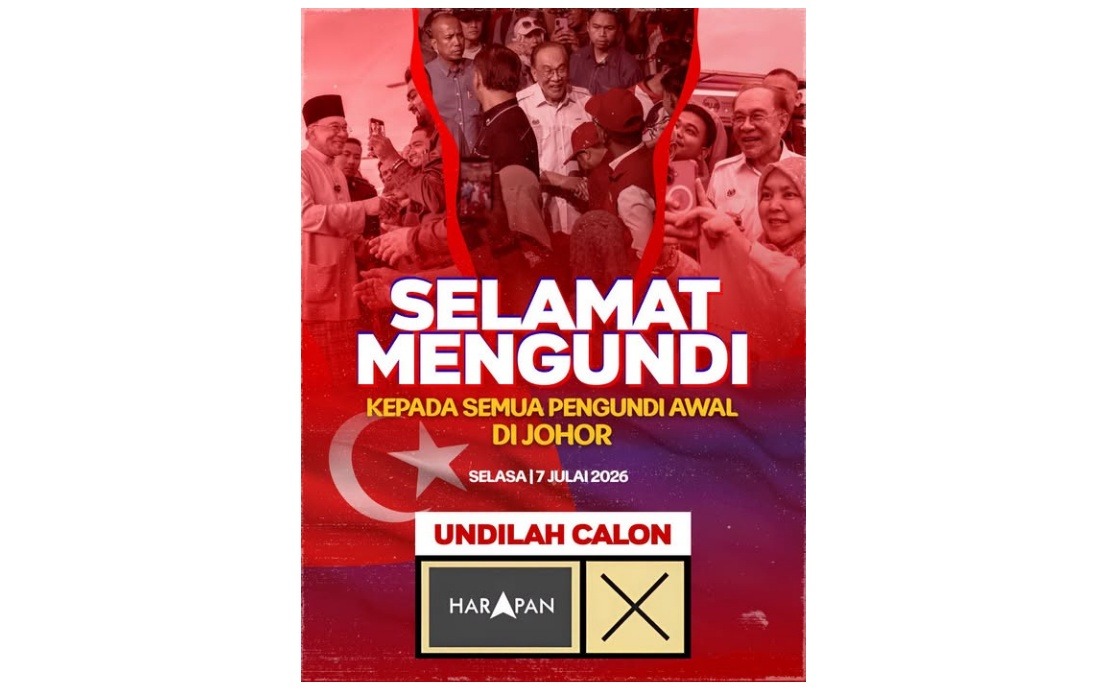
Prime Minister Datuk Seri Anwar Ibrahim has encouraged the approximately 25,000 early voters participating in Johor's 16th state election to cast their ballots in favour of Pakatan Harapan, positioning the coalition's campaign message around delivering improved prospects for the economically significant state. In a Facebook statement released on July 7, Anwar emphasised the importance of voter participation while explicitly urging support for the opposition coalition's candidates across all 56 contested seats.
The early voting phase commenced with polling centres opening simultaneously across Johor, accommodating military and police personnel who are unable to vote during the main election day scheduled for Saturday. A combined 24,751 registered early voters—comprising 12,041 Malaysian Armed Forces members and their spouses alongside 12,710 Royal Malaysia Police and General Operations Force personnel with their families—were eligible to participate during this preliminary voting window. The distribution of polling stations reflected the demographic spread of these voters, with 53 locations dedicated to police and security force staff and an additional 11 centres serving military voters.
The staggered opening hours and closing times at these 64 polling centres, beginning at 8 am with closures between noon and 6 pm depending on individual location capacity, underscored the logistical complexity of managing early voting across a geographically dispersed state. Early voting provisions for security and armed forces personnel represent a significant component of electoral administration in Malaysia, ensuring that those on active duty maintain their voting rights despite operational commitments that may prevent their participation on the main polling day.
Pakatan Harapan's campaign strategy in Johor reflects the broader competitive landscape in one of Malaysia's most politically contested states. The coalition fielded candidates across all 56 state assembly seats, with the parliamentary-aligned parties each contributing substantially to the campaign effort. PKR, the dominant coalition member, fielded 20 candidates, while Amanah contributed 19 nominees and DAP provided 17 contenders, demonstrating a calculated distribution designed to balance representation and electoral prospects across different constituencies and voter demographics.
The overall electoral contest encompasses considerably broader participation, with 172 candidates from multiple parties competing across the state seats and approximately 2.7 million registered voters preparing to cast ballots during the main election phase. This candidate-to-voter ratio illustrates the competitive intensity of Johor's electoral environment, where multiple political formations vie for dominance in a state with significant economic and demographic importance within the Malaysian federation. The scale of participation, both in terms of overall electorate and competing candidates, positions Johor as a crucial bellwether for Malaysian political trends.
Anwar's direct appeal to early voters carries particular significance given his position as both Prime Minister and chair of the Pakatan Harapan coalition. His messaging strategy emphasised collective responsibility and future-oriented considerations, framing the election as an opportunity for voters to actively shape the state's development trajectory. The explicit call to "choose Harapan candidates for a better future for Johor" positioned the coalition's campaign around tangible governance outcomes and improved living standards rather than abstract political philosophies.
The timing of early voting in Johor coincides with intensified campaign activities as parties mobilise resources and messaging in the final stretch before Saturday's main polling day. Early voting participation rates often provide preliminary indicators of overall electoral momentum and voter engagement levels, offering campaigns real-time feedback on messaging effectiveness and grassroots mobilisation success. The 24,751 early voters, while numerically modest relative to the total electorate, represent engaged citizens with institutional connections that may influence broader voting patterns.
Johor's political significance extends beyond state-level implications. As Malaysia's second-most populous state and a major economic engine, electoral outcomes in Johor historically reverberate through national political calculations. The coalition dynamics in this election—involving PKR, Amanah, and DAP operating as a unified electoral force—reflect the broader Pakatan Harapan architecture that has governed Malaysia at the federal level since 2022. Performance in Johor consequently carries implications for national political stability and coalition cohesion.
The security and military composition of early voters in this election reflects Malaysia's constitutional framework guaranteeing voting rights to uniformed service personnel despite operational demands. This provision ensures democratic participation remains comprehensive, though the practical requirement for early voting highlights the tension between security commitments and electoral participation. The high proportion of early votes—representing approximately one percent of the total registered electorate—suggests that military and police deployment levels in Johor remain substantial, with approximately one-fifth of these institutional voters being unable to participate during regular polling hours.
Beyond Anwar's public appeal, the early voting phase serves practical electoral administration functions while simultaneously representing a moment for campaigns to assess mobilisation effectiveness among organised constituencies. Police and military voters, though relatively small in absolute numbers, represent coherent demographic groups with distinct interests in issues including remuneration, welfare provisions, and institutional autonomy. Parties typically devote specific attention to these constituencies, recognising their stability and potential organisational influence within broader electoral coalitions.

