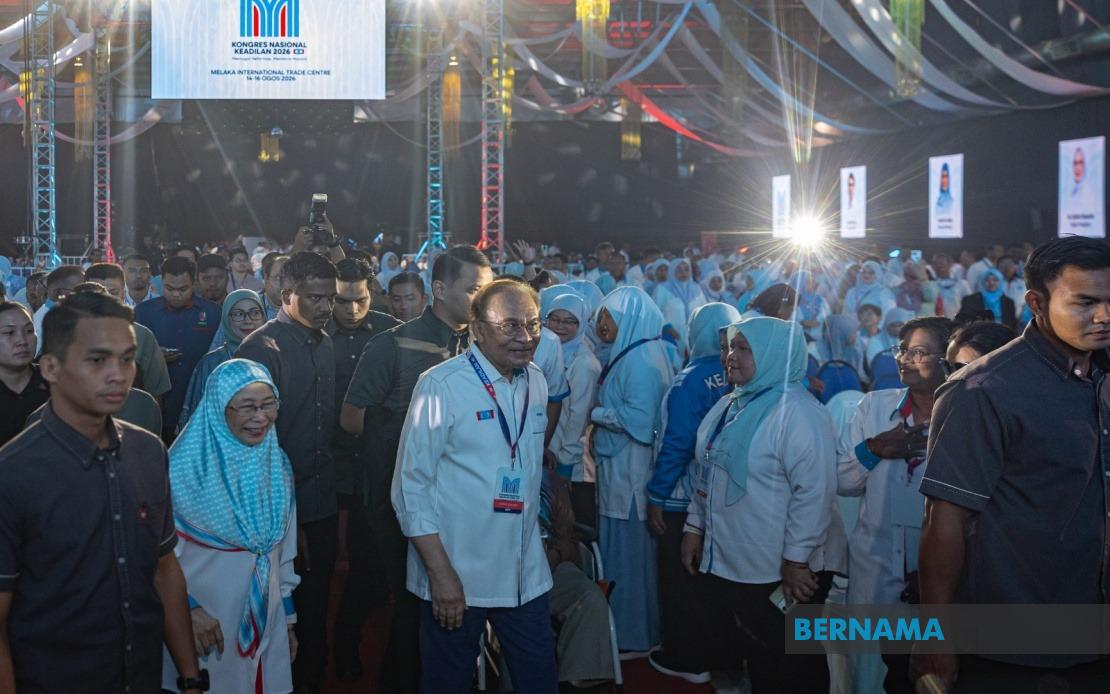
Prime Minister Datuk Seri Anwar Ibrahim has doubled down on his commitment to sustaining the working relationship between the Unity Government and UMNO-Barisan Nasional at the federal level, signalling that pragmatic governance and economic delivery remain his administration's defining priorities. Speaking at the Melaka International Trade Centre during his closing remarks at the PKR National Congress 2026, Anwar sought to allay concerns about the coalition's durability by framing continued cooperation as essential to maintaining the political equilibrium necessary for national progress.
The timing of Anwar's statement carries particular significance given recent developments that have prompted scrutiny of the government's coalition architecture. By publicly reaffirming the arrangement at a flagship party gathering, the PKR president appears intent on sending a clear message to both allies and critics that strategic partnerships transcend the immediate grievances or rivalries that periodically surface within Malaysia's fractious political ecosystem. His emphasis on choosing "stability and the people's prosperity through economic growth" reflects a deliberate pivot toward substantive governance metrics as the yardstick by which the Unity Government should be measured.
Anwar's framing of political decision-making is particularly noteworthy for what it implicitly critiques. By cautioning against choices driven by "personal interests, positions or anger," the Prime Minister appears to be addressing concerns that Malaysia's political class sometimes prioritises factional advantage or individual advancement over collective welfare. This distinction between narrow self-interest and broader national benefit has become increasingly central to how Anwar justifies the coalition arrangement, especially given the historical antagonism between PKR and UMNO.
The maintenance of federal-level cooperation between the Unity Government and UMNO-BN represents one of Malaysia's most consequential political compromises of recent years. For those accustomed to the adversarial politics of the pre-2020 era, the notion of PKR and UMNO governing in tandem remains counterintuitive. Yet Anwar's consistent messaging suggests that this arrangement has become sufficiently embedded in his strategic calculus that dismantling it would be politically costlier than tolerating the inherent tensions it generates.
From an economic perspective, Anwar's invocation of prosperity and growth as binding principles makes intuitive sense. A fragmented federal government pursuing contradictory policies would be ill-equipped to execute the structural reforms and investment initiatives necessary to boost Malaysia's competitiveness. The collaboration with UMNO-BN, whatever its ideological friction, provides the parliamentary arithmetic to pass legislation and secure budget allocations without constant negotiation or compromise that could impede momentum.
However, the sustainability of this arrangement hinges on whether both sides can maintain sufficient discipline to prevent coalition tensions from metastasising into open conflict. Periodic disagreements over ministerial appointments, budget allocations, and policy direction are inevitable when ideologically disparate parties govern jointly. The challenge for Anwar lies in managing these inevitable frictions without allowing them to rupture the coalition at moments when political sentiment might shift.
The Malaysian electorate's patience with the current configuration cannot be taken for granted indefinitely. Voters who backed the Unity Government in 2022 did so partly as a rejection of UMNO's previous tenure, making the sight of UMNO ministers in senior cabinet positions a source of ambivalence for some PKR and allied party supporters. Anwar's emphasis on results and prosperity is thus not merely rhetorical flourish but a practical necessity—the coalition's legitimacy rests substantially on its ability to deliver tangible improvements in living standards, employment, and economic opportunity.
From a Southeast Asian perspective, Malaysia's political stability carries regional implications. Investor confidence, cross-border trade relationships, and ASEAN coordination all benefit from a predictable federal government capable of executing coherent policy over an extended timeframe. Anwar's reaffirmation of coalition commitment can therefore be read as an implicit commitment to the continuity required for regional engagement and integration initiatives.
The broader question underlying Anwar's statement concerns whether Malaysia can sustain non-ideological coalition governance as a permanent feature of its political system, or whether current arrangements represent a temporary accommodation pending electoral realignment. His insistence that stability and prosperity must take precedence over partisan advantage suggests he views pragmatic coalition-building not as a regrettable necessity but as a preferable model for Malaysian governance going forward.
Within PKR's internal dynamics, Anwar's closing address at the party congress served an additional function—reassuring the party base that federal cooperation with UMNO need not compromise PKR's longer-term identity or electoral prospects. By situating the arrangement within a narrative of national interest rather than strategic weakness, he seeks to maintain party cohesion while pursuing an unpopular partnership.

