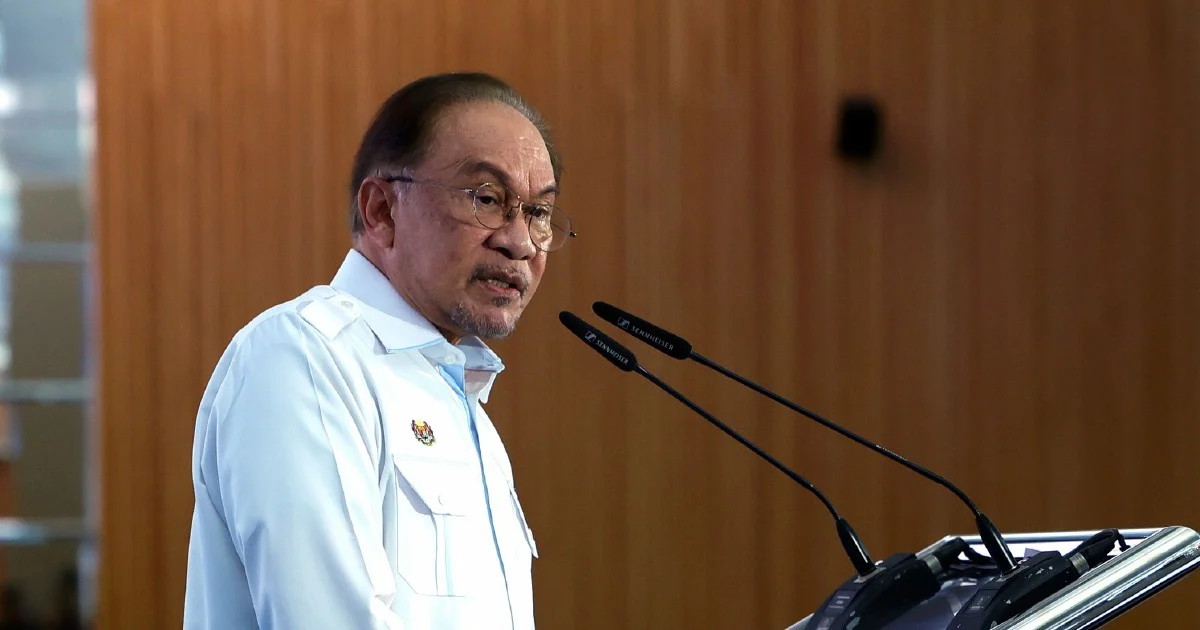
Prime Minister Datuk Seri Anwar Ibrahim has firmly rejected allegations suggesting the federal government favours certain states over others when distributing development funds, moving to dispel concerns that have periodically surfaced regarding the equity of Malaysia's fiscal federalism system.
The dismissal comes against a backdrop of ongoing political tension surrounding resource distribution across the nation's diverse states, some governed by the ruling coalition and others under opposition control. Such accusations have become a recurring theme in Malaysian politics, particularly when states controlled by different political parties question the fairness of central budgetary allocations intended for infrastructure, education, and social development projects.
Anwar's response addresses a fundamental question in Malaysia's federal structure: whether development resources flow equitably regardless of a state's political alignment or economic capacity. This concern resonates particularly among leaders in states that feel marginalised in national planning priorities, and carries implications for public perception of governmental impartiality.
The Prime Minister's stance reflects the government's broader position that resource allocation follows transparent, merit-based criteria rather than political calculation. However, the persistence of such allegations indicates a credibility gap that warrants examination. Independent analysis of federal disbursements could illuminate whether perceptions of unfairness stem from actual disparities or from the fundamental reality that wealthier, more urbanised states naturally attract greater absolute investment due to project scale and economic viability.
Historically, Malaysia's development allocation system has been shaped by multiple factors: state government capacity to implement projects, population size, economic contribution to federal revenues, and identified infrastructure gaps. Poorer states theoretically receive proportionally higher allocations through mechanisms like the dedicated development funds for rural and lower-income regions. Yet the visibility of major federal projects in politically significant areas can create impressions of bias that official statistics may not fully dispel.
The issue gains urgency given Malaysia's development objectives outlined in the Twelfth Malaysia Plan and successive economic blueprints, which emphasise inclusive growth and regional balance. If federal allocation mechanisms are perceived as inequitable—whether justifiably or not—they undermine confidence in national planning and breed resentment that weakens social cohesion across state lines.
Anwar's rebuttal suggests the administration believes its allocation framework is defensible and based on rational criteria. Yet political leadership occasionally requires not merely dismissing concerns but engaging substantively with the underlying anxieties. Publishing detailed breakdowns of development spending by state, criteria for project selection, and comparative analyses of per-capita allocations could strengthen such defences and provide empirical grounding for public trust.
The broader context involves Malaysia's challenge in balancing federal fiscal centralisation with meaningful state autonomy. The federal government controls substantial revenue sources while states depend heavily on federal transfers, creating structural tensions. When development allocations become politically contentious, they reflect deeper questions about whether the federal system serves all Malaysians equitably or privileges certain regions and political constituencies.
Regionally, Malaysia's approach to federal fiscal distribution carries significance for ASEAN neighbours managing similar federal dynamics. Indonesia, India, and other diverse nations grapple with comparable tensions between central and state governments over resource allocation. How Malaysia navigates and communicates about this challenge could inform governance discussions across Southeast Asia.
The rejection of unfairness claims, while politically necessary, should ideally be accompanied by concrete measures enhancing transparency and accountability in development spending. These might include independent audits of allocation methodologies, public databases tracking project disbursements by constituency and state, and clearer communication of the principles guiding resource distribution decisions.
For Malaysian stakeholders, the overarching concern transcends partisan politics: ensuring that federal development resources genuinely serve national development goals and reach all states according to their needs and capacities. Whether Anwar's dismissal of allegations proves persuasive will likely depend less on rhetorical assertion and more on measurable outcomes demonstrating equitable development progress nationwide. The credibility of Malaysia's federal development system ultimately rests not on denying concerns but on consistently delivering inclusive, transparent, and defensible resource allocation across all thirteen states and three federal territories.
Moving forward, constructive dialogue between federal authorities and state governments—particularly those questioning current arrangements—could help identify specific concerns requiring policy adjustments. Such engagement would signal serious commitment to addressing equity perceptions rather than simply rejecting them.

