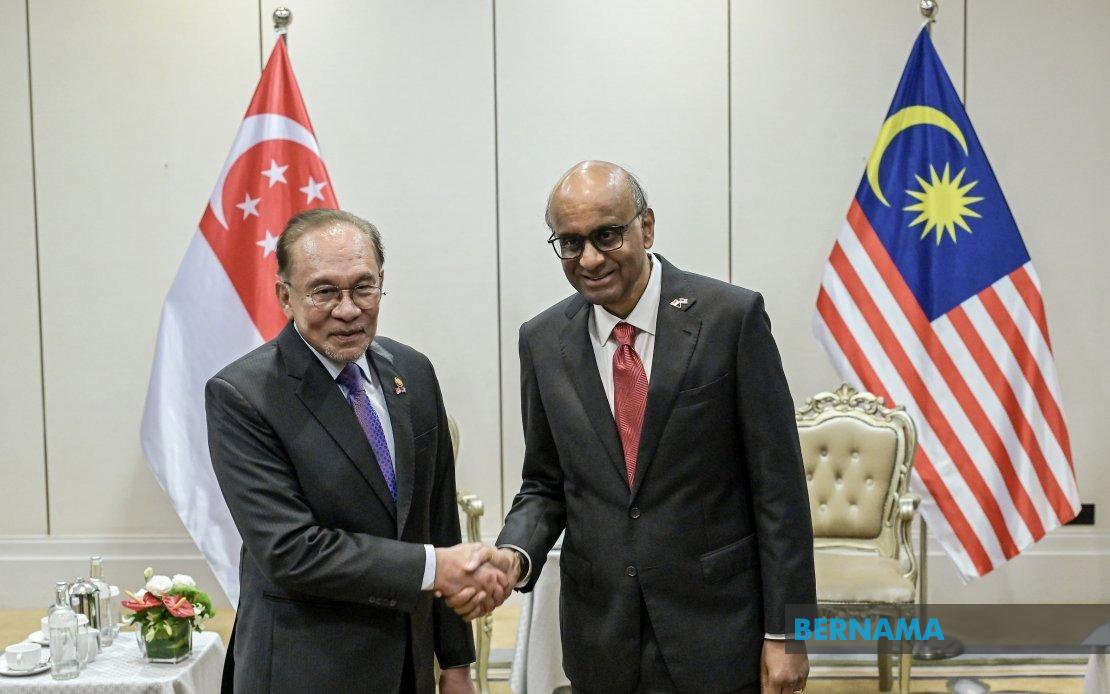
Prime Minister Datuk Seri Anwar Ibrahim received Singapore President Tharman Shanmugaratnam on Monday as the city-state's leader began a three-day visit to Malaysia, marking a significant moment in bilateral relations between the neighbouring nations. The meeting, lasting 40 minutes, took place in conjunction with the official state visit spanning July 13 to 15, a reciprocal arrangement following the Yang di-Pertuan Agong Sultan Ibrahim's state visit to Singapore in May 2024.
The engagement brought together Malaysia's top economic and foreign policy officials alongside their counterparts from Singapore. Alongside Prime Minister Anwar, the meeting included Foreign Minister Datuk Seri Mohamad Hasan, Investment, Trade and Industry Minister Datuk Seri Johari Abdul Ghani, and Entrepreneur and Cooperatives Development Minister Steven Sim Chee Keong, underscoring the importance placed on economic and trade dimensions of the visit by both governments.
President Tharman's arrival in Malaysia was ceremonially marked by a formal reception at Istana Negara, where the Yang di-Pertuan Agong accorded him a state welcoming ceremony befitting his position and the occasion. This protocol-rich opening set the tone for substantive discussions on matters of mutual concern and opportunity between two economically intertwined Southeast Asian neighbours whose relationship extends well beyond ceremonial gestures.
The economic dimension of Malaysia-Singapore relations looms particularly large in the broader context of regional integration. Singapore stands as Malaysia's second-most significant trading partner globally, a position that underscores the depth of commercial interdependence. Within the Association of Southeast Asian Nations itself, Singapore ranks as Malaysia's premier trading partner, a distinction reflecting decades of complementary economic structures and proximity.
Bilateral commerce between the two nations has demonstrated robust growth momentum. In 2025, total bilateral trade reached RM402.35 billion, equivalent to approximately US$93.97 billion, representing an increase of 1.5 per cent compared to the previous year. The trajectory accelerated notably in the year-to-date period, with trade figures for January through May 2025 climbing 14.5 per cent to RM189.90 billion (US$47.87 billion) relative to the same period in 2024, when bilateral trade stood at RM165.93 billion (US$37.65 billion).
This expanding trade relationship reflects deeper structural factors binding the two economies. Singapore's role as a major financial hub and entrepôt for regional trade complements Malaysia's endowment of natural resources and manufacturing capabilities. Malaysian companies utilise Singapore's financial markets and regional networks to access global opportunities, whilst Singaporean investors have long recognised the potential within Malaysia's domestic market and manufacturing sector. The consistent double-digit growth in bilateral commerce during early 2025 suggests these complementarities remain potent.
For Malaysian policymakers, the visit represents an opportunity to discuss issues spanning trade facilitation, cross-border investment, and supply chain collaboration in an increasingly complex global economic environment. The participation of the Investment, Trade and Industry Minister alongside the Foreign Minister signals attention to concrete commercial outcomes rather than diplomatic ceremony alone. Both nations share interests in maintaining efficient regional logistics networks and ensuring predictable trading arrangements amid global economic uncertainty.
The three-day format permits substantive engagement beyond the initial courtesy call, likely encompassing working sessions on bilateral committees and sectoral discussions. Malaysia and Singapore have established institutional mechanisms for regular economic dialogue, reflecting their status as major trading partners requiring ongoing coordination on matters affecting commerce, investment flows, and regulatory harmonisation. These structured conversations help prevent friction points and identify emerging opportunities.
From Singapore's perspective, the visit reinforces the strategic importance of maintaining robust relations with its larger neighbour. As a small city-state dependent on regional economic integration and stable inter-state relationships, Singapore's leadership regularly engages in high-level visits throughout the region. Malaysia's significance—as the largest economy in ASEAN by land area and a crucial source of trade revenue—makes presidential engagement with Malaysian counterparts a regular priority.
The reciprocal nature of the visits, with the Yang di-Pertuan Agong's journey to Singapore preceding President Tharman's Malaysian trip, demonstrates the principle of equality and mutual respect underlying contemporary Malaysia-Singapore relations. Such formal exchanges of state visits between heads of state carry symbolic weight, signalling to regional and international observers that bilateral relations remain strong despite occasional diplomatic frictions that arise between neighbouring nations.
For Malaysian readers and businesses, the visit carries implications for ongoing economic relations and investment opportunities. The strength of bilateral commerce suggests continued potential for Malaysian enterprises in sectors ranging from manufacturing to services, particularly those seeking regional footprints. The early 2025 trade growth figures indicate sustained demand across sectors despite global economic headwinds, suggesting fundamentals remain sound even as international conditions fluctuate.
The visit also occurs within the context of broader Southeast Asian economic integration efforts. Both Malaysia and Singapore remain committed to implementing the Regional Comprehensive Economic Partnership and other trade agreements shaping the region's commercial architecture. High-level political engagement such as this state visit helps ensure that implementation challenges are addressed and that both nations continue progressing toward shared objectives of deepening regional economic connectivity.
As Malaysia navigates an increasingly complex geopolitical and economic landscape, maintaining strong relations with Singapore—a stable, prosperous neighbour and crucial economic partner—remains strategically essential. President Tharman's three-day visit, despite its ceremonial elements, ultimately serves practical purposes in sustaining the dialogue channels and personal relationships that underpin smooth economic cooperation between two societies whose prosperity remains intimately connected.

