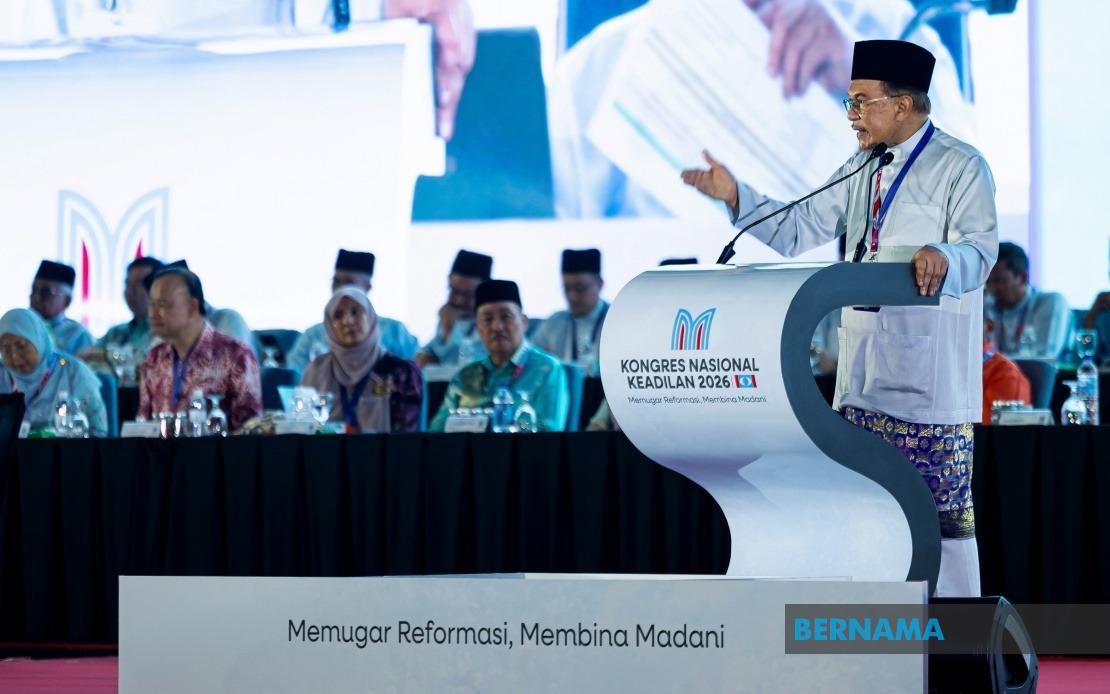
Prime Minister Datuk Seri Anwar Ibrahim moved swiftly on Thursday to dismiss mounting speculation about tensions between himself and Deputy Prime Minister Datuk Seri Dr Ahmad Zahid Hamidi, insisting their working relationship continues to function effectively despite visible strains within Malaysia's Unity Government coalition. Speaking at the 2026 PKR National Congress in Melaka, the premier directly challenged characterizations of deteriorating trust, framing such assessments as reflecting an individual's tendency to perceive conflict rather than representing objective reality.
The Prime Minister's carefully calibrated response came as former UMNO Youth leader Khairy Jamaluddin alleged that confidence between Anwar and Zahid had reached its lowest ebb since the unlikely coalition of Pakatan Harapan and Barisan Nasional first formed following the 15th General Election in 2022. Khairy's criticism appeared to strike at the heart of coalition stability precisely as the partnership faces mounting operational challenges. Rather than engage defensively with the substance of those allegations, Anwar positioned the dispute as fundamentally philosophical, distinguishing between what he described as his peaceful approach to governance and what he characterized as Khairy's confrontational worldview.
This rhetorical manoeuvre served multiple purposes within Malaysian politics' complex landscape. By framing disagreement as a matter of perspective and temperament rather than substantive policy or personal animosity, Anwar sought to minimize the political oxygen available to those questioning the coalition's viability. The Prime Minister simultaneously used the platform of the PKR congress to publicly acknowledge Zahid's instrumental contributions to the Unity Government's establishment, a gesture that functioned both as appreciation and implicit pressure against further public criticism from BN quarters.
The timing of Anwar's comments reflects broader anxieties about coalition cohesion that have intensified following Barisan Nasional's decision to cooperate with Perikatan Nasional in Negeri Sembilan's recent state election. That move represented a significant departure from the unity coalition's original architecture and signalled BN's willingness to explore alternative political partnerships when convenient. For PH components and their supporters, the development raised uncomfortable questions about whether the federal coalition remained more than a temporary convenience bound together only by immediate electoral necessity rather than shared ideological or programmatic commitments.
Anwar's insistence that internal disagreements can be resolved through dialogue and peaceful deliberation offers an optimistic diagnosis of what increasingly appears to be a more serious structural problem. The Unity Government was always an uncomfortable marriage of convenience between ideologically divergent partners who shared little beyond a mutual interest in preventing Perikatan Nasional from controlling federal power. Two years into this arrangement, both BN and PH have discovered that managing coalition dynamics whilst simultaneously positioning themselves for potential future contests demands considerable diplomatic sophistication.
The specific allegations regarding Anwar-Zahid relations merit examination beyond the Prime Minister's dismissal. Trust between political partners is built through consistent patterns of behaviour, transparent communication, and demonstrated commitment to shared objectives. When former senior figures within UMNO make public claims about deteriorating confidence at the apex of the coalition, they typically do so based on observable shifts in communication frequency, substantive consultations, or collaborative decision-making. Khairy's intervention thus represents not merely personal observation but potentially reflects broader anxieties within UMNO leadership about the partnership's future trajectory.
For Malaysian observers and regional analysts monitoring the stability of Southeast Asia's largest federal democracy, these coalition tensions carry implications beyond parliamentary mathematics. A fractured Unity Government could force earlier elections, trigger ministerial reshuffles that destabilize policy implementation, or create openings for Perikatan Nasional resurgence in peninsular politics. The economic implications of political uncertainty during periods of fiscal restructuring and social spending adjustments warrant consideration, particularly as Malaysia navigates post-pandemic recovery and addresses structural labour market challenges.
Anwar's public comments also serve to signal confidence to international stakeholders and domestic investors concerned about governance continuity. By asserting that coalition differences represent manageable disagreements rather than fundamental breakdowns, the Prime Minister attempts to maintain the narrative of stable executive authority capable of implementing medium-term policy agendas. This reassurance carries particular weight given Malaysia's role as a regional economic hub and its ongoing attractments for foreign direct investment dependent on perceived political stability.
The broader context reveals that both Anwar and Zahid face substantial incentives to maintain at least functional cooperation despite genuine strategic tensions. For Anwar, coalition collapse during his tenure would severely damage his political legacy and hand the initiative to Perikatan Nasional forces he remains committed to constraining. For Zahid, maintaining influence within federal governance whilst simultaneously preserving UMNO's independence and identity requires careful navigation of coalition obligations without surrendering critical autonomy. These mutual dependencies create pressure toward public displays of unity even as private disagreements accumulate.
Yet such interdependence, however necessary, remains fragile without deeper mechanisms for managing divergence. The Unity Government has essentially operated on the basis of implicit understandings and ad hoc negotiations rather than formal institutional structures for dispute resolution. As coalition pressures accumulate and individual ambitions increasingly diverge, reliance on personal relationships and public rhetoric becomes insufficient to prevent serious fracture. Anwar's Thursday comments represent merely the latest iteration of conflict management through rhetorical restraint rather than addressing fundamental structural vulnerabilities that continue to plague this uncomfortable partnership.
Looking forward, the stability of Malaysia's federal government will likely depend less on public assurances of unity and more on whether coalition partners can develop more durable mechanisms for managing inevitable disagreements. Whether that occurs through formal coalition agreements, institutional oversight mechanisms, or renewed personal commitment between senior leaders remains uncertain. What appears clear is that simple dismissal of tensions, however artfully expressed, offers insufficient foundation for sustaining this coalition through its next critical political test.

