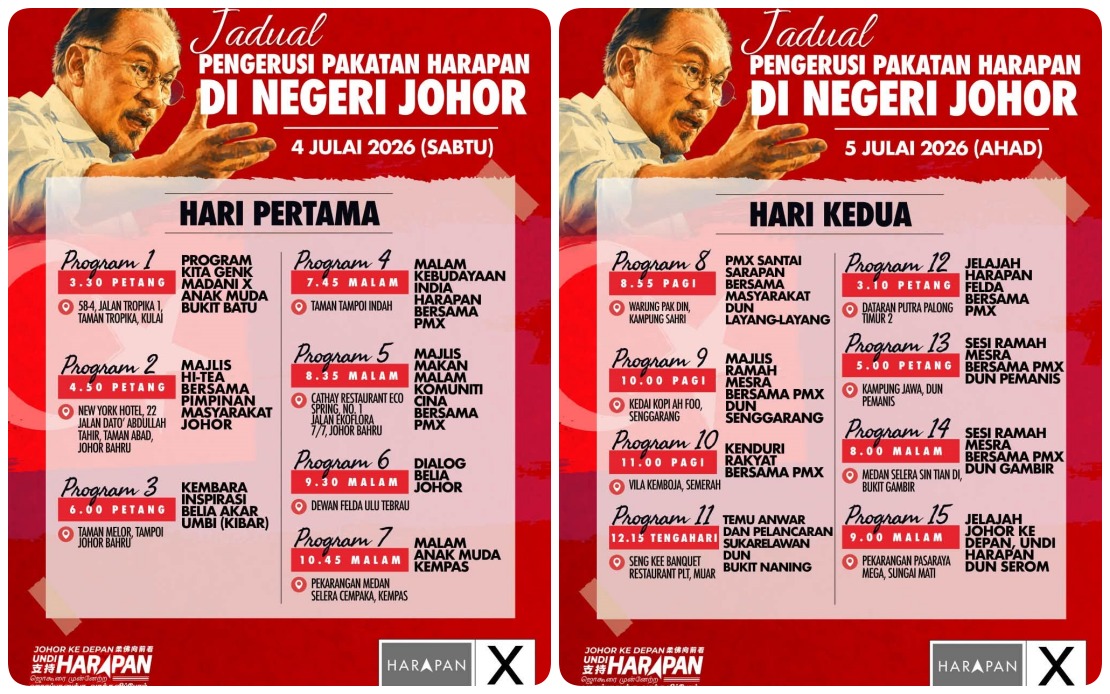
Prime Minister Datuk Seri Anwar Ibrahim is intensifying Pakatan Harapan's push in Johor with a punishing schedule of seven campaign events across the state on July 4, underscoring the coalition's determination to consolidate support in one of Malaysia's most politically significant regions. The wide-ranging programme reflects the high stakes surrounding the 16th Johor state election and signals PH's strategy of deploying its top leadership to energise grassroots activists and persuade swing voters in critical constituencies.
Anwar's itinerary demonstrates a carefully calibrated approach to reaching different voter demographics throughout the day. The Prime Minister begins with direct voter engagement sessions in the morning, moves into afternoon engagements with community leaders at a high-end hotel setting in Johor Bahru at 4.50 pm, and concludes with youth-focused programming in the evening. This sequencing reflects broader campaign strategy across the region, where mobilising younger voters has become increasingly central to modern electoral contests in Malaysia.
A dedicated youth dialogue session scheduled for 9.30 pm at Felda Ulu Tebrau Hall represents a particularly significant component of the day's activities. Youth engagement has proven consequential in recent Malaysian elections, with younger voters demonstrating distinct preferences and higher propensity to support reform-oriented candidates. By dedicating substantial campaign time to this demographic, Anwar's presence signals that PH views the youth vote as decisive in determining the election outcome.
The intensity of Anwar's campaign schedule underscores the competitive nature of the Johor contest. Pakatan Harapan is fielding candidates across all 56 state assembly seats, representing a comprehensive territorial claim that demonstrates confidence but also acknowledges the need for systematic coverage. The coalition's candidate distribution—20 from PKR, 19 from Amanah, and 17 from DAP—reflects negotiated power-sharing arrangements among the three constituent parties, with PKR's larger representation reflecting its position as the dominant coalition partner.
Johor's political significance extends well beyond the state assembly itself. As Malaysia's second-largest state by population and a traditional stronghold of Barisan Nasional, any substantial shift in Johor's political complexion would reverberate through national politics and affect the balance of forces within Parliament. A strong PH showing would substantially strengthen Anwar's political position heading into potential federal negotiations, whereas a disappointing result would embolden opposition voices questioning his leadership.
The full campaign schedule, which Anwar plans to extend with eight additional events on July 5, reveals the resource intensity of modern Malaysian electoral campaigns. Top-level leadership deployment across multiple days and dozens of events reflects both the availability of resources and the perceived importance of Anwar's personal presence in persuading voters. In Malaysian political culture, particularly in competitive contests, the attendance of senior national figures carries considerable symbolic weight and can influence local campaign momentum.
The broader electoral landscape in Johor includes 172 candidates competing across the 56 constituencies, indicating a highly fragmented contest in certain areas. This proliferation of candidates may advantage larger, better-resourced parties with superior ground organisation and media access, potentially favouring PH's campaign infrastructure compared to smaller opposition parties. However, the large candidate field also suggests that certain constituencies will feature multiple credible challengers, keeping several contests genuinely competitive.
The electoral timeline provides compressed space for campaigns to effect voter persuasion. With the election scheduled for July 11 and early voting occurring on July 7, candidates and party machinery have limited days remaining after Anwar's campaign events to consolidate any momentum generated. This compressed timeframe makes the intensive week of top-leadership engagement particularly crucial, as campaigns must generate visible momentum quickly or risk losing public attention before polling day.
For Malaysian observers, Anwar's Johor campaign intensity reflects the perceived stakes of this particular election within PH's broader political project. The coalition's performance in Johor will provide crucial indicators regarding voter appetite for continued PH governance, the resilience of the 2022 electoral coalition that brought PH to power, and whether demographic shifts are benefiting reform-oriented parties as some analysts suggest. A weak showing would raise questions about PH's viability in future federal elections, while a strong result would provide renewed momentum heading into other anticipated state contests.
The campaign events also provide PH with opportunities to present its governance record and policy agenda directly to voters, moving beyond media-filtered presentations. Community leader forums and youth dialogues create spaces where detailed policy discussion becomes possible, potentially distinguishing substantive governance performance from broader national political narratives. These direct engagement formats may prove particularly valuable for addressing voter concerns specific to Johor's economic conditions and state-level policy priorities.
Regional context adds further significance to the Johor election. A strong Johor result would strengthen PH's position in Southeast Asia's most populous democratic confederation and potentially influence how other regional governments assess Malaysia's political trajectory. Conversely, a poor showing might suggest that reform coalitions face structural challenges in sustaining electoral support, with implications for how regional observers evaluate Malaysia's democratic resilience.
Anwar's personal investment of campaign time in Johor also reflects tactical positioning within his own party and coalition. By demonstrating unwavering commitment to PH's electoral success and coupling that with visible, energetic campaign presence, Anwar consolidates his leadership credentials and demonstrates to PKR grassroots that he prioritises their electoral fortunes. This dynamic becomes particularly relevant given the highly personalised nature of Malaysian political leadership and the importance of demonstrating accessibility to party cadres.
The remaining days before July 11 will reveal whether the intensive campaign effort translates into measurable voter movement. Early voting on July 7 will provide initial indicators of turnout levels and potentially early returns on whether PH's campaign messaging has successfully mobilised core supporters and persuaded swing voters to back coalition candidates across Johor's diverse constituencies.

