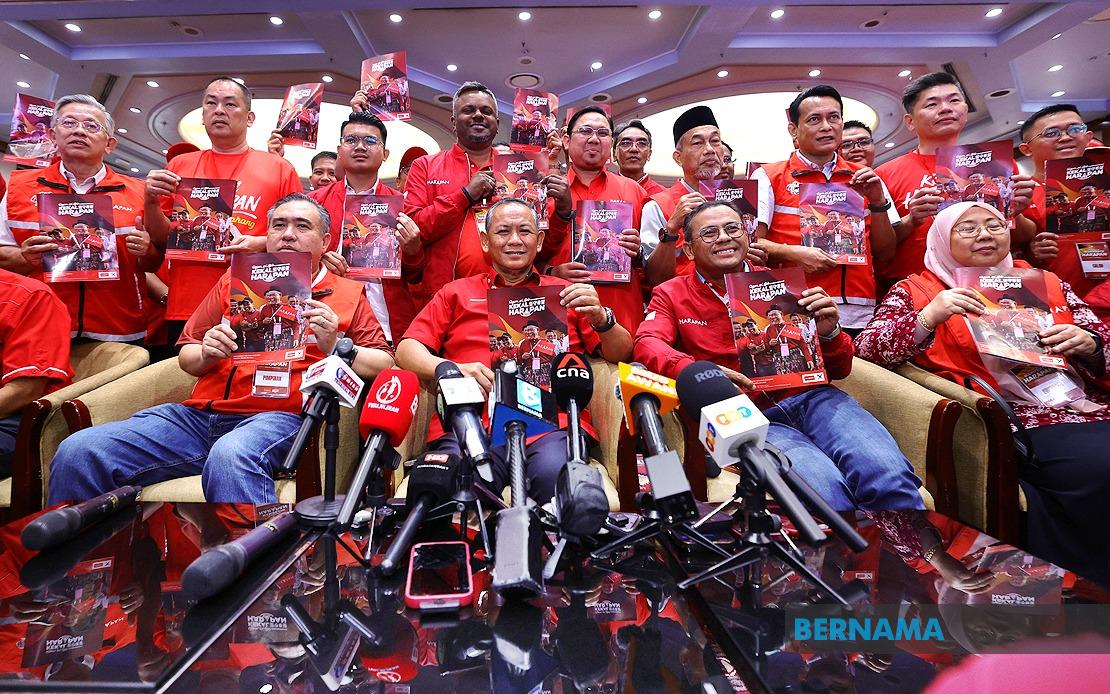
Prime Minister Anwar Ibrahim will swing through Negeri Sembilan this Wednesday to energise the Pakatan Harapan campaign machine ahead of the 16th state election scheduled for Aug 1. The party's Negeri Sembilan chairman Datuk Seri Aminuddin Harun confirmed the timeline during a manifesto launch in Seremban on Sunday, indicating that the PM's visit will encompass multiple campaign events in the constituencies of Sikamat and Paroi alongside senior party officials and ground-level election machinery.
Aminuddin downplayed the significance of Anwar's absence from the manifesto launch ceremony itself, framing the missing PM as a logistical matter rather than a sign of reduced commitment. He emphasised that the coalition had already demonstrated preparedness by unveiling its electoral platform and priorities, and that the manifesto itself represented concrete pledges the coalition intended to fulfil once in power. His reassurances reflected a common dynamic in Malaysian electoral politics, where the timing of high-profile appearances can trigger speculation about internal party dynamics or shifting priorities.
The manifesto unveiled at the Seremban event articulates Pakatan Harapan's vision across a broad spectrum of governance concerns. Administrative stability ranks prominently, alongside commitments to enhance public welfare and strengthen the state's economic competitiveness. Educational advancement, housing accessibility, youth engagement and women's empowerment feature as pillars of the coalition's proposed agenda. The platform also addresses cultural preservation, modern agricultural development, strategic infrastructure projects, tourism expansion and interethnic harmony—a comprehensive shopping list designed to address perceived voter priorities across the state's diverse demographic composition.
The gathering brought together the coalition's senior leadership ecosystem. DAP secretary-general Anthony Loke attended in his dual capacity as the party's Chennah seat candidate, while Selangor Menteri Besar Datuk Seri Amirudin Shari participated in his role as PH's election director, positioning the campaign as a pan-coalition effort rather than solely a Negeri Sembilan affair. PKR's secretary-general Datuk Dr Fuziah Salleh and Amanah vice-president Datuk Dr Mohd Hatta Md Ramli similarly lent their presence, signalling organisational cohesion within the coalition infrastructure.
Aminuddin, who is himself contesting the Linggi seat, emerged as the manifesto's primary spokesperson—a designation underscoring his standing within the state party structure and the coalition's confidence in his electoral prospects. His positioning as both party chairman and direct candidate suggests he carries responsibility for translating campaign rhetoric into tangible constituency-level results, a dual accountability that typically weighs heavily on political figures during electoral cycles.
Negeri Sembilan holds particular significance within Malaysia's broader political equilibrium. As a state capable of swinging between governing coalitions and a bellwether of voter sentiment, electoral outcomes here often influence perceptions of wider coalitional strength or fragility. The state's mixed socioeconomic profile—encompassing both industrial zones and rural districts, with a substantial Bumiputera population alongside significant non-Bumiputera communities—renders it a microcosm of Malaysia's electoral diversity. A strong showing would bolster PH's national narrative; conversely, any erosion of support would generate uncomfortable questions about the coalition's grassroots resilience.
The timing of Anwar's campaign visit sits within a conventional rhythm of Malaysian electoral strategy. With early voting scheduled for July 28 and polling day set for Aug 1, the window for high-profile presidential-style campaigning remains relatively narrow. Prime ministerial appearances function as force multipliers in Malaysian politics, typically generating media coverage and conveying an impression of institutional gravitas. That Anwar has allocated Wednesday to Negeri Sembilan underscores the state's perceived importance within PH's calculus, though it also reflects the practical constraint that sitting PMs cannot be ubiquitously present across all contested constituencies.
The manifesto's emphasis on administrative stability carries particular resonance in Negeri Sembilan's political context. Perceptions of governmental competence and effective service delivery—matters that resonate acutely at the state level where citizens interact most directly with bureaucratic systems—frequently outweigh grand national narratives in determining voting behaviour. By anchoring its platform in concrete governance domains like education, housing and infrastructure, PH seeks to reframe electoral competition around technocratic performance rather than abstract ideological differences.
The coalition's framing around economic competitiveness similarly addresses a constituency concern. Negeri Sembilan's economy, while diversified, remains vulnerable to broader regional and global economic fluctuations. Agricultural modernisation and infrastructure investment represent tangible policy levers through which state governments can influence local prosperity, making these manifesto planks more than rhetorical flourishes. The emphasis on youth development and women's empowerment additionally signals PH's attempt to consolidate support among demographic segments that have demonstrated volatility in recent electoral cycles.
The presence of multiple coalition parties at the manifesto launch—representing the DAP's urban-oriented voter base, PKR's grassroots network and Amanah's specific constituencies—visually demonstrated the architecture of PH as a functioning multi-party alliance rather than a single monolithic entity. This staging became particularly important given ongoing speculation about intra-coalition tensions, resource allocation disputes and differing policy preferences within PH. By appearing unified around a shared manifesto, the coalition attempted to project an image of organisational coherence to both supporters and wavering voters.
For Malaysian observers monitoring state-level politics, the Negeri Sembilan election serves as a testing ground for broader coalitional strategies and messaging approaches. The state's results will likely furnish data points informing how PH and opposition coalitions calibrate their appeals ahead of potential federal elections. The campaign visit by Anwar, then, represents more than local constituency-level activity—it constitutes part of a higher-order political performance designed to demonstrate prime ministerial engagement with sub-national contests and reaffirm PH's institutional commitment to winning and governing states beyond its traditional strongholds.

