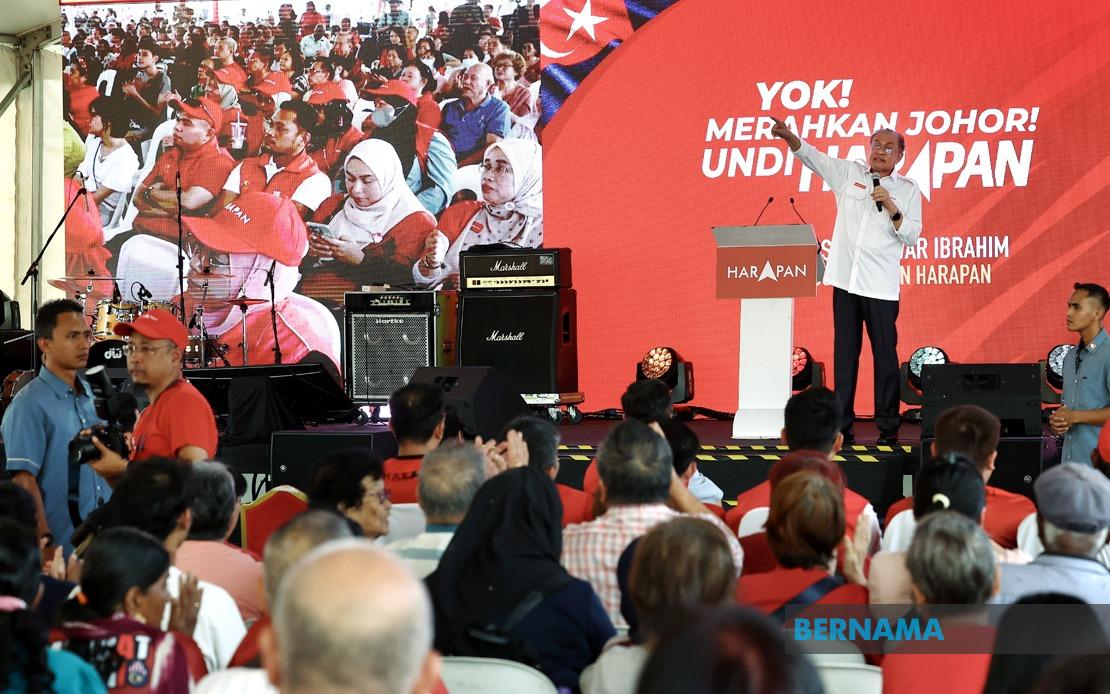
Prime Minister Datuk Seri Anwar Ibrahim has issued a direct appeal to all parties contesting the Johor state election, urging them to abandon the incarceration of former Prime Minister Datuk Seri Najib Razak as a talking point in their campaign messaging. Speaking at a Pakatan Harapan rally in Kulai, Anwar characterised continued references to Najib's prison sentence as a distraction from the substantive governance challenges facing the nation, implying that electoral contenders should redirect their energies toward addressing tangible concerns affecting ordinary Malaysians.
The timing of Anwar's intervention reflects the sensitive nature of the Najib question within Malaysian politics. Though the former premier is currently serving his sentence, the circumstances surrounding his conviction and the broader 1MDB scandal remain deeply polarising among voters and within the political establishment. By calling for a cessation of campaign rhetoric centred on Najib, Anwar appears to be attempting to establish a higher standard of political discourse for the Johor contest, one supposedly grounded in policy substance rather than personalised attacks or references to recent high-profile legal proceedings.
Anwar's core contention rests on the argument that deploying Najib's predicament as campaign material obscures the real financial obligations now binding the government. The Prime Minister emphasised that the nation continues to grapple with an outstanding 1MDB debt totalling RM51 billion—a sum that, in his estimation, represents a profound opportunity cost for Malaysia's development trajectory. This framing transforms what might otherwise appear as a plea for civility into a statement about fiscal responsibility and the lingering consequences of previous administrations' decisions.
The monetary burden stemming from the 1MDB affair has become one of the defining fiscal challenges for the current government. With RM51 billion still owed, Anwar underscored the practical implications of this obligation by outlining what resources might otherwise have been directed toward public services. Schools remain under-resourced in numerous communities; hospital infrastructure across the country struggles with aging facilities and capacity constraints; road networks in both urban and rural areas require substantial investment; and social assistance programmes aimed at vulnerable populations operate under perpetual budget constraints. Each of these areas, in Anwar's framing, represents a legitimate claim on public funds that remains unfunded precisely because of the debt servicing obligations inherited from the 1MDB misappropriation.
The statement also carries implications for Malaysian political culture more broadly. By attempting to establish this boundary—that discussion of Najib's incarceration should not feature prominently in electoral campaigns—Anwar is potentially seeking to establish norms around what constitutes acceptable campaign rhetoric. This reflects a broader global trend wherein political leaders attempt to elevate discourse standards, though the effectiveness of such appeals often depends on whether opposing camps view them as genuine expressions of principle or as strategic manoeuvres designed to limit discussion of inconvenient topics.
For Johor voters specifically, Anwar's intervention suggests that the incumbent coalition intends to fight the state election primarily on competence and delivery grounds rather than relying heavily on references to Najib's downfall. This strategic choice implies confidence in the government's record on economic and social management, at least insofar as that record might be presented and defended in the Johor context. Whether opposition parties will heed this call remains to be seen, as some may view continued references to 1MDB as integral to their electoral positioning, particularly if they are attempting to differentiate themselves from the ruling coalition.
The presence of Youth and Sports Minister Mohammed Taufiq Johari, Deputy Investment, Trade and Industry Minister Sim Tze Tzin, and other senior Pakatan Harapan figures at the Kulai rally underscored the importance the coalition places on the Johor campaign. Their attendance alongside Anwar represented a show of organisational unity and suggested that the 1MDB debt and its consequences would indeed feature in the coalition's broader messaging, even if direct references to Najib's imprisonment were to be avoided.
Anwar's emphasis on the practical consequences of the 1MDB scandal—rather than its sensational dimensions or legal proceedings—also shifts the conversation onto ground that may be more advantageous to the government. Voters concerned primarily with pocketbook issues, service delivery, and infrastructure quality might find arguments centred on fiscal constraints and misallocated resources more persuasive than those dwelling on personalised accountability or punishment. This rhetorical move effectively attempts to reframe the 1MDB narrative from one of justice and retribution into one of resource management and competing priorities.
The scale of the RM51 billion debt cannot be overstated in the Malaysian context. For perspective, this figure represents a substantial proportion of annual government revenue and reflects the magnitude of resources that might otherwise be available for developmental spending. Over successive years, the interest payments and principal repayment obligations associated with this debt will constrain budgetary flexibility, potentially limiting the government's ability to launch new initiatives or expand existing programmes, even as demographic changes and economic pressures create mounting demands on public services.
Anwar's intervention also carries diplomatic dimensions. By urging contestants to cease politicising Najib's incarceration, the Prime Minister positioned the government as transcending partisan point-scoring in favour of focusing on collective challenges. This framing, if accepted by voters and media observers, could burnish the ruling coalition's image as a force for stability and constructive governance. Conversely, if opposition parties reject the call and continue featuring Najib prominently in their campaigns, they risk being characterised as engaged in divisive or backward-looking politics.
The Johor state election itself represents a significant test for the Pakatan Harapan coalition, as it competes to maintain or expand its influence in a state where political loyalties remain contested and fluid. The decision to establish this boundary around campaign discourse—to declare Najib's situation off-limits for electoral ammunition—reflects strategic calculations about which messages will resonate most effectively with the voting public and which will most convincingly distinguish the government's approach from that of its rivals.

