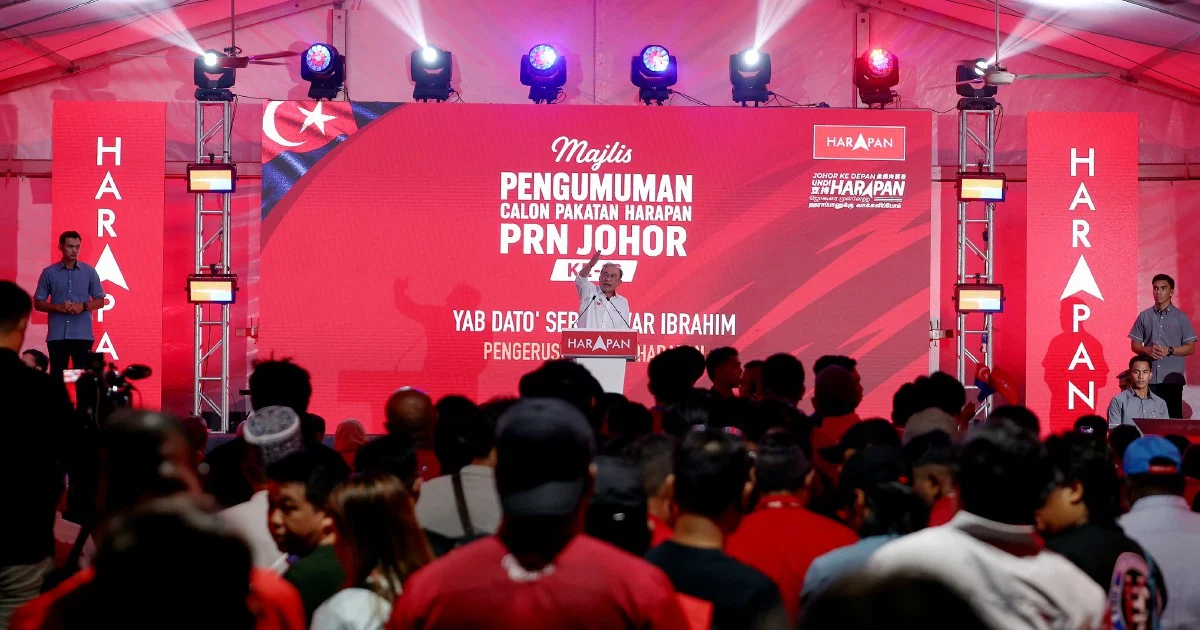
Pakatan Harapan chairman Datuk Seri Anwar Ibrahim has drawn a clear distinction between electoral competition and the constitutional role of Johor's royal institutions, arguing that the upcoming state election must remain confined to the political arena. Speaking at Tangkak, Anwar emphasised that voters should decide the election's outcome based on policy platforms and party performance, rather than allowing monarchical bodies to influence the democratic process. His statement reflects broader concerns within Malaysia's political establishment about maintaining clear boundaries between the nation's constitutional monarchy and its electoral system.
Anwar's intervention into the Johor campaign carries particular weight given his position as the Prime Minister and PH chairman, signalling that his coalition views the electoral process with considerable seriousness. The statement implies that opposition voices have raised concerns about royal institutions being drawn into political calculations, a sensitive matter in Malaysia's constitutional framework. By explicitly calling for separation between these spheres, Anwar is attempting to reassure voters that the democratic process will be conducted with respect for constitutional protocols while remaining free from external pressures.
The distinction Anwar draws reflects Malaysia's unique constitutional structure, where the Yang di-Pertuan Agong and state rulers hold important ceremonial and consultative powers. However, these powers are constitutionally circumscribed and should not extend to direct interference in electoral outcomes or campaign processes. The reminder becomes necessary when electoral temperatures rise and political actors seek to mobilise all possible advantages, sometimes by invoking cultural or institutional legitimacy beyond the purely political domain.
Johor's electoral importance cannot be overstated within Malaysia's political landscape. As the nation's second-largest state by population and a traditional BN stronghold, Johor's composition in the state assembly directly influences national political calculations. Control of Johor affects coalition mathematics in parliament, shapes regional power dynamics, and determines resource allocation at the state level. Any suggestion that royal institutions might favour one electoral outcome over another risks undermining public confidence in both the monarchy and the electoral system itself.
Anwar's assertion that political battles should remain within appropriate boundaries suggests he wants to insulate the monarchy from partisan pressure while establishing clear rules of electoral engagement. Malaysia's experience with elections has occasionally seen attempts to invoke royal sentiment in support of particular candidates or parties, a practice that Anwar is effectively warning against. By stating his position publicly, he is signalling that PH expects all parties to conduct their campaigns within secular political frameworks rather than attempting to leverage constitutional institutions for electoral advantage.
The timing of Anwar's remarks indicates mounting campaign intensity in Johor. As election day approaches, candidates and parties intensify their appeals to voters, and the temptation to invoke symbols beyond party politics increases proportionally. Royal symbols carry particular resonance in Malaysian culture and politics, making them potentially powerful but constitutionally problematic tools in electoral campaigns. Anwar's statement serves as a preemptive clarification that such approaches would be inappropriate and counterproductive.
From a Southeast Asian perspective, Malaysia's experience in maintaining monarchical institutions while developing democratic practices offers instructive lessons about institutional balance. Unlike parliamentary democracies where the head of state exists entirely outside electoral politics, Malaysia's system requires active constitutional engagement with the monarchy while preserving electoral integrity. This delicate equilibrium demands that political leaders regularly reaffirm the separation between campaigns and royal prerogatives, as Anwar is doing.
The PH chairman's intervention also reflects broader anxieties about institutional independence in Malaysian politics. Recent years have witnessed considerable debate about the appropriate roles of various constitutional bodies, from the monarchy to the judiciary to the military. By explicitly advocating for electoral autonomy, Anwar positions his coalition as defender of democratic norms and institutional restraint, contrasting this positioning with suggestions that opponents might be tempted to mobilise extrapolitical resources in support of their campaigns.
For voters in Johor, Anwar's message provides reassurance that the election will be decided on substantive grounds—performance records, policy proposals, local development, and leadership competence. It promises that the campaign will not descend into institutional conflicts or attempts to invoke royal authority to settle partisan disputes. This framing appeals to citizens who value both democratic participation and respect for constitutional institutions, positioning PH as committed to orderly democratic processes.
The statement also carries implications for how subsequent Johor campaigns will be conducted. By publicly staking out this position, Anwar creates expectations that all parties will observe these boundaries. Should opposition parties or any other political actors attempt to invoke royal institutions in their campaigns, Anwar's prior statement will serve as benchmark against which such conduct can be measured and criticized. This preemptive positioning strengthens his moral authority to critique any perceived boundary violations.
Anwar's remarks must also be understood within Malaysia's broader constitutional conversation. The nation continues to negotiate the proper relationship between its traditional institutions and its modern democratic systems. Rulers occupy revered positions in Malaysian society and the constitutional order, but their power must operate within defined parameters that respect electoral autonomy. By emphasising this distinction, Anwar contributes to ongoing national debate about institutional balance and democratic development.

