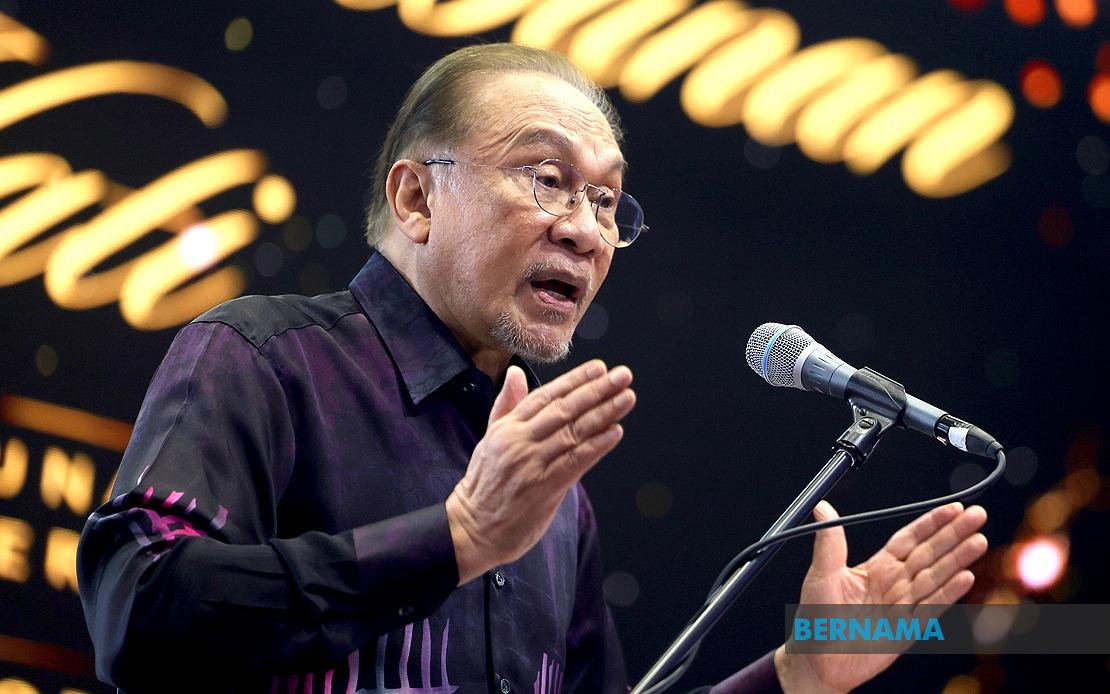
Prime Minister Datuk Seri Anwar Ibrahim delivered an impassioned appeal for national cohesion at a gathering in Seremban on June 20, urging Malaysians from all communities to resist attempts by certain leaders to sow ethnic discord. Speaking at a dinner function hosted by Pertubuhan Lima Generasi Malaysia, Anwar stressed that the nation's capacity to thrive depends fundamentally on citizens rejecting the temptation of racial antagonism and instead embracing the cooperative spirit that has historically defined Malaysian society.
The prime minister articulated a vision of Malaysia grounded in its ethnic plurality, portraying diversity not as a source of inherent tension but as a competitive advantage in an increasingly interconnected world. He emphasized that Malaysia's multiethnic composition—encompassing Malays, Chinese, Indians, Kadazans, and other communities—constitutes one of the country's most valuable assets, provided that this diversity is underpinned by genuine mutual respect and substantive cooperation across communal lines. This framing positions intercommunal harmony not merely as a moral imperative but as an economic and political necessity for national progress.
Anwar specifically called out the divisive rhetoric being deployed by certain political figures who seek to weaponize ethnic identity for electoral or factional advantage. He characterized efforts to pit Malays against Chinese, Chinese against Indians, and Indians against Malays as fundamentally corrosive to the national project, describing such tactics as appeals to the baser instincts of voters rather than to their better nature or shared interests. The prime minister's explicit naming of this pattern suggests growing concern within government circles about the intensification of communal messaging in contemporary Malaysian politics, where politicians have increasingly found electoral success through appeals to narrow ethnic grievances.
The remarks carry particular significance given the fractious state of Malaysian politics in recent years, marked by episodes of intensified communal polarization and the emergence of identity-based political movements that have challenged the more inclusive platforms traditionally associated with the ruling coalition. Anwar's intervention at a Seremban event—in Negeri Sembilan, governed by Menteri Besar Datuk Seri Aminuddin Harun who also attended—demonstrates the government's commitment to projecting messages of unity across its territorial base and institutional structures. The participation of the state government underscores that this appeal for cohesion emanates not solely from federal leadership but reflects a coordinated messaging strategy.
The Pertubuhan Lima Generasi Malaysia, the organization hosting the event, represents a grassroots movement focused on community engagement and civil society participation. The gathering of more than 1,000 members provided Anwar with a platform to communicate directly with activist-oriented citizens who typically serve as opinion leaders and community organizers within their respective neighborhoods and networks. By addressing such civic organizations, the prime minister seeks to mobilize what might be termed the moderate middle ground—citizens who reject extremist positioning on either side of ethnic divides and who can serve as advocates for inclusive politics within their own social circles.
Anwar's emphasis on collective strength through unity reflects a strategic recognition that Malaysia's competitive position in Southeast Asia and the broader global economy depends on internal stability and the productive mobilization of its human capital across all communities. Persistent ethnic polarization imposes significant costs on the nation, fragmenting the labor market, complicating governance, discouraging foreign investment, and consuming political energy that might otherwise be directed toward addressing concrete policy challenges in education, healthcare, infrastructure, and economic opportunity. The prime minister's message implicitly invokes these practical consequences of division while celebrating the demonstrable achievements possible through multiethnic cooperation.
The timing of these remarks occurs against a backdrop of ongoing political maneuvering within Malaysia's coalition government and competition with opposition groups for electoral dominance. Various political actors have sought to mobilize ethnic constituencies through targeted messaging, and Anwar's public intervention represents an attempt to establish what might be characterized as a moral and practical counterweight to such strategies. By framing unity as the authentic expression of Malaysian identity and values, the government seeks to delegitimize divisive rhetoric even as it competes for votes and political support within an increasingly segmented electorate.
For Malaysian readers and observers across Southeast Asia, the prime minister's statement reflects broader tensions between inclusive nation-building rhetoric and the particularistic appeals that often prove electorally effective in multicommunal democracies. The challenge of constructing and maintaining cross-ethnic coalitions remains fundamental to Malaysian politics, and Anwar's emphasis on unity addresses this persistent structural reality. His framing suggests that government strategy depends partly on appealing to citizens' higher instincts and shared interests rather than attempting to compete with opposition groups in mobilizing narrow communal grievances.
The appeal also carries implications for regional dynamics, as ASEAN's success depends significantly on its member states' capacity to manage internal diversity and maintain political stability. Malaysia's experience as a longstanding multiethnic democracy—despite periodic communal tensions—provides important lessons for other Southeast Asian nations grappling with similar challenges of accommodating diverse populations within single political frameworks. The prime minister's public commitment to unity and his explicit rejection of communal polarization reinforces Malaysia's positioning as a voice for moderation within regional discourse.
Looking forward, the effectiveness of Anwar's message will likely depend on whether the government can translate such rhetorical appeals into concrete policy outcomes that demonstrably benefit all communities and address the material grievances that sometimes fuel ethnic resentment. Speeches celebrating unity, while important for establishing the ideological foundations of inclusive governance, must be accompanied by economic policies, resource allocation, and institutional practices that reinforce the message that all Malaysians share a common stake in national prosperity. The true test of commitment to unity lies not in ceremonial gatherings or stirring rhetoric, but in the sustained allocation of resources and political attention to ensure that Malaysia's diversity genuinely functions as a source of collective strength rather than vulnerability.

