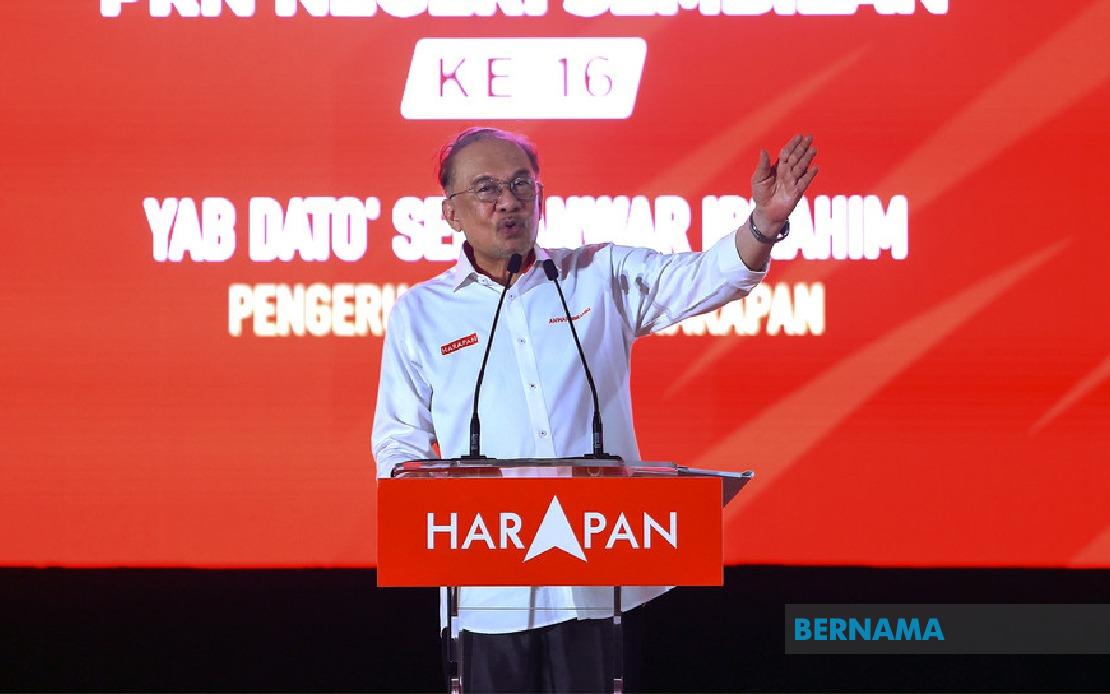
Prime Minister Datuk Seri Anwar Ibrahim has made a direct appeal to voters in Negeri Sembilan to maintain their support for Pakatan Harapan in the state election scheduled for August 1, arguing that electoral continuity is essential to preserve momentum on infrastructure and public welfare programmes across the state. In a social media statement released as the campaign period began, Anwar positioned the upcoming poll as a critical juncture for the economically important central region, framing the election not merely as a routine democratic exercise but as a referendum on the coalition's stewardship.
The timing of Anwar's intervention underscores the significance Kuala Lumpur attaches to retaining control of Negeri Sembilan, a state that occupies a strategic position within Malaysia's economic corridor and has long been regarded as a political bellwether. As both Prime Minister and chairman of the Pakatan Harapan coalition, Anwar's public plea carries substantial weight within party ranks and signals the coalition's determination to resist any erosion of support in a state where PH has held the mentri besar position since 2018. The emphasis on continuity resonates with a broader political narrative that portrays development as a fragile achievement vulnerable to disruption through electoral uncertainty.
Much of Anwar's argument rests on the track record of Menteri Besar Datuk Seri Aminuddin Harun, whom he characterised as embodying qualities of integrity and administrative competence. The Prime Minister's invocation of Aminuddin's leadership style—emphasising humility and accountability—appears designed to deflect potential criticism that might arise from opposition parties contesting the state election. By framing the incumbent as a capable administrator rather than a partisan political operator, Anwar attempts to elevate the contest above routine partisan competition and grounds his appeal in governance performance rather than ideological positioning.
The coalition's emphasis on federal-state collaboration reflects a genuine structural advantage that PH enjoys in Negeri Sembilan. With the same coalition commanding both state and federal governments, there exists operational synergy in project implementation, budgetary allocation, and administrative decision-making that would be disrupted were an opposition party to win control of the state assembly. This interconnection between state and federal governance has enabled faster project cycles and more efficient resource deployment, benefits that voters may tangibly experience through improved infrastructure, services, and employment opportunities.
For Malaysian and Southeast Asian observers, the Negeri Sembilan election carries broader implications beyond the state itself. It represents one of the key tests of whether Anwar's Federal Government can consolidate political support and maintain coalitional stability following years of flux within Malaysian politics. A strong showing would reinforce the notion that Pakatan Harapan has achieved a degree of political bedding-in after the turbulence of the 2022 general election. Conversely, any significant loss of support would signal fractures that could embolden opposition parties and complicate governance at the federal level.
The electoral calendar compressed into a fortnight—with nominations on Saturday, early voting on July 28, and polling day on August 1—means that campaign dynamics will move at an accelerated pace. Anwar's early positioning allows PH to set the interpretive frame before opposition messaging gains traction, establishing a narrative centered on development and stability rather than allowing opponents to define the contest around dissatisfaction or alternative visions. The short campaign period also limits the time available for opponents to mobilise grassroots discontent, if any exists.
Negeri Sembilan's economic profile makes it particularly important to the federation's prosperity. The state sits within the Klang Valley's extended periphery and benefits from its proximity to the federal territory's commercial and manufacturing sectors. Infrastructure projects, industrial development zones, and connectivity improvements across Negeri Sembilan have multiplier effects that ripple through the broader national economy. Voters in the state are thus acutely aware that electoral outcomes influence their economic livelihoods through the quality of public investment and the stability of governance frameworks.
Anwar's appeal also contains an implicit warning against political fragmentation and the paralysis that can accompany divided government. The invocation of halting progress "halfway" suggests that opposition victory would not merely represent an alternative governing approach but would constitute a reversal or abandonment of existing trajectories. This framing may resonate with voters who have experienced the disruptive effects of political instability in recent years and who prioritise predictability and sustained implementation of development strategies.
The coalition's strategy appears to hinge on the argument that Aminuddin's leadership has earned democratic endorsement through demonstrable results rather than merely through party loyalty or factional alignment. By elevating the personal standing of the incumbent mentri besar, Anwar provides cover for PH supporters who might otherwise feel ambivalent about electoral participation and offers the coalition's wavering supporters a compelling reason to remain engaged with the coalition's political project. This personalisation of governance also allows PH to deflect criticism that might otherwise attach to the coalition as a whole by attributing achievements to individual leadership qualities.
As the election approaches, the fundamental question before Negeri Sembilan voters concerns whether the benefits of continued Pakatan Harapan stewardship outweigh any accumulated frustrations with coalition governance. Anwar's public intervention indicates that PH leadership perceives genuine risk in the electoral outcome and believes that active mobilisation from the federal level remains necessary to secure victory. The appeal to maintain momentum represents an attempt to translate abstract governance achievements into concrete electoral support, converting institutional stability into votes.

