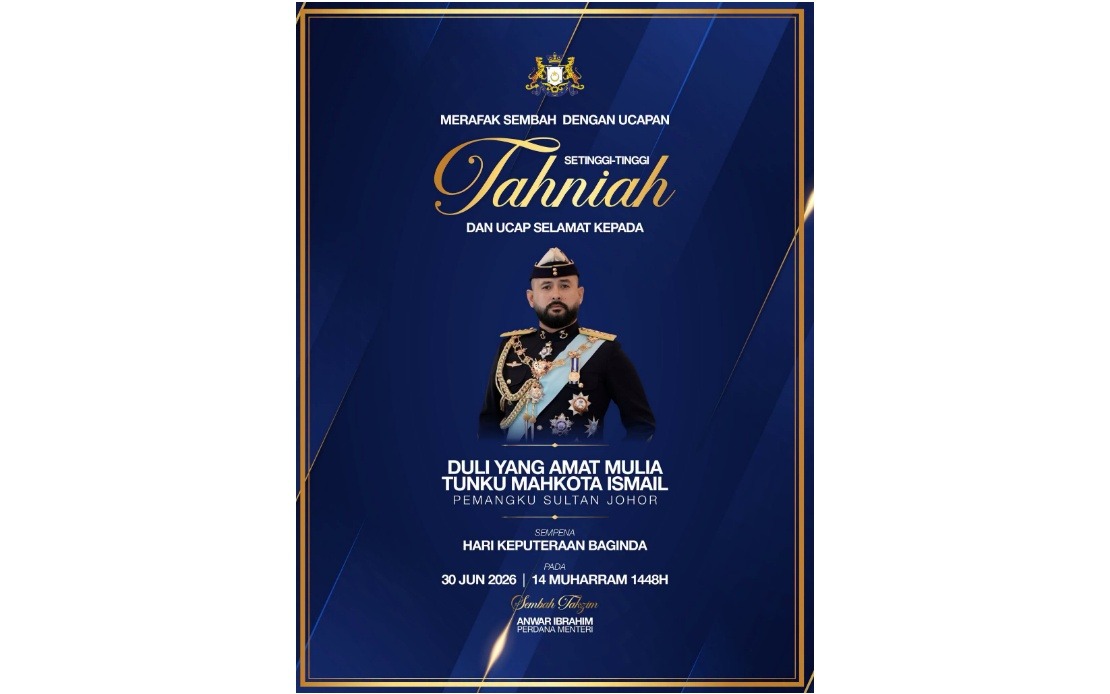
Prime Minister Datuk Seri Anwar Ibrahim has marked the birthday of Tunku Mahkota Ismail, the Regent of Johor, with warm congratulations and expressions of goodwill. The gesture, shared through a Facebook post on June 30, reflects the customary protocol extended by Malaysia's top political leadership to members of the royal institution during significant personal occasions. Anwar's message centred on wishes for the Johor regent to enjoy sustained good health, personal well-being, and continued blessings as he navigates his responsibilities.
The Prime Minister's acknowledgement carries particular significance given the prominent role that Johor and its royal family hold within Malaysia's constitutional framework. As one of the nine sultans whose representatives participate in the election of the Yang di-Pertuan Agong, the Regent of Johor occupies a position of considerable constitutional weight. Tunku Mahkota Ismail, in his capacity as regent, acts as the reigning authority of Darul Ta'zim during periods when the Sultan is unavailable or overseas, making his leadership directly consequential for the approximately 4.2 million residents of the state.
Deputy Prime Minister Datuk Seri Dr Ahmad Zahid Hamidi similarly extended his felicitations through social media, though his message incorporated more explicit reference to the regent's governing responsibilities. Zahid's statement emphasised the importance of divine protection and continued wisdom in administering Johor Darul Ta'zim and representing the interests of the Bangsa Johor. The invocation of Allah's guidance and mercy in matters of state governance reflects the manner in which religious and constitutional language interweave within Malaysian political discourse, particularly when addressing the royal institution.
Such public birthday acknowledgements between the executive and the royal household serve multiple functions within Malaysia's constitutional monarchy. They demonstrate respect for the separation of powers while simultaneously affirming the bonds of institutional cooperation that underpin the nation's governance structure. For a diverse, multi-ethnic federation like Malaysia, where the monarchy functions partly as a unifying symbol transcending partisan politics, these moments of formal courtesy carry symbolic weight beyond their surface-level pleasantries.
The timing and manner of these wishes also reflect contemporary Malaysian political communication practices, with Facebook serving as the preferred platform for senior government officials to address the public and state their positions. This reflects the digitalisation of political messaging in Malaysia, where social media announcements often carry the same weight as traditional press releases or formal statements. Both the Prime Minister and Deputy Prime Minister ensured their birthday wishes reached wide audiences, reinforcing public awareness of the nation's leadership structure and its relationship with the monarchy.
Johor's administrative and economic importance cannot be understated in the Malaysian context. As the second-largest state by population and home to significant manufacturing, port, and agricultural sectors, the state's governance directly affects broader regional prosperity. The smooth functioning of Johor's administration depends partly on harmonious relations between the state's royal leadership and the federal government, making these ceremonial acknowledgements part of the broader fabric of intergovernmental coordination.
The Regent's position, whilst ceremonial in many respects, carries genuine authority in constitutional matters affecting the state. Tunku Mahkota Ismail has in recent years become an increasingly visible figure in Johor's public affairs, attending state functions, visiting communities, and engaging in developmental initiatives. His birthday recognition by the nation's two senior-most political leaders underscores the continued relevance of royal institutions within Malaysia's political architecture, even as the country navigates democratic processes and evolving governance challenges.
For Southeast Asian observers, Malaysia's ceremonial acknowledgement of royal occasions offers insight into how constitutional monarchies operate within the region. Unlike some neighbouring countries where the monarchy maintains greater distance from electoral politics, Malaysia's system integrates royal institutions directly into constitutional mechanisms, creating a unique balance between elected representatives and hereditary authority. The birthday wishes from Anwar and Zahid exemplify this model in action, demonstrating how political leadership acknowledges and respects the institutional role of the monarchy.
Looking forward, the relationship between the federal government and Johor's leadership will likely remain significant as Malaysia addresses economic recovery, regional connectivity initiatives, and internal political stabilisation. The cordial exchange of birthday greetings between national and state-level leadership, though ostensibly ceremonial, serves as a barometer of institutional health and cooperation. Such moments, amplified through digital platforms, contribute to public confidence in the coherence and stability of Malaysia's constitutional framework during periods when political tensions elsewhere might suggest otherwise.

