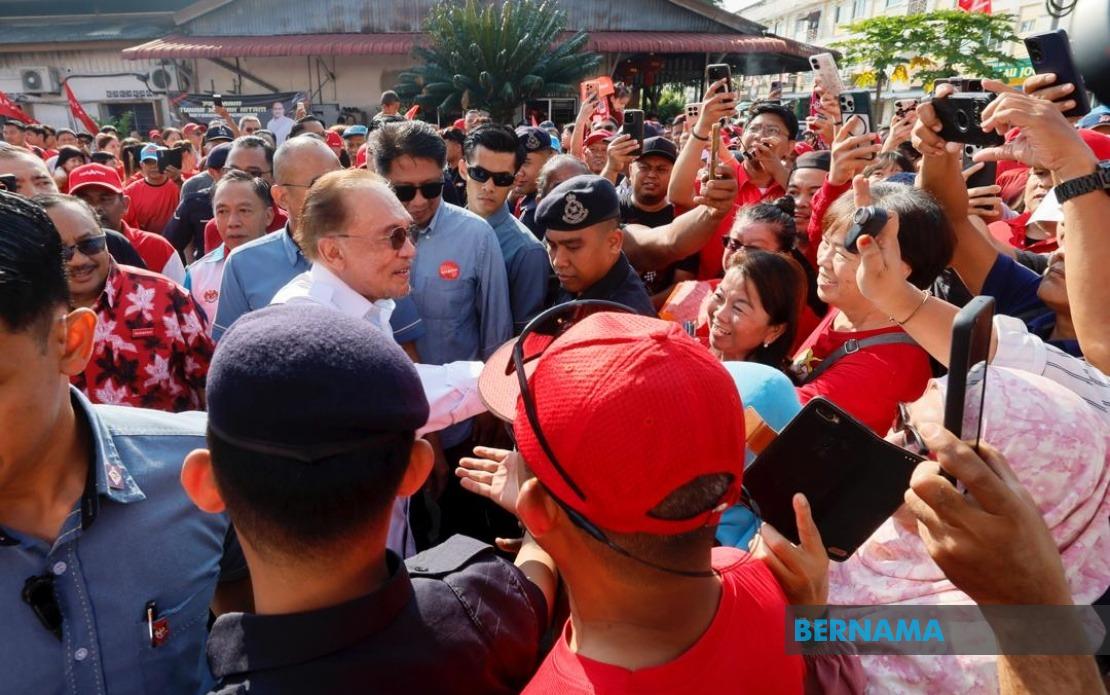
Prime Minister Datuk Seri Anwar Ibrahim's appearance at a grassroots campaign event in Simpang Renggam has injected fresh momentum into Pakatan Harapan's push for victory in the Johor state election, with the visit generating tangible enthusiasm among party machinery and candidates on the ground just days before polls open on July 11. The unscheduled gathering, held on the ninth day of the two-week campaign period, attracted more than 1,000 residents who seized the chance to meet Anwar and directly engage with coalition candidates contesting in nearby state seats.
PH's Machap candidate Nur Hafiz Roslan described the Prime Minister's visit as far more than a symbolic gesture, emphasising that Anwar's hands-on participation sent a powerful signal about the coalition's campaign philosophy and operational priorities. Beyond the headline value of a prime ministerial appearance, Nur Hafiz underscored how Anwar's message—rooted in concepts of public service and spiritual rectitude—reshaped the tone of local campaign conversations, redirecting discussion away from partisan conflict toward community welfare and governance delivery. The emphasis on serving constituents without favouritism emerged as a central theme Anwar relayed during his interactions with campaign personnel and voters alike.
Anwar's messaging to candidates in the region focused on executing campaign work with diligence while maintaining ethical and spiritual standards, a positioning that reflects broader concerns within PH about distinguishing its campaign conduct from that of rivals. For Nur Hafiz, this framing proved particularly valuable in the context of Simpang Renggam parliamentary constituency and the two adjacent state seats, where community trust and candidate credibility directly influence voter decisions. The Prime Minister's emphasis on delivering impartial public services—a commitment Nur Hafiz pledged to uphold—addresses persistent voter concerns about political patronage and resource allocation disparities in Johor.
Guna Balakrishnan, PH's candidate for the Layang-Layang state seat, credited Anwar's visit with strengthening his personal connection to voters and providing validation for intensified community outreach efforts. Despite reported encouragement from local residents, Guna recognised that sustained voter engagement represented the critical difference between polling day sentiment and actual electoral performance. Anwar's explicit directive to Guna—that electoral success must translate into tangible area development and community welfare programmes—framed the stakes of the election in concrete, local terms, moving beyond ideological appeals to practical governance commitments.
The casual, interactive format of the gathering distinguished this campaign event from formal political rallies typical of Malaysian elections. The 'PMX Santai Sarapan Bersama Masyarakat' (Anwar's Casual Breakfast With Community) programme's deliberately informal tone appeared designed to humanise the Prime Minister and create space for unmediated voter interaction. Attendees repeatedly highlighted Anwar's approachable demeanour and the relaxed atmosphere as factors that influenced their assessment of coalition candidates and campaign sincerity. This approach carries particular significance in Johor, where voter perceptions of leader accessibility and authenticity have shaped electoral outcomes in recent cycles.
Voter testimonies from the event reveal how leadership presence translates into ground-level campaign effects. Chuan Chee Mei, 48, indicated that witnessing Anwar's direct support for local candidates and willingness to participate in community settings substantially strengthened her household's commitment to backing PH candidates. Similarly, Noor Takiyudin Salleh, 38, attributed his voting intention partly to the visibility and apparent sincerity demonstrated through the Prime Minister's casual public engagement. These individual reactions, multiplied across the 1,000-plus attendees, suggest measurable shifts in voter sentiment and campaign momentum within the targeted constituencies.
The timing of Anwar's visit reflects strategic campaign calculations about where PH resources should be concentrated during the final week before July 11 polling. Machap and Layang-Layang represent competitive seats where campaign intensity and voter mobilisation could prove decisive, making prime ministerial intervention a calculated investment rather than random appearance. For Johor, where PH and rival coalitions maintain relatively competitive positions in multiple state constituencies, marginal improvements in voter turnout and last-minute persuasion efforts can alter seat distributions significantly.
The broader context of the Johor state election—encompassing 172 candidates contesting 56 seats across two election days, with early voting scheduled for July 7—underscores the logistical intensity and compressed timeframe within which campaigns operate. PH's decision to deploy Anwar personally into specific constituencies indicates confidence in these seats' electoral viability while acknowledging that campaign infrastructure alone may require high-level reinforcement. The ground organisation required to assemble and manage 1,000-plus voters for a morning campaign event demonstrates the operational sophistication PH has maintained in Johor despite mixed recent electoral performance.
For Malaysia's broader political landscape, the Johor election serves as a significant indicator of coalition strength heading into potential federal electoral cycles. Johor's voting patterns have historically influenced federal outcomes, making the state's July 11 results consequential beyond state-level governance questions. PH's campaign approach in constituencies like Machap and Layang-Layang—emphasising accessible leadership, concrete community commitments, and ethical governance—establishes messaging templates potentially deployable in wider political contests. Conversely, campaign performance in these seats will inform coalition strategists about voter receptiveness to current PH positioning and messaging frameworks.
The emphasis within the campaign gathering on service delivery without discrimination directly addresses voter concerns documented across Malaysian constituencies regarding resource allocation and political patronage. By centering campaign discourse on equitable governance and public welfare, PH leadership attempts to differentiate coalition campaign positioning and appeal to swing voters increasingly concerned about governance quality and institutional fairness. Whether such messaging translates into voting behaviour depends substantially on voter confidence in PH's historical governance delivery and future capacity to implement pledged policies.
Candidates' descriptions of the Prime Minister's visit as motivational rather than simply symbolic suggest its value extends beyond immediate media coverage into campaign team morale and volunteer retention. Campaign workers operating in competitive constituencies face psychological pressures and physical demands that high-level leadership presence can ameliorate. Anwar's personal attendance and engagement with grassroots operatives appears to have restored motivation among party machinery in Machap and Layang-Layang, potentially translating into more sustained voter outreach efforts during the final campaign week.
As the July 11 polling date approaches, momentum shifts initiated through prime ministerial visits become increasingly difficult to reverse, creating potential advantages for coalitions able to generate such events effectively. PH's deployment of Anwar to specific Johor constituencies demonstrates confidence in these seats while implicitly signalling areas where coalition performance may be vulnerable. The measured voter responses documented from Simpang Renggam suggest Anwar's campaign intervention achieved its apparent objectives of reinforcing candidate credibility and consolidating marginal PH support.
The Johor state election ultimately reflects broader questions about Malaysian coalition politics, voter preferences for leadership styles and governance approaches, and the persistent importance of local constituency dynamics in electoral outcomes. PH's Johor campaign, as demonstrated through events like the Simpang Renggam gathering, attempts to balance national leadership visibility with localised community engagement, potentially offering insights into coalition strategy for subsequent electoral contests at state and federal levels.

