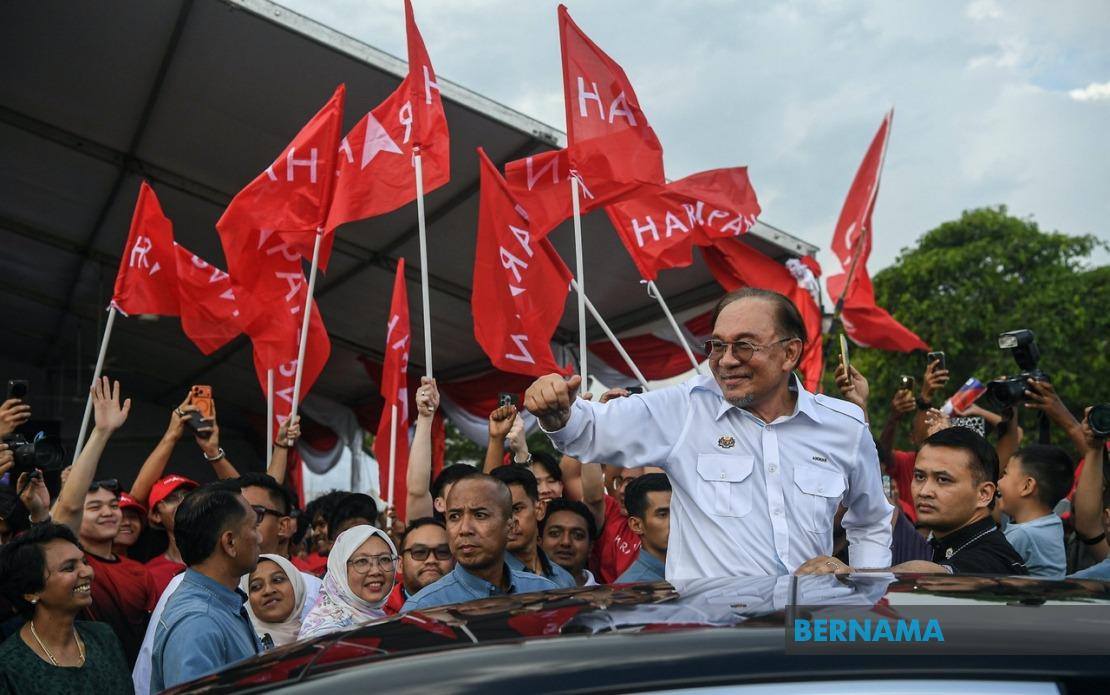
Prime Minister Datuk Seri Anwar Ibrahim's active participation in Pakatan Harapan's campaign for the 16th Johor State Election has delivered a considerable momentum boost to the coalition's bid to retain control of the state, according to party leadership. Communications Minister Datuk Fahmi Fadzil highlighted the tangible enthusiasm witnessed at grassroots level during recent campaign events, offering a bellwether of voter receptiveness to PH's messaging as the election cycle enters its final stretch ahead of Saturday's polling day.
Fahmi, who serves as PH's Communications director, observed first-hand the intensity of public response during two campaign rallies held in Senggarang and Semerah within Batu Pahat district. His observations point to more than mere attendance figures; he emphasised the spontaneous and organic nature of community engagement, suggesting deeper levels of voter interest than standard political theatre might produce. The anecdotal detail of an elderly resident transporting his wife by trishaw specifically to encounter the Prime Minister underscores a demographic dimension often overlooked in electoral analysis—the ability of high-profile political leaders to mobilise citizens who might not typically engage through conventional campaign channels.
This grassroots dimension carries particular significance for Pakatan Harapan's broader political project in Johor, a state where the coalition has undergone significant structural changes since the 2018 general elections. The visible enthusiasm suggests that PH's messaging regarding governance, economic management, and development priorities is resonating across diverse segments of the Johor electorate, transcending urban-rural divides and reaching constituencies that have traditionally leaned towards other political formations. The reception Anwar encountered thereby provides qualitative evidence complementing whatever polling data the coalition may possess internally.
The communications strategy evident in the campaign schedule reflects deliberate coordination aimed at maximising the Prime Minister's political capital. Over Saturday and Sunday of the preceding weekend, Anwar attended 15 separate campaign events distributed throughout the state, a logistical undertaking designed to blanket major population centres while providing material for media coverage and reinforcing PH's narrative through repeated exposure. This intensity of scheduling demonstrates confidence within PH's hierarchy that Anwar's presence translates directly into electoral advantage, whether through converting persuadable voters or consolidating existing support bases.
Pakatan Harapan's comprehensive fielding of candidates across all 56 State Legislative Assembly seats represents a significant resource commitment and reflects the coalition's determination to contest every available position rather than ceding ground to opposition formations. This full-slate approach contrasts with earlier electoral cycles and signals internal party consolidation, particularly given the diverse composition of PH's membership spanning multiple political parties with distinct constituencies and ideological orientations. The coalition's ability to field viable candidates in all seats, coupled with visible leadership presence, suggests organisational capacity that should concern opposition competitors.
The election dynamics in Johor assume heightened importance within Malaysia's broader political landscape, given the state's economic significance, population scale, and symbolic weight as the historic heartland of UMNO-led governance. Control of Johor's state government carries ramifications extending beyond local administration into the national political balance, influencing coalitional dynamics at federal level and signalling voter sentiment regarding the current administration's performance. A convincing PH victory would reinforce Anwar's leadership credentials and provide tangible evidence of electoral viability, while any erosion of PH's position would invite scrutiny of the federal government's policy direction and political sustainability.
The reported reception quality also illuminates evolving voter attitudes toward political engagement itself. The spontaneity of community responses—rather than choreographed, stage-managed encounters—suggests genuine curiosity and receptiveness rather than mere partisan commitment. This distinction matters considerably for interpreting electoral signals; voters willing to make spontaneous efforts to encounter political leaders often exhibit higher propensity to translate that interest into actual electoral participation. The trishaw anecdote, while seemingly minor, exemplifies the accessibility and approachability that Anwar's campaign messaging appears to convey to constituencies that might harbour scepticism toward elite political figures.
Fahmi's interpretation of community response as reflecting acceptance of PH's campaign narrative merits analytical scrutiny. The coalition's messaging throughout the Johor election period appears to centre on governance competence, development delivery, and economic management—positioning PH as the custodian of pragmatic administration rather than ideological positioning. This approach acknowledges the Johor electorate's demonstrated preference for performance-based politics, particularly regarding infrastructure development, employment generation, and fiscal management. Whether this messaging emphasis proves decisive depends partly on how effectively opposition parties counter with alternative narratives regarding governance capability.
The demographic composition of those turning out for campaign events provides clues regarding PH's support trajectory. Fahmi's specific mention of elderly voters alongside presumably younger attendees suggests cross-generational appeal, a crucial metric for electoral sustainability. Johor's population pyramid skews older than national averages in several districts, rendering senior voter engagement particularly consequential for aggregate electoral outcomes. If PH successfully mobilises older voters—traditionally more reliable at polling—the coalition's path to maintaining state control strengthens considerably.
The early voting phase conducted on the day Fahmi visited Bernama's operations room provides real-time feedback regarding turnout patterns and voter behaviour. Early voting participation rates often correlate with election-day turnout, offering predictive indicators for actual results. Higher-than-expected early voting could suggest either heightened voter engagement more broadly or tactical advantages for particular coalitions with stronger ground-level mobilisation infrastructure. The timing of Fahmi's comments—made during active polling—underscores PH's strategy of maintaining narrative momentum even as ballots began being cast.
For Malaysian observers and regional analysts tracking Southeast Asian electoral trends, the Johor election demonstrates continued dynamism within Malaysia's democratic system. Competitive elections featuring genuine uncertainty regarding outcomes remain central to Malaysian political practice, despite various challenges to institutional resilience. The visible campaign activity, public engagement, and leadership presence across PH exemplify democratic norms in operation, offering counterpoint to concerns regarding democratic backsliding elsewhere in the region. Johor's electoral exercise, while state-level in formal scope, carries implications for the broader trajectory of Malaysian democracy and governance quality.

