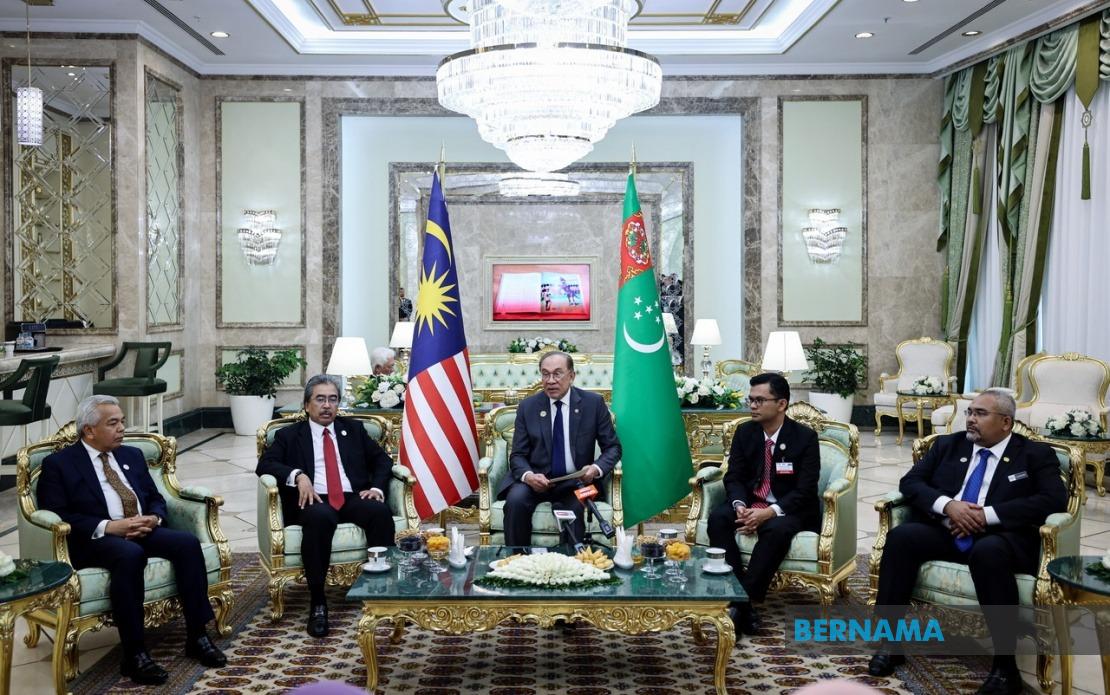
Prime Minister Datuk Seri Anwar Ibrahim has characterised his official working visit to Turkmenistan as a milestone achievement, highlighting significant progress in cultivating stronger ties and establishing a framework for enhanced strategic cooperation between Malaysia and the Central Asian nation. Speaking on the conclusion of the two-day engagement that commenced on June 18, Anwar underscored the visit's role in catalysing fresh momentum for collaborative ventures across multiple sectors aligned with the priorities of both governments.
The Prime Minister's delegation travelled to the Turkmenistan capital with a focused agenda, bringing together key figures responsible for driving Malaysia's economic growth and international relations strategy. Accompanying Anwar were Minister of Investment, Trade and Industry Datuk Seri Johari Abdul Ghani and Minister of Economy Akmal Nasrullah Mohd Nasir, alongside representatives from the Prime Minister's Office and Foreign Ministry, demonstrating the high-level commitment Malaysia has placed on the bilateral relationship. The composition of the delegation reflected deliberate positioning around trade, investment, and economic dimensions, signalling Malaysia's intent to move beyond traditional diplomatic courtesies toward tangible commercial outcomes.
This represents Anwar's first formal state visit to Turkmenistan since assuming office as Malaysia's 10th Prime Minister in November 2022, making the engagement particularly significant as it marks the beginning of substantive engagement between the two administrations at the highest level. The visit took place at the formal invitation of Turkmenistan President Serdar Berdimuhamedov, underlining the reciprocal interest both nations hold in deepening their connection. Anwar expressed gratitude toward the Turkmenistan leadership and broader governmental apparatus for the reception extended to the Malaysian contingent, characterising the hospitality as indicative of shared commitment to relationship building.
The energy sector emerged as a principal focal point of discussions, reflecting geographical realities and complementary economic interests. Turkmenistan possesses substantial hydrocarbon reserves and developing energy infrastructure, while Malaysia brings experience in energy exploration, production, and downstream operations through entities like PETRONAS. The convergence of these capabilities presents considerable potential for joint ventures in oil and gas development, infrastructure investment, and technological knowledge transfer. By positioning energy cooperation as a priority, both nations can address their respective strategic imperatives while contributing to regional energy security and economic development.
Anwar emphasised that the bilateral engagement has inaugurated what he termed a fresh chapter in cooperative endeavours, suggesting the visit transcends ceremonial function and establishes operational pathways for substantive collaboration. The emphasis on "mutual interest" as a guiding principle indicates that negotiations and agreements reached during the visit are premised on reciprocal benefit rather than asymmetrical arrangements. This approach typically fosters more durable partnerships, as both parties retain confidence that engagement serves their fundamental national objectives and population wellbeing.
The presence of PETRONAS officials within the Malaysian delegation underscores how private sector entities are being mobilised as instruments of diplomatic engagement and economic statecraft. As Malaysia's national oil and gas producer, PETRONAS brings technical expertise, investment capacity, and operational experience that directly translates into tangible outcomes for partnership proposals. The inclusion of corporate representatives in high-level bilateral missions reflects contemporary practice wherein government diplomacy and commercial enterprise operate in concert to advance national economic interests within the international system.
For Southeast Asian observers, Malaysia's strategic outreach to Central Asia carries broader geopolitical significance. The region represents an emerging frontier for diversified economic engagement, as countries seek to break historical patterns of concentrated bilateral relationships. By establishing formal protocols and cooperation frameworks with Turkmenistan, Malaysia simultaneously strengthens its own energy security, enhances PETRONAS's international portfolio, and positions itself as a capable interlocutor for Central Asian states seeking Asian partnerships. This diversification strategy reflects recognition that economic resilience depends upon multiple supply channels and market outlets rather than concentration within traditional networks.
The timing of this engagement also reflects the regional context of shifting energy dynamics. As global transitions toward renewable energy accelerate, hydrocarbon-producing nations face pressure to maximise returns from existing reserves while remaining economically viable. Malaysia and Turkmenistan can jointly explore how energy cooperation can be structured within transitional frameworks that address climate imperatives while securing economic interests. Such collaboration might encompass investment in cleaner energy production technologies, infrastructure modernisation, or joint exploration ventures that meet contemporary environmental standards.
Anwar's acknowledgment of contributions from the Malaysian Embassy in Ashgabat, security personnel, and media representatives indicates the orchestrated nature of contemporary diplomatic engagement, wherein multiple institutional actors coordinate to achieve policy objectives. The embassy network serves as the operational foundation enabling high-level visits, while security arrangements reflect the complexity of protecting senior government officials, and media engagement shapes public understanding of diplomatic initiatives and their significance. This institutional dimension often remains invisible to public discourse but proves essential for translating diplomatic ambitions into operational reality.
Looking forward, the outcomes of this inaugural visit will likely establish parameters for successive engagements and concrete project development. Initial visits typically establish relationship foundations, signal commitment, and identify priority areas for deeper investigation. Subsequent phases typically involve technical discussions, contract negotiations, and implementation of agreements in principle. The success of this foundational visit thus carries implications extending well beyond the immediate bilateral relationship, potentially influencing how Malaysia approaches Central Asian engagement more broadly and how it positions itself within evolving economic geographies centred on energy security and regional connectivity.

