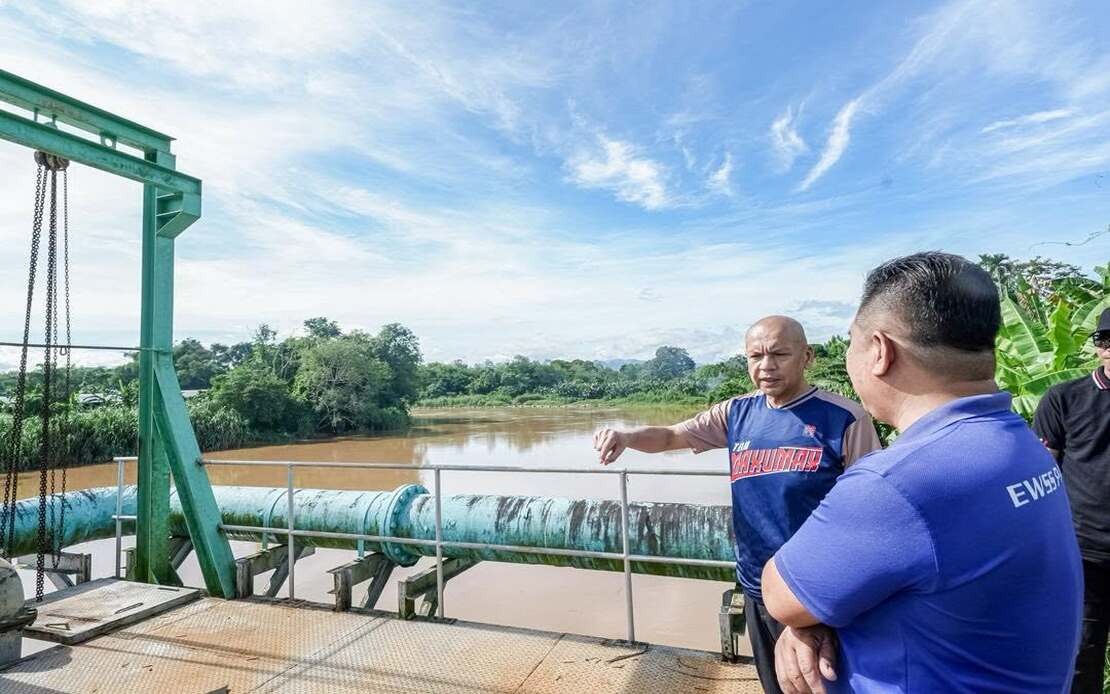
Papar's water crisis has moved onto the ministerial agenda. Domestic Trade and Cost of Living Minister Datuk Armizan Mohd Ali conducted an on-site review of the district's water supply stabilization efforts on June 19, following up on a strategy session held four days earlier to assess project implementation and tackle the recurring supply problems plaguing the community. The ministerial inspection underscores growing concern over water security in this Sabah district, where demand continues to outpace supply capacity.
Two principal infrastructure initiatives are currently under way to resolve Papar's persistent water challenges. The first involves upgrading the Kogopon Water Treatment Plant from its present 40 million litres per day capacity to 80 million litres daily, effectively doubling its output. Simultaneously, authorities are expanding the Kampung Kabang intake system to draw additional raw water supplies. Together, these complementary projects represent a comprehensive approach to expanding both treatment capability and water sourcing in the district.
The urgency of these upgrades reflects Papar's demographic and economic expansion. As the district experiences rising demand from growing residential populations and economic activity, existing infrastructure has proven insufficient to meet consumption needs reliably. The Kogopon plant expansion represents the most visible and significant response to this capacity gap, though the Kampung Kabang intake improvements are equally critical to ensuring adequate raw water availability throughout the year, particularly during dry seasons.
Yet even as these longer-term solutions progress, Papar residents are contending with immediate operational disruptions. During his visit, Armizan examined two facility sites—the EWSS Plant and the JETAMA Limbahau Plant—both of which have encountered unexpected shutdowns due to raw water quality deterioration. These facilities depend on consistent water clarity at their inlet points, measured in nephelometric turbidity units or NTU values. When raw water becomes excessively turbid or cloudy, typically during heavy rainfall that stirs up sediment in source rivers, the plants must cease operations until water quality improves to treatable standards.
This turbidity issue has emerged as a critical vulnerability in Papar's water management. When either plant experiences elevated NTU readings at their intake points, operators have little choice but to halt production, creating supply gaps across the district. Over the past week preceding Armizan's inspection, both facilities faced such shutdowns, leaving consumers without guaranteed service. The phenomenon reflects the broader challenge that Southeast Asian water utilities face: dependence on surface water sources susceptible to seasonal and weather-driven quality variations.
Armizan's on-site assessment strategy carries particular significance for Malaysian infrastructure governance. By conducting direct field observation rather than relying solely on written reports, he sought to obtain first-hand understanding of operational constraints and challenges that facility managers and engineers encounter daily. This approach enables policymakers to identify bottlenecks and implement responsive solutions with greater precision than distance-based decision making would allow. For Papar, such engagement signals official recognition that the district's water situation demands sustained high-level attention.
The turbidity problems represent a critical interim challenge alongside longer-term capacity expansion. While upgrading the Kogopon facility and Kampung Kabang intake will address supply shortages, these multi-year projects cannot provide immediate relief for consumers experiencing regular service interruptions. Water authorities must therefore implement parallel measures: enhanced monitoring and early-warning systems for raw water quality, maintenance protocols to optimize existing treatment efficiency, and perhaps investment in pre-treatment technologies that can tolerate higher turbidity thresholds. The EWSS and JETAMA plants require operational strategies that minimize disruption impact.
For Malaysian and regional context, Papar's experience reflects broader Southeast Asian urban water challenges. Rapid district growth, aging infrastructure, climate variability, and raw water quality fluctuations create compound pressures on utility systems designed for earlier population levels. Sabah's geography—with its tropical rainfall patterns and river-dependent water sources—amplifies these pressures. Other Malaysian districts and Southeast Asian cities face comparable predicaments, making Papar's response potentially instructive.
The minister's statement emphasized that field-level monitoring generates actionable intelligence essential for effective problem-solving. Implementation challenges, operational surprises, and community impacts remain largely invisible to headquarters-based planners. Direct observation enables officials to calibrate interventions more accurately, identify unforeseen obstacles, and communicate credibly with affected residents about progress and timelines. In Papar, where water supply directly affects daily life and economic productivity, such transparency matters considerably.
Government accountability frameworks depend partly on regular high-visibility engagement with problem areas. Armizan's inspection demonstrates official commitment to resolving Papar's water crisis, signaling to residents and stakeholders that their difficulties command ministerial-level attention. Such visibility, while not solving technical challenges immediately, establishes political commitment to sustained follow-through on infrastructure investment and operational improvements.
Moving forward, Papar's situation will depend on several interdependent factors. The Kogopon upgrade must proceed on schedule and perform to specifications once completed. The Kampung Kabang intake expansion must deliver promised raw water volumes year-round. Operating protocols at the EWSS and JETAMA plants must be optimized to minimize turbidity-related shutdowns. Water quality monitoring infrastructure must provide early warning of deterioration. And importantly, water demand management initiatives—conservation campaigns, leak reduction in distribution networks, and industrial efficiency measures—must complement supply expansion efforts.
Armizan's review represents a checkpoint in what will necessarily be a multi-phase resolution process. The capital investments being made address supply adequacy, but Papar's water security also depends on maintaining treatment facilities, managing raw water sources, and gradually improving distribution network efficiency. For residents and business operators in the district, these projects offer hope that chronic shortages will eventually ease, though the interim period of occasional disruptions may persist as construction and upgrades continue.

