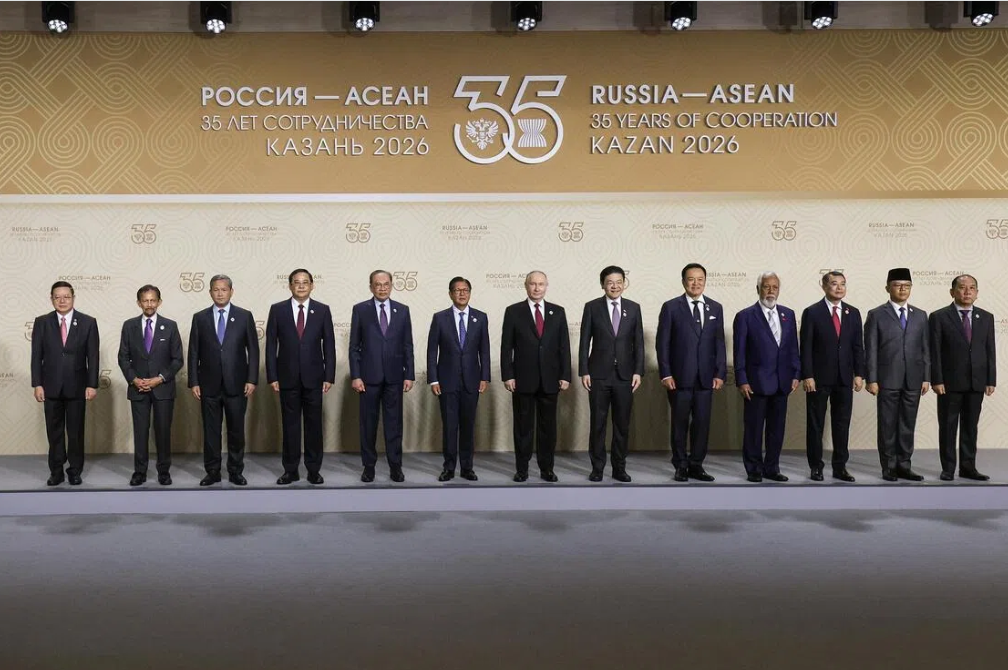
Asean and Russia have moved to consolidate their 35-year relationship by adopting a comprehensive roadmap for cooperation, even as geopolitical rifts complicate their broader engagement with the international community. The Asean-Russia Commemorative Summit held in Kazan on June 17 and 18 produced several binding agreements intended to deepen ties across maritime security, trade, energy and cultural exchanges. The gathering, hosted by Russian President Vladimir Putin, underscored both sides' interest in maintaining dialogue channels at a time when major power competition is reshaping regional dynamics across Asia and Europe.
Three principal documents emerged from the summit to formalize the partnership framework. The Kazan Declaration provides a retrospective assessment of Asean-Russia bilateral relations whilst setting strategic priorities for the next phase of engagement. Separately, a Joint Statement on Cultural Cooperation was adopted to broaden people-to-people connections and expand cultural programming. Most significantly, negotiators finalised the Asean-Russia Comprehensive Plan of Action spanning 2026 to 2030, establishing concrete mechanisms for implementing cooperative initiatives across multiple sectors. These instruments signal that despite tensions elsewhere, both actors view their Southeast Asian-Russian relationship as sufficiently valuable to warrant institutional reinforcement.
For Malaysia and other Southeast Asian nations, the summit's emphasis on Asean centrality carries particular significance. Prime Minister Lawrence Wong, speaking on behalf of Singapore, stressed that Asean's twin imperatives—deepening intra-bloc integration whilst expanding external partnerships—have become increasingly critical as global conditions grow more unpredictable. Russia's endorsement of Asean centrality and its commitment to participating in key regional mechanisms such as the East Asia Summit and Asean Regional Forum demonstrates Moscow's interest in remaining relevant in Southeast Asian affairs. The pledge to engage with these platforms throughout 2024 and during Singapore's Asean chairmanship in 2027 suggests that Russia intends to avoid complete marginalisation from regional decision-making structures.
Cooperation frameworks identified at the summit reflect shared vulnerabilities and overlapping interests that transcend ideological differences. Disaster management and counter-narcotics operations feature prominently in the agreed agenda, areas where Russian expertise and Southeast Asian capacity-building needs can intersect productively. Educational and civil service training exchanges have historically strengthened bilateral ties; the commitment to expand these programmes signals recognition that long-term relationship sustainability depends on cultivating mutual understanding among government officials and emerging leaders. Such people-to-people initiatives become particularly valuable when high-level political dialogue faces constraints.
Yet the summit occurred within a context of significant strategic contradiction. Singapore has maintained sanctions against Russia since 2022 following Moscow's invasion of Ukraine, a position grounded in defence of international law and the UN Charter rather than alignment with any particular power bloc. This principled stance creates an inherent tension: Asean states, including Singapore, continue to uphold the legal and normative architecture of the international system whilst simultaneously seeking to preserve pragmatic working relationships with Russia. Wong's bilateral meeting with Putin exemplified this delicate balancing act, with the Prime Minister emphasising that constructive engagement need not imply agreement on contentious issues.
Singapore's articulation of its Ukraine position reflects broader Asean thinking on sovereignty and territorial integrity. Wong explicitly stated that Singapore's stance derives from consistent commitment to international law rather than bloc alignment, a formulation designed to preserve credibility with all major powers whilst maintaining moral clarity. Similarly, Singapore's welcome for the nascent US-Iran peace agreement and hopes for restored transit through the Strait of Hormuz underscore Asean's interest in reducing friction points that could disrupt regional commerce and security. For Malaysian readers, Singapore's emphasis on unimpeded passage through key maritime waterways resonates strongly, given Malaysia's own stakes in freedom of navigation through congested chokepoints.
The geographic choice of Kazan itself merits consideration. Located in Russia's Volga region and home to a substantial Muslim population through the Republic of Tatarstan, the venue symbolised Moscow's effort to engage Asean through regional rather than purely federal channels. Wong's meeting with Tatarstan's Rais Rustam Minnikhanov, building on former Minister Mentor Lee Kuan Yew's 2007 visit, reinforced this multi-level diplomatic approach. Such engagement broadens Russia's relationships beyond Moscow's central government, potentially creating alternative pathways for cooperation if federal-level ties experience further strain.
The five-year cooperation plan carries practical implications for Southeast Asian economies. Maritime security cooperation assumes heightened importance given regional concerns over freedom of navigation and port security. Trade and investment frameworks could facilitate economic ties as Russia seeks to diversify partnerships in response to Western sanctions. Energy cooperation addresses long-term supply security questions relevant to Southeast Asia's development trajectories. Yet these economic dimensions remain constrained by the sanctions regime and broader Western pressure on companies engaging extensively with Russia, potentially limiting the commercial realisation of agreed frameworks.
Asean's balancing act reflects a broader regional interest in avoiding forced choice between major powers. The bloc's insistence on centrality, its advocacy for dialogue-based conflict resolution, and its emphasis on international law all represent efforts to preserve agency and manoeuvrability. Russia's participation in Asean mechanisms validates this model by demonstrating that major powers can engage regional institutions without requiring smaller nations to abandon neutrality or universal principles. However, sustaining this arrangement requires Russia to respect Asean's autonomy and avoid attempts to weaponise the bloc against other powers.
Looking forward, the Asean-Russia relationship will likely experience continued evolution shaped by broader geopolitical forces beyond Southeast Asia's control. The willingness demonstrated at Kazan to deepen institutional ties suggests both sides recognise value in maintaining channels of communication and cooperation. Yet the relationship's trajectory will ultimately depend on whether Russia can demonstrate restraint in ways that do not violate Asean's commitment to international law, and whether Asean states can expand cooperation with Moscow without incurring pressure from Western partners increasingly focused on great power competition. This delicate choreography will test whether regional organisations can truly remain central in an era of intensifying superpower rivalry.

