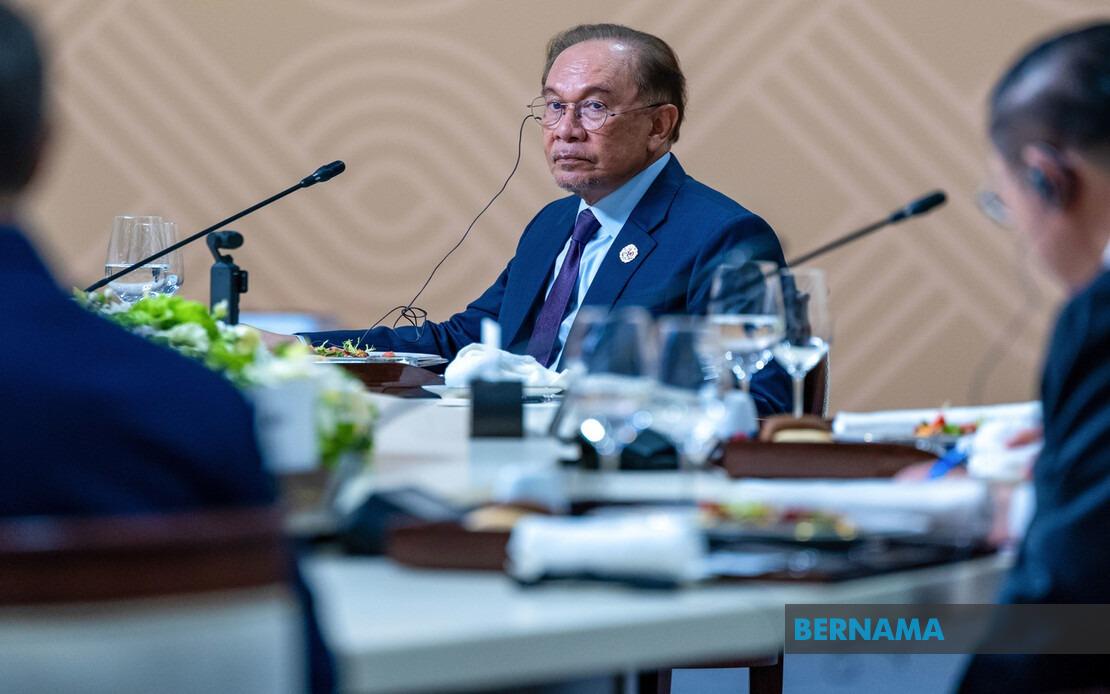
Prime Minister Datuk Seri Anwar Ibrahim has called for ASEAN and the Shanghai Cooperation Organisation to leverage their combined strength in tackling transnational challenges that threaten regional stability and prosperity. Speaking at the ASEAN-Russia Commemorative Summit in Kazan on June 18, Anwar emphasised that cross-border crime and energy security demand coordinated action from both blocs, as these threats operate with greater speed and sophistication than traditional governance structures can match.
The foundation for deeper collaboration already exists, Anwar noted, anchored in a 2005 memorandum of understanding that explicitly covers counter-terrorism, drug control, money laundering prevention, and energy cooperation frameworks. Rather than negotiating entirely new agreements, the Prime Minister argued that ASEAN and the SCO should concentrate their efforts on executing measurable results within defined timelines by building upon this established legal architecture. This pragmatic approach reflects the reality that institutional frameworks mean little without committed implementation and adequate resource allocation.
The urgency becomes apparent when examining the nature of modern transnational crime. Online scams, illicit financial flows, and human trafficking networks operate across borders with remarkable speed, moving funds and victims faster than conventional law enforcement can respond. Anwar stressed that intelligence-sharing and capacity-building between ASEAN and SCO nations represent the most effective countermeasure, enabling rapid information exchange and coordinated enforcement actions. For Malaysia and other Southeast Asian economies, where online fraud and human trafficking remain persistent challenges, such cooperation offers concrete pathways to disrupting criminal networks that prey on vulnerable populations and drain national resources.
Energy cooperation emerged as the second pillar of Anwar's proposal, reflecting both the economic interdependence and strategic importance of the energy sector across the region. The SCO brings together major energy producers including Russia, Kazakhstan, and Iran alongside substantial consumers in China and India, creating a natural coalition for addressing global energy security concerns. Anwar, who holds the Finance portfolio in addition to his prime ministerial duties, positioned energy transition as an opportunity rather than a constraint, particularly regarding the shift toward cleaner sources while maintaining reliable supply chains.
Malaysia's specific energy interests encompass liquefied natural gas, renewable integration, grid modernisation, and safety protocols, Anwar explained, indicating that Southeast Asian nations view energy cooperation as equally important for economic growth and climate commitments. The proliferation of renewable energy sources and emerging technologies requires the kind of knowledge-sharing infrastructure that multilateral cooperation provides, enabling smaller nations to access expertise and technologies that individual bilateral relationships might not deliver. For Malaysia's energy security, participation in broader SCO frameworks offers access to diverse supply sources and reduces dependence on any single trading partner.
Beyond security and energy, Anwar identified the Eurasian Economic Union as another avenue for deepening ASEAN engagement, again emphasising existing frameworks rather than institutional innovation. He proposed that business communities from both blocs should interact more frequently through dedicated dialogue platforms and participation in major economic forums, creating organic commercial relationships rather than relying solely on government-to-government agreements. These private-sector connections generate sustained economic activity and build constituencies within each region with vested interests in maintaining stability and deepening integration.
Small and medium enterprises require particular attention in bridging ASEAN-EAEU trade gaps, Anwar argued, as they face disproportionate barriers including market access limitations and technological capability gaps. Targeted support mechanisms enabling SMEs to acquire necessary skills and technologies would democratise participation in regional trade, potentially unlocking significant economic value currently locked behind scale barriers. For Malaysia's substantial SME sector, such initiatives could open new export markets and supply chain opportunities, particularly in Southeast Asian countries where regulatory familiarity and geographic proximity provide competitive advantages.
Emerging sectors including the digital economy, artificial intelligence, cybersecurity, and food security represent frontier areas where ASEAN and Eurasian interests increasingly overlap, according to Anwar's assessment. These domains transcend traditional economic categorisation, involving both security dimensions and commercial opportunity. Food security particularly resonates given regional vulnerabilities to climate disruption and supply chain fragmentation, while cybersecurity and AI governance require coordinated policy approaches to prevent regulatory fragmentation that harms legitimate business while failing to constrain malicious actors.
The timing of Anwar's remarks at the ASEAN-Russia summit underscores shifting geopolitical dynamics in which Southeast Asian nations seek to maintain engagement with multiple major powers rather than choosing exclusive alignments. Malaysia's position as both an ASEAN member and an SCO dialogue partner reflects this balanced approach, enabling the nation to extract benefits from different frameworks without sacrificing strategic flexibility. For Southeast Asia more broadly, strengthening institutional connections with Eurasian organisations provides alternative pathways for addressing shared challenges while reducing over-reliance on Western-led structures that may not address regional priorities with equal emphasis.
The practical implementation of Anwar's proposals faces recognised challenges, particularly coordination across diverse political systems and varying national priorities within each bloc. However, the identification of specific, achievable objectives with defined timelines increases prospects for meaningful progress beyond ceremonial cooperation. By concentrating on intelligence-sharing infrastructure, energy technology transfer, and private-sector engagement mechanisms rather than ambitious structural reforms, ASEAN and SCO can demonstrate tangible results that justify further institutional investment.
For Malaysian readers, these initiatives carry direct implications for personal security, economic opportunity, and national prosperity. Enhanced crime-fighting cooperation affects online safety and reduces human trafficking victimisation. Energy cooperation influences electricity prices and supply reliability. Trade facilitation for SMEs creates employment and entrepreneurial opportunities. The diplomatic architecture Anwar articulated represents not abstract institutional tinkering but practical mechanisms for addressing problems that affect daily life across the region.

