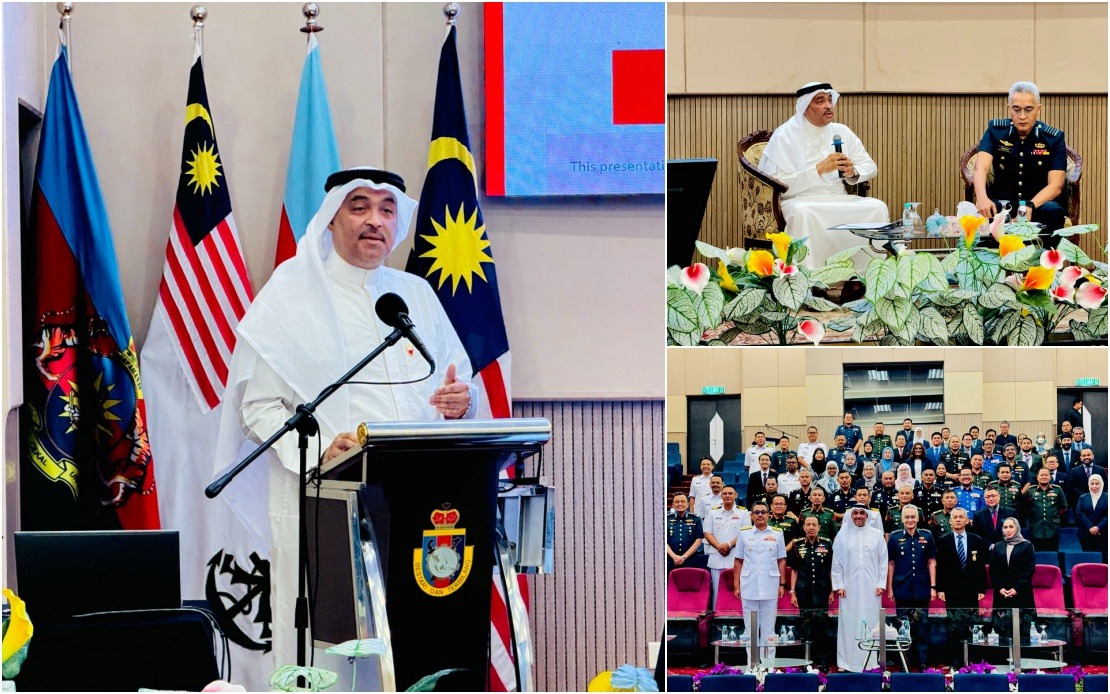
Bahrain's Ambassador to Malaysia Dr Waleed Khalifa Al Manea has signalled a significant deepening of ties between the two nations, describing the partnership as one rooted in mutual benefit and underpinned by strong political will from both capitals. Speaking at a major defence policy forum in Putrajaya, the ambassador framed the expanding relationship within a context of comprehensive cooperation spanning economic, security and diplomatic dimensions that reflect shared regional interests.
The foundation for this enhanced engagement rests on the personal relationship between His Majesty King Hamad bin Isa Al Khalifa of Bahrain and His Majesty Sultan Ibrahim, King of Malaysia, according to Al Manea. Equally significant are the parallel commitments from Bahrain's Crown Prince and Prime Minister, His Royal Highness Prince Salman bin Hamad Al Khalifa, and Malaysia's Prime Minister Datuk Seri Anwar Ibrahim, both of whom have prioritised advancing bilateral mechanisms. This alignment at the highest political level suggests the partnership extends beyond ceremonial gestures into substantive policy coordination across government structures.
The breadth of cooperation encompasses diverse fields, though specific sectoral details remain sparse in current announcements. However, the strategic context becomes clearer when examining the security dimensions of the relationship. Al Manea's presence at the National Resilience College's Executive Week Programme, where he delivered a lecture on Middle Eastern security dynamics, underscores how deeply the two governments are engaging on defence and strategic matters. The participation of senior Malaysian military officers, police leadership and maritime enforcement officials signals institutional-level commitment to understanding and coordinating on shared threats.
One symbolic manifestation of strengthened bilateral ties is Malaysia's hosting of the 2026 Formula 1 Gulf Air Bahrain Grand Prix. While motorsport may seem tangential to statecraft, such high-profile international events serve as platforms for cultural exchange and soft power projection. For Bahrain, the arrangement represents recognition within Southeast Asia and positions the kingdom prominently in Malaysian sporting and tourism calendars. For Malaysia, it deepens Gulf region connections through a globally resonant medium, enhancing the nation's profile in Middle Eastern policy circles.
The security dimension of the partnership reflects genuine strategic convergence. Al Manea outlined Bahrain's comprehensive approach to regional challenges, emphasizing sovereignty protection, civilian safeguarding, factual documentation and diplomatic coordination. These priorities resonate strongly with Malaysia's own strategic doctrine, which similarly balances military readiness with diplomatic engagement and institutional transparency. The kingdom's experience navigating complex Gulf dynamics offers instructive lessons for Southeast Asian nations managing great power competition and regional tensions.
Critically, Al Manea addressed Iran's military actions against Gulf Cooperation Council member states, highlighting attacks on civilian populations, infrastructure and maritime shipping lanes. These tensions carry implications far beyond the Middle East. Malaysia and ASEAN face direct ramifications through disruptions to critical sea lanes, particularly the Strait of Hormuz, through which significant portions of Asian trade and energy supplies transit. When one-fifth of global petroleum passes through contested waters, regional conflicts acquire immediate economic and strategic significance for Southeast Asia's energy security and supply chain resilience.
During Bahrain's presidency of the United Nations Security Council in April, the kingdom leveraged its diplomatic position to advance international maritime security initiatives. These efforts focused on protecting freedom of navigation and safeguarding critical infrastructure—concerns that directly affect Malaysian and ASEAN shipping interests. By working through multilateral channels, Bahrain has positioned itself as a responsible stakeholder in global stability frameworks that benefit smaller maritime trading nations dependent on predictable sea lane access.
Malaysia's co-sponsorship of UN Security Council Resolution 2817 represents more than symbolic solidarity; it demonstrates practical alignment with Gulf security concerns. The resolution reaffirmed state sovereignty, protected civilian populations and called for an end to cross-border attacks. For Malaysia, this positioning reflects both humanitarian commitments and strategic calculation—supporting international norms that protect smaller nations from larger powers' unilateral actions serves Malaysia's long-term interests in an increasingly contested Indo-Pacific region.
The depth of institutional engagement, demonstrated by the National Resilience College forum's attendance, suggests the partnership operates across multiple government layers rather than remaining confined to diplomatic channels. Senior military officials, defence academics and parliamentary representatives participated in discussions framing Middle Eastern security challenges. This suggests Malaysian strategic thinkers are integrating Gulf dynamics into their regional security assessments, recognizing that instability extending from the Persian Gulf to the Strait of Malacca creates interconnected risks requiring coordinated responses.
Bahrain's emphasis on comprehensive approaches combining defence, diplomacy and collective action aligns well with ASEAN's established preference for multilateral frameworks and consensus-building mechanisms. The kingdom's messaging about protecting civilians and advancing international coordination reflects values that resonate within Southeast Asian security discourse, creating potential for deeper collaboration on humanitarian concerns, maritime safety and counter-terrorism efforts.
Looking forward, the strategic partnership appears positioned to expand in practical dimensions beyond ceremonial exchanges. Shared concerns about maritime security, energy supply protection and regional stability provide substantive foundations for cooperation. As Middle Eastern tensions persist and Southeast Asian nations seek to maintain strategic autonomy while managing great power involvement in their regions, partnerships with responsible Gulf actors like Bahrain offer mechanisms for information sharing, coordinated diplomacy and crisis communication.

