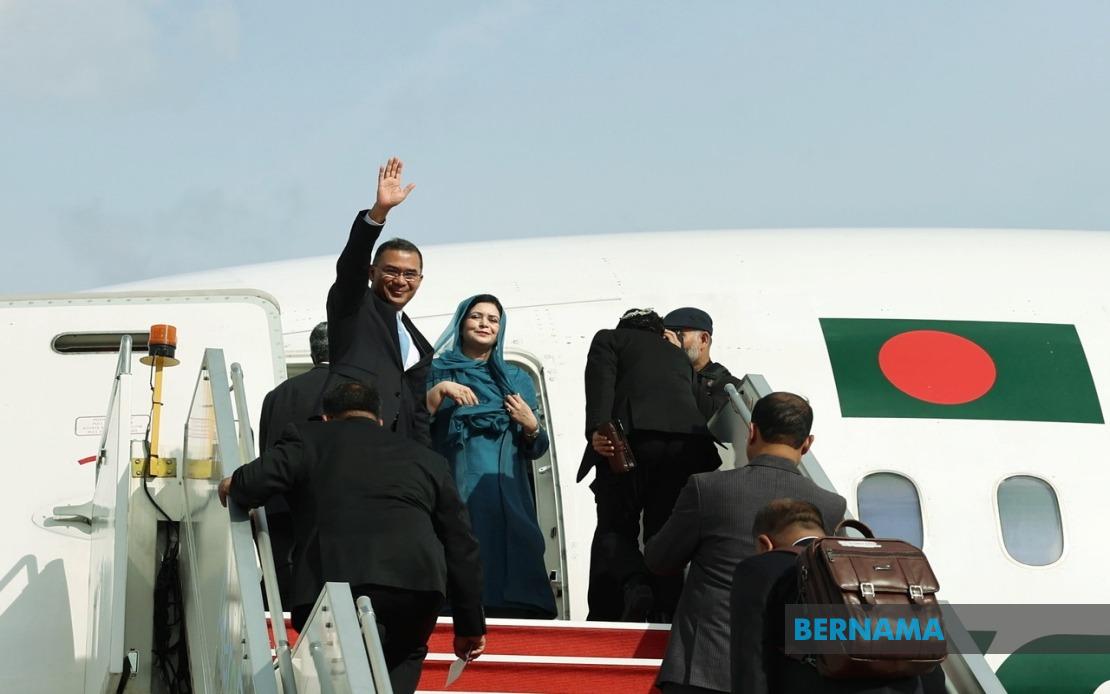
Bangladesh Prime Minister Tarique Rahman departed Malaysia on Saturday afternoon, bringing to a close a two-day official visit that underscored deepening diplomatic and economic ties between Kuala Lumpur and Dhaka. The special aircraft carrying Tarique and his delegation lifted off from Kuala Lumpur International Airport at 5 pm, marking the end of his first bilateral overseas trip since assuming office in February 2026. Minister in the Prime Minister's Department (Religious Affairs) Dr Zulkifli Hasan attended a formal ceremonial send-off that included a guard of honour from the First Battalion of the Royal Ranger Regiment, a gesture reflecting the significance Malaysia attaches to the Bangladesh leader's visit.
Earlier on Saturday, Tarique held substantial bilateral discussions with Prime Minister Datuk Seri Anwar Ibrahim at the Perdana Putra Complex, where both leaders examined regional and global challenges requiring coordinated responses. The conversation ranged across geopolitical developments and mutual economic interests, revealing considerable alignment on several critical fronts. Both nations committed to exploring expanded collaboration across sectors integral to their respective development agendas, with semiconductors, energy security, agricultural advancement, human resources and education emerging as priority areas alongside conventional trade and investment channels.
The visit produced three significant formal instruments aimed at institutionalizing cooperation. A Memorandum of Understanding on Cultural Cooperation was signed, alongside two Exchanges of Notes addressing Counter-Terrorism Research and Investment Promotion and Facilitation respectively. These agreements reflect recognition by both governments that deepening people-to-people connections and security cooperation complement traditional economic partnerships. The cultural MoU carries particular weight given Southeast Asia's increasing emphasis on soft power and regional identity-building through cultural diplomacy.
Economic partnership emerged as perhaps the most consequential dimension of the talks. Malaysia and Bangladesh pledged to accelerate a fast-track free trade agreement, signalling commitment to reducing barriers and expanding bilateral commerce. The two nations also identified energy cooperation and the halal industry as growth sectors warranting enhanced focus. Bangladesh's explicit aspiration to secure ASEAN Sectoral Dialogue Partner status received supportive acknowledgment, indicating Malaysian backing for deepening Bangladeshi integration within the region's institutional framework. Additionally, both governments expressed interest in Bangladesh joining the Regional Comprehensive Economic Partnership, suggesting alignment on broader Asian economic integration objectives.
Trade data underscores the relationship's commercial foundations. During 2025, bilateral merchandise exchange totalled RM12.18 billion, with Malaysian exports dominating at RM10.08 billion, predominantly petroleum products reflecting Bangladesh's energy requirements for industrial expansion. Bangladeshi exports to Malaysia, valued at RM2.10 billion, comprise mainly textiles, apparel and footwear, segments where the country maintains competitive advantages. Bangladesh ranked as Malaysia's 28th-largest global trading partner while serving as the second-most significant commercial partner in South Asia after India, highlighting India's outsized economic footprint in the region whilst emphasizing Bangladesh's growing importance as both market and supplier.
On the global stage, Tarique and Anwar demonstrated substantial convergence on international issues extending beyond bilateral concerns. Both leaders reiterated support for the Palestinian cause and expressed grave concern regarding the humanitarian catastrophe unfolding in Gaza, positioning their nations within the broader Muslim-majority world's humanitarian advocacy. They also committed to collaborative efforts promoting durable peace initiatives addressing Gulf region tensions and Iranian concerns, reflecting shared interest in preventing Middle Eastern instability from cascading into Asian markets and security environments. This alignment signals that despite geographic separation, Malaysia and Bangladesh perceive interconnected security interests warranting coordinated diplomatic positioning.
The Rohingya refugee crisis received particular attention during discussions, with both nations recognizing this protracted humanitarian emergency as demanding region-wide solutions. Malaysia and Bangladesh agreed to strengthen coordination through ASEAN mechanisms whilst engaging Myanmar authorities on finding lasting resolutions. This commitment acknowledges that neither nation can unilaterally resolve the crisis, requiring institutional frameworks and inclusive dialogue involving the country hosting displaced populations. For Malaysia, which hosts significant Rohingya populations, the commitment to regional collaboration addresses domestic pressures whilst potentially influencing Myanmar's refugee repatriation policies.
Tarique's visit represents his inaugural bilateral foreign tour since assuming office, a decision that underscores Bangladesh's strategic prioritization of Southeast Asian engagement. Choosing Malaysia as the first destination signals appreciation for Kuala Lumpur's regional influence and economic significance. The visit's timing, occurring barely months into his administration, suggests Bangladesh recognizes the importance of establishing credible diplomatic relationships and clarifying foreign policy orientations to regional partners and international observers. By engaging closely with Anwar Ibrahim's Malaysian government, Tarique has signalled that Dhaka will remain engaged with Southeast Asia's institutional mechanisms and diplomatic frameworks.
The departure for China immediately following the Malaysia visit reflects Bangladesh's broader balancing strategy within the multipolar Asian order. Bangladesh maintains substantial economic relationships with Beijing, particularly in infrastructure and manufacturing sectors, whilst simultaneously cultivating ties with Southeast Asian democracies. This sequencing of visits—Malaysia preceding China—may indicate deliberate signalling about Bangladesh's nuanced approach to major power relationships, neither exclusively aligned with any single partner nor isolated from critical regional players. For Malaysian observers, the arrangement underscores how smaller Asian nations calibrate diplomatic engagement to maximize strategic autonomy and economic benefits.
Looking forward, the formal agreements reached during this visit establish institutional foundations for relationship deepening. The fast-track FTA negotiations will prove consequential for business communities in both nations, potentially unlocking commercial opportunities in energy, agricultural products and manufactured goods. Bangladesh's pursuit of ASEAN Sectoral Dialogue Partnership status may gain momentum through Malaysian advocacy, particularly if other ASEAN members recognize value in deeper Bangladesh integration. For Malaysia, strengthening Bangladesh relations diversifies its South Asian partnerships beyond India, potentially offering alternative supply chains and market access relevant to semiconductor development and energy security strategies.
The visit also highlights evolving dynamics within South and Southeast Asian regionalism. Bangladesh's eastward orientation toward ASEAN and RCEP membership aspirations reflects recognition that South Asian institutions, dominated by India's overwhelming size and influence, may offer limited space for smaller players. Malaysia's receptiveness to Bangladesh's regional integration efforts suggests ASEAN perceives value in expanding membership or dialogue partnerships beyond traditional parameters. This realignment could gradually reshape Asian geopolitical equilibrium, with multiple middle-power relationships replacing the previous binary focus on US-China competition and India-Pakistan rivalry.

