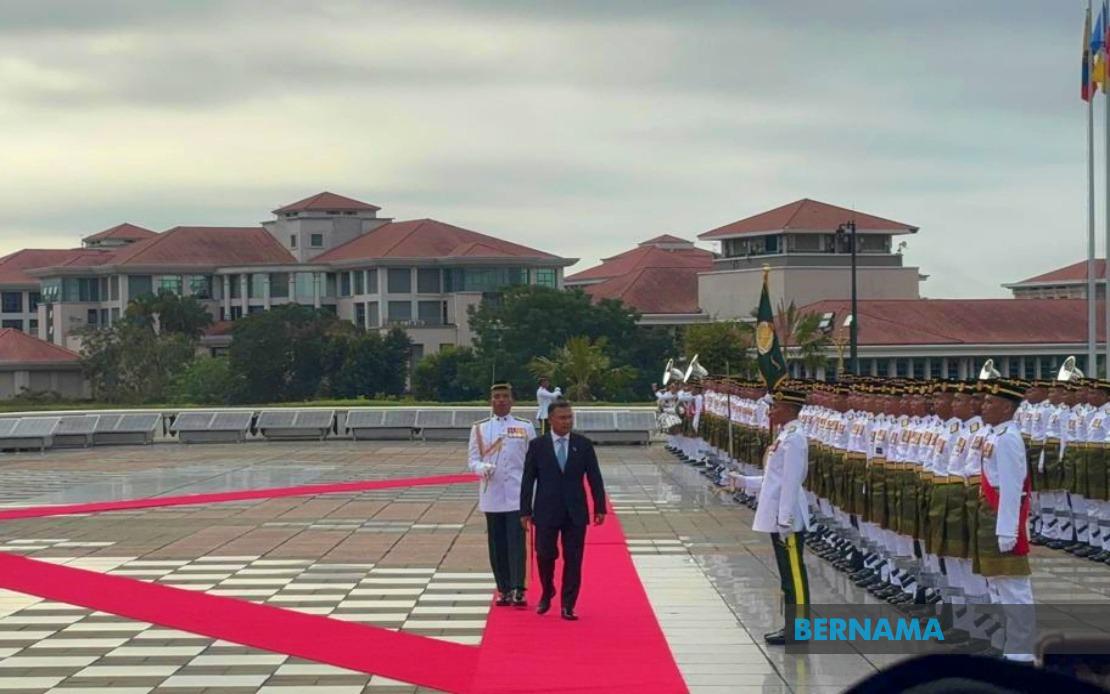
Bangladesh Prime Minister Tarique Rahman arrived in Malaysia on Saturday morning for a two-day official state visit, receiving full diplomatic honours at the Perdana Putra Complex in Putrajaya. The ceremonial reception, held at 9 am, underscored the importance both nations place on their bilateral relationship, with Prime Minister Datuk Seri Anwar Ibrahim personally receiving the distinguished guest ahead of the formal proceedings.
The welcoming ceremony followed traditional diplomatic protocol, beginning with the simultaneous playing of national anthems for both countries. Tarique then proceeded to inspect a guard of honour composed of three officers and 103 personnel from the First Battalion of the Royal Ranger Regiment, commanded by Major Nur Ahmad Zaim Zahari. This formal military presentation reflected Malaysia's recognition of Bangladesh's status as a significant regional and South Asian partner.
The high-level attendance at the ceremony demonstrated Kuala Lumpur's commitment to strengthening ties with Dhaka. Alongside Prime Minister Anwar, the reception included Deputy Prime Minister Datuk Seri Dr Ahmad Zahid Hamidi, Foreign Minister Datuk Seri Mohamad Hasan, Home Minister Datuk Seri Saifuddin Nasution Ismail, and Communications Minister Datuk Fahmi Fadzil. Several other Cabinet members, diplomatic corps representatives, and senior government officials were also present, reflecting the multifaceted nature of Malaysia-Bangladesh engagement across numerous sectors.
Following the ceremonial reception, Prime Minister Tarique signed the official guest book before engaging in a private one-on-one session with Anwar Ibrahim. This initial private discussion was followed by a comprehensive bilateral meeting that brought together senior ministers and high-ranking officials from both nations. These structured talks provided an opportunity for detailed discussions on shared interests and collaborative opportunities without the constraints of public ceremony.
The substantive agenda for these bilateral talks encompasses a broad spectrum of cooperation areas. Both governments intend to review progress made in existing Malaysia-Bangladesh bilateral relations whilst identifying new avenues for deepened partnership. Priority sectors include trade and investment expansion, human resource development and labour mobility, semiconductor manufacturing and electronics, renewable and conventional energy projects, agricultural cooperation, and educational exchanges. Beyond economic matters, the two nations are expected to exchange perspectives on regional stability, counterterrorism strategies, and international developments affecting South Asian and Southeast Asian interests.
The formal exchanges scheduled to occur following the bilateral meetings demonstrate the practical outcomes of this visit. Both leaders will witness the signing of a Memorandum of Understanding focused on cultural cooperation, establishing frameworks for enhanced people-to-people exchanges through arts, heritage, and educational initiatives. Additionally, two Exchanges of Notes will be formalised: one addressing cooperative research and capacity-building in counter-terrorism operations, and another promoting bilateral investment facilitation and protection. These agreements signal commitment to security cooperation whilst creating institutional mechanisms to reduce barriers to capital flows between the two economies.
Prime Minister Anwar will subsequently host an official luncheon in Tarique's honour, providing an informal setting for continued dialogue and relationship-building. Tarique is accompanied on this visit by his spouse, Dr Zubaida Rahman, Bangladesh Foreign Minister Dr Khalilur Rahman, and a delegation of senior government officials, enabling substantive engagement across multiple ministerial portfolios simultaneously.
The economic dimensions of Malaysia-Bangladesh relations underscore the practical importance of this visit. In 2025, bilateral trade reached RM12.18 billion, equivalent to approximately USD2.84 billion. Malaysian exports to Bangladesh comprised RM10.08 billion, with petroleum products as the dominant export category, reflecting Malaysia's hydrocarbon resources and refining capabilities. Bangladesh supplied RM2.10 billion in imports, predominantly textiles, apparel, and footwear products, leveraging that nation's significant manufacturing capacity in labour-intensive sectors. These trade flows demonstrate complementary economic structures that create mutual benefits.
Within Malaysia's broader trading relationships, Bangladesh occupies a strategic position in the South Asian region. As Malaysia's second-largest trading partner in South Asia after India, Bangladesh represents significant commercial importance. The RM12.18 billion trade volume places Bangladesh as Malaysia's 28th largest trading partner globally, a ranking that reflects the substantial economic ties between nations separated by maritime distance but connected through multiple commercial corridors and shared interests in regional prosperity.
For Malaysia, Bangladesh represents a critical gateway to South Asian markets and a source of skilled labour in sectors where demographic challenges require workforce supplementation. For Bangladesh, Malaysia serves as a major export destination, investment source, and technology partner. The visitor's emphasis on semiconductors and energy cooperation suggests both nations recognise the importance of positioning themselves within emerging global supply chains, particularly as regional powers increasingly prioritise technological self-sufficiency and energy security amid geopolitical uncertainties.
The timing of this official visit carries significance beyond bilateral considerations. As Southeast Asian nations navigate complex relationships with major powers and address transnational challenges including maritime security, counterterrorism, and climate change, strengthened Malaysia-Bangladesh cooperation contributes to broader regional stability architecture. Bangladesh's geographic position spanning South Asia and maritime Southeast Asia makes it relevant to Malaysian security and economic interests, whilst Malaysia's ASEAN membership and developed institutional capabilities offer Bangladesh pathways to regional integration and technological advancement.
This visit exemplifies how Southeast Asian nations maintain robust diplomatic engagement with South Asian partners, recognising that regional prosperity and security require frameworks extending beyond formal regional groupings. The emphasis on structured bilateral mechanisms, institutional arrangements, and sectoral cooperation reflects mature diplomatic practice oriented toward sustainable, multidimensional partnerships rather than transactional engagements. As both nations face domestic developmental challenges and external uncertainties, deepened cooperation in agreed priority areas promises tangible benefits for citizens and businesses across both economies.

