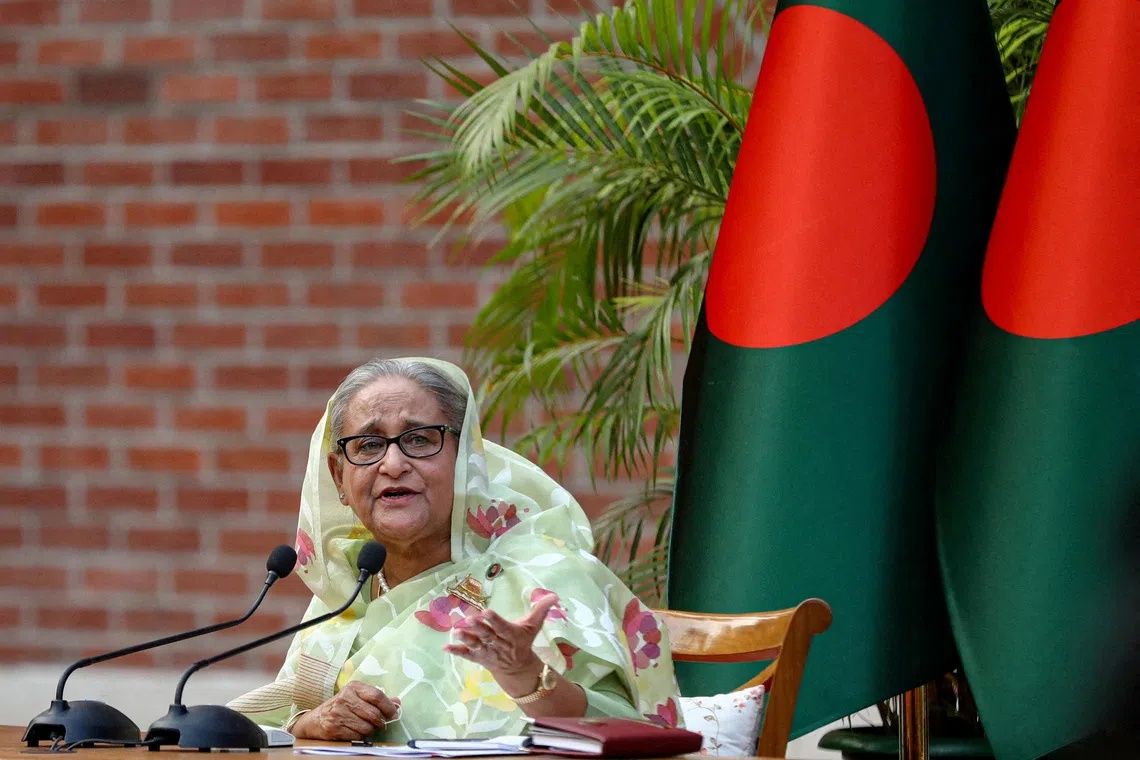
Bangladesh's government has formally appealed to India for clarity on its position regarding an upcoming virtual address by exiled former prime minister Sheikh Hasina from New Delhi, warning that permitting such political activity from a fugitive could undermine the neighbourly relations both nations are attempting to rebuild. The statement represents Dhaka's first official response to Hasina's scheduled appearance at an event hosted by the Foreign Correspondents' Club of South Asia on August 5, which will commemorate the second anniversary of the popular uprising that forced her government from power last year.
Hasina, now 78 years old, departed Bangladesh in August 2024 and has since taken refuge in India, a decision that has become a growing flashpoint between two nations working to restore cooperation following months of diplomatic tension. The planned virtual address, which will include appearances by her son Sajeeb Wazed Joy and other speakers, has prompted Dhaka to question whether New Delhi intends to maintain a consistent approach toward exiled political figures operating from Indian territory. Bangladesh's State Minister for Foreign Affairs Shama Obaed Islam conveyed this concern to reporters late on Monday, emphasising that Dhaka seeks a clear signal from the Indian government about its willingness to restrict such activities.
The timing of this dispute reflects the delicate state of bilateral relations. Since Tarique Rahman's administration assumed office following elections in February, both Dhaka and New Delhi have publicly signalled their commitment to putting aside recent grievances and moving toward constructive engagement. Bangladesh's government has framed its request as a protective measure, seeking assurances that India will not inadvertently become a platform for opposition figures to undermine the current government in Dhaka. Islam stressed that repeated communications have already been sent through diplomatic channels expressing concerns over Hasina and other Awami League leaders issuing political statements from Indian soil, yet said the government would escalate matters formally if necessary.
The extradition question remains unresolved and contentious. Bangladesh has persistently sought Hasina's return through legal extradition procedures, citing multiple criminal cases filed against her since her departure. Most significantly, in 2025 she was sentenced to death in absentia for crimes against humanity related to a military crackdown in 2024 that international observers, including the United Nations, estimate killed approximately 1,400 people. Hasina has publicly rejected the verdict as legally invalid, contesting the legitimacy of proceedings conducted during her absence and after a change of government.
Rather than acquiescing to Bangladesh's legal proceedings, Hasina has maintained a defiant posture, recently telling Reuters that she intends to return to Bangladesh in December despite the outstanding charges and death sentence. This declaration adds another layer of complexity to the current diplomatic situation, suggesting that the former prime minister views her exile as temporary and retains political ambitions within Bangladesh. Her commitment to re-engaging in Bangladeshi politics from abroad, coupled with her stated intention to return, appears to validate Dhaka's concerns about fugitive political actors using foreign territory to maintain organisational capacity and public visibility.
India's position on this matter carries particular weight given the strategic importance of the bilateral relationship and the geographic proximity of the two nations. Historically, India has taken varied approaches toward exiled political figures, sometimes granting asylum for humanitarian reasons while simultaneously attempting to avoid direct involvement in their host country's internal political disputes. Islam's reference to India's previous indication that it would not expect fugitives to conduct political activities from its territory suggests that New Delhi may have provided such assurances in private diplomatic conversations, yet the apparent gap between stated principle and implementation remains unclear.
The Foreign Correspondents' Club of South Asia, which is organising the August 5 event, has not immediately responded to Bangladeshi government concerns or requests for comment. As an independent media association, the club likely views the event as falling within the purview of free speech and press freedom, standard protections afforded to international journalist organisations. However, the political sensitivity of the occasion—marking the anniversary of an uprising that resulted in significant casualties—means that hosting Hasina's remarks carries unmistakable symbolic weight and potential diplomatic ramifications for India.
For Malaysia and other Southeast Asian nations monitoring this situation, the Bangladesh-India dispute illustrates the complexities that arise when neighbouring countries manage exiled political figures and competing claims to legitimacy. The principle of non-interference in internal affairs, a cornerstone of ASEAN diplomacy, appears tested when one nation perceives another as providing logistical or diplomatic cover for opposition groups. The case also demonstrates how transitions of government, particularly those driven by popular movements as occurred in Bangladesh, can create prolonged diplomatic tensions around questions of accountability and the treatment of deposed leaders.
Dhaka's approach to this matter reflects a government seeking to consolidate its position while simultaneously attempting to maintain positive relations with a crucial regional partner. By framing the issue as one of reciprocal respect for each country's sovereignty and internal stability, rather than as a direct attack on India, Bangladesh has adopted diplomatic language designed to invite rather than antagonise. Yet the underlying tension persists: if India permits Hasina to conduct political activities from New Delhi, it may be perceived as tacitly supporting efforts to challenge the legitimacy of Bangladesh's current government, potentially damaging the nascent warming of ties that both nations have worked to nurture since February's political transition.

